
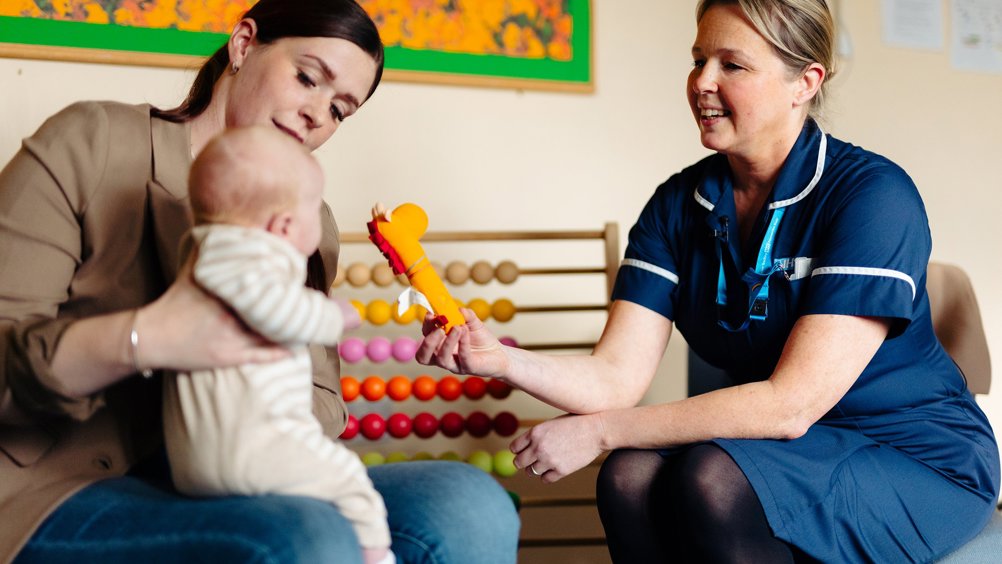
The Alarm Distress Baby Scale tool focuses on deciphering baby’s social behaviour through eye contact, their facial expressions, vocalisation, and level of activity.
Its trial in the UK by the charity follows a visit by the Princess of Wales to view its use in Denmark two years ago.
The tool aims to “better understand the ways babies express their feelings” and support health visitors in supporting interactions between parents and children, according to the charity.
For the trial it was used by health visitors from South Warwickshire NHS Foundation Trust and Humber Teaching NHS Foundation Trust for four months in 2023.
Evaluation of its use found that health visitors felt it was an “improvement on previous approaches that predominantly focused on the parents’ perspective or environmental factors”.
Health visitors also told evaluators that its use was “hugely beneficial” and “of great importance” to their work supporting families.
In addition, they reported that training to use the tool “required minimal additional time and could be embedded into routine activities”.
As well as improving parent and child relationships it also helped health visitors identify babies and families in need of further support.
The tool is attributed to helping identify behavioural concerns among one in 10 babies involved in the trial.
The charity wants to see the trial used in other areas UK-wide, where its use will also be evaluated.
Last year, @earlychildhood funded a trial of an observational tool which helps health visitors to interpret baby behaviour and support parent-child interactions. Today, we’re delighted to share the evaluation results, which are overwhelmingly positive.https://t.co/Rc6IRIgfa4 pic.twitter.com/rxbuxQgq50
— The Royal Foundation Centre for Early Childhood (@Earlychildhood) March 21, 2024
“The quality of the relationships between babies and their parents or carers, during the first weeks and months of life, shapes their developing brains and lays the foundations for their future health and wellbeing,” said Centre for Early Childhood executive director Christian Guy.
“So, it is vital that we provide families with the best possible advice and support at this crucial time.
“The results of the initial phase of testing are so encouraging. We now want to move quickly to ensure we build on this work, bringing the benefits of this model to more health visitors across the country so that, ultimately, more babies and their families get the support they need to thrive.”
University of Oxford professor Jane Barlow, who oversaw the trial’s evaluation, said that the tool “has really helped health visitors to read the baby during interactions and develop greater sensitivity in terms of the observation of potential attachment and bonding issues” which would not have previously been picked up.
“Babies are born with amazing social abilities,” she added.
“They are ready to relate and engage with the world around them, communicating how they feel through their behaviours.”