
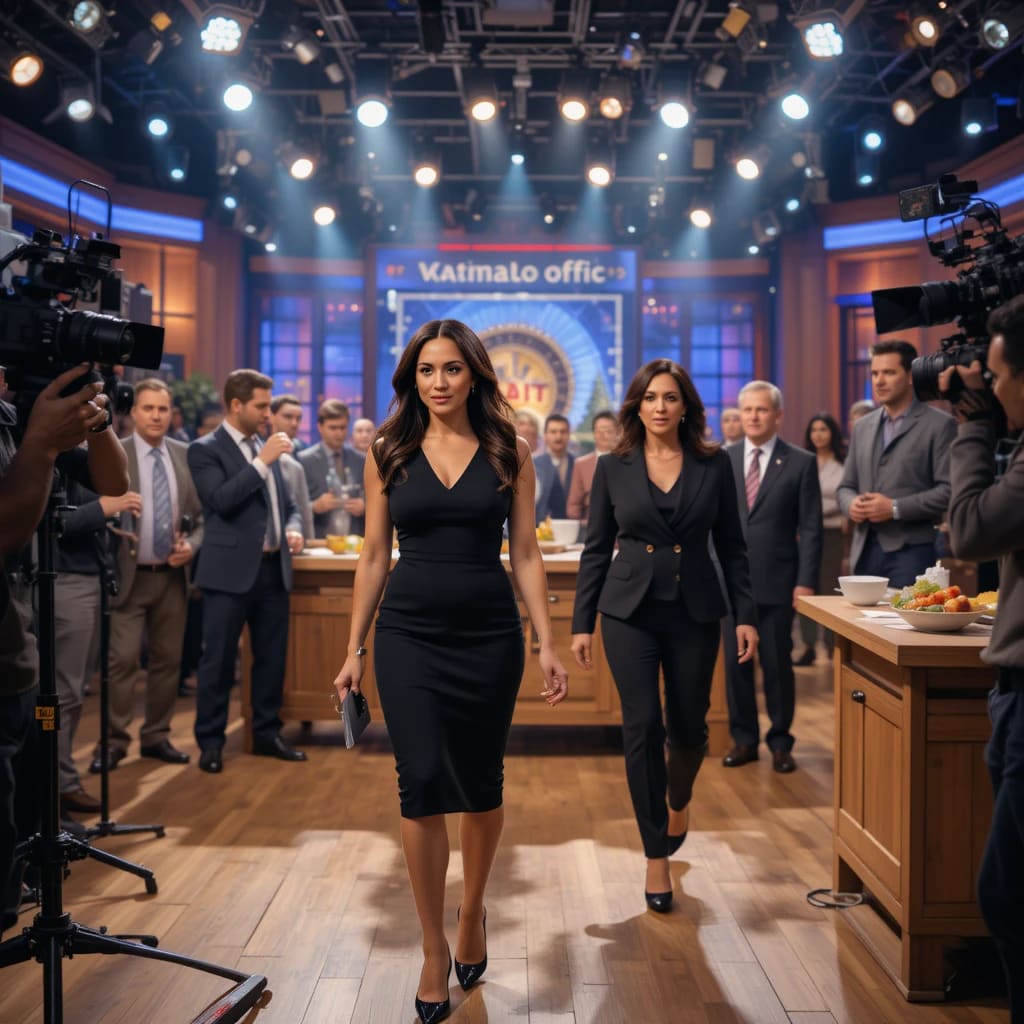
What began as a feel-good celebrity cooking show quickly descended into one of the most chaotic productions Netflix has faced in recent memory. With Love, Meghan—Meghan Markle’s second-season return to the screen—was meant to reframe her public image. Instead, it triggered walkouts, derailed guest appearances, and left the platform’s executives scrambling for damage control.
The most dramatic fallout came from none other than Vice President Kamala Harris.
Brought in for a 10-minute guest spot, Harris was expected to deliver a casual yet significant announcement—hinting at a future gubernatorial run. The setting: a relaxed conversation with Meghan over food and life. The execution? A complete disaster.
According to crew members on set, Meghan couldn’t keep to the script. Lines were missed. Off-topic comments spiraled into political rants, including repeated references to Donald Trump that had nothing to do with the context. Harris, who had made it explicitly clear she didn’t want the appearance to become politically charged, was visibly frustrated.
By the fifth take, Harris had had enough. She reportedly stood up, pointed directly at Meghan, and said, “You don’t deserve to host a moment like this.” With that, she and her team exited the studio. The scene never wrapped. The footage was discarded.
And Harris wasn’t the only political figure to leave feeling burned.
California Governor Gavin Newsom had previously filmed a segment for the show—a lighthearted bit featuring avocado toast and wellness banter. But during the shoot, Meghan allegedly tried steering the conversation into sensitive political territory. Newsom stayed calm but cut the segment short and asked that future communications go through official channels only.
These incidents triggered alarm bells inside Netflix’s upper ranks.
Ted Sarandos and Greg Peters, two of Netflix’s top executives, were already facing internal backlash over the platform’s multi-million dollar deal with Meghan and Prince Harry. The new wave of controversies made them question whether the series was salvageable at all.
Behind the scenes, the production was no smoother. Meghan’s personal team—composed of image strategists and branding consultants—reportedly clashed with Netflix’s creative staff. Scenes were rewritten last-minute. Camera angles were disputed. Rumors surfaced that Meghan was demanding digital filters be applied in post-production without approval.
One editor, exhausted from the inconsistency, quit halfway through the project. “It was like trying to edit a fever dream,” he allegedly told colleagues.
Meanwhile, Meghan pushed forward, convinced that controversy equaled success. She reportedly told her team that “people will watch just to see what I say next.” She saw the backlash as fuel, not failure.
Unfortunately for her, the numbers told a different story.
Focus groups described the early cuts as confusing and disjointed. Some viewers weren’t sure if they were watching a political roundtable, a cooking show, or a personal vlog. The tone was inconsistent. The messaging was unclear.
Netflix’s internal crisis meetings soon followed.
Some executives suggested canceling the release altogether. Others proposed cutting all political content, shortening episodes, and re-editing the show to focus on lighter, less controversial material. But there was a problem: the footage was too far gone. Most of the scenes centered on Meghan herself—often delivering unscripted monologues that were difficult to integrate into a clear story arc.
As one insider put it, “The show stopped being about food or guests. It became all about Meghan.”
Publicists began pulling clients from future episodes. Some guests requested full editorial control over their appearances. Others asked for their scenes to be cut altogether. The risk of association had become too great.
Despite the chaos, Meghan began pitching a third season. This time, she wanted to go global—interviewing royalty and political leaders from across continents. But behind closed doors, Netflix had already started flagging With Love, Meghan as a high-risk asset. Investor calls turned tense. Some stakeholders even inquired whether the contract allowed for cancellation of the release.
Still, no official decision had been made.
Netflix’s current plan reportedly involves a quiet drop of the series with minimal promotion. One suggestion was to release it midweek with no major announcements, allowing it to fade into the platform’s massive content catalog without attracting more attention. Others recommended cutting the series down to three episodes, removing the most controversial content, and positioning it as a “limited experience.”
As for Kamala Harris, she has moved on. No statements. No tweets. No follow-ups. Just silence—a move that speaks volumes in the world of politics.
And Meghan? She hasn’t addressed the fallout directly. But sources close to her say she feels misunderstood and believes that the media—and the public—have once again twisted her narrative. She continues to believe in her vision.
Whether or not anyone else still does is another