

Camelback to Piestewa: Iconic mountains around the Phoenix area
Take a look around the Valley and you’ll see a distinct landscape of peaks and mountains. There are six of the most recognizable.
Robert F. Kennedy Jr. hiked Camelback Mountain in July heat wearing jeans, continuing the landmark’s appeal to prominent figures.Camelback Mountain has attracted politicians, celebrities and entertainers for decades, including Katy Perry, Jelly Roll and Barry Goldwater.The mountain has been featured in film and television, including the 1950s Western “26 Men” and a young Steven Spielberg’s “Escape to Nowhere.”
Robert F. Kennedy Jr. caused an online sensation by hiking Camelback Mountain in July heat while wearing blue jeans, adding a new episode to the Phoenix landmark’s celebrity mystique.
But Kennedy, President Donald Trump’s secretary of Health and Human Services and the son of the late Sen. Robert F. Kennedy, was far from the first national politician or celebrity attracted to Camelback’s natural grandeur.
In the years since President Rutherford B. Hayes in 1879 designated the mountain as part of the Salt River Pima-Maricopa Indian Community — a decision he later revoked — Camelback has been a beacon not only to Arizona hikers and environmental enthusiasts but a former U.S. presidential nominee, a future vice presidential nominee and a first lady, among others.
Camelback’s rugged appeal extends to entertainers and sports figures, too.
Days before Kennedy’s July 19 hike to the summit, pop star Katy Perry brought up Camelback Mountain during her July 12 concert at PHX Arena, telling her fans she used to hike it.
Earlier in the year, rapper and country singer Jelly Roll climbed Camelback and in February posted a video on social media to mark progress in his ongoing weight-loss journey.
Camelback Mountain starred in 1950s Western
It’s not surprising. Camelback Mountain’s influence on show business and politics goes way back.
In the late 1950s, a black-and-white TV Western called “26 Men” was filmed at the old Cudia City movie set and sound stage near Camelback Road and 40th Street in Phoenix. The syndicated 1957-59 show was set in the early 1900s and chronicled the exploits of the 26 men who made up the Arizona Rangers. Tris Coffin starred as the historical figure Capt. Tom Rynning, and the plots were ostensibly based on true stories.
Old television buffs in Phoenix watching “26 Men” on DVD will enjoy catching glimpses of Camelback Mountain, its distinctive rock feature the Praying Monk, and other local mountain ranges occasionally pop up as backdrops to the action.
In the 1960s, aspiring filmmaker Steven Spielberg also instinctively understood Camelback Mountain’s cinematic appeal.
The future Hollywood heavyweight used Camelback for his pre-fame 1962 8mm movie “Escape to Nowhere,” a World War II movie set in North Africa.
By that time, preservationists were starting to worry about Camelback Mountain’s future as it was targeted for more and more development.
Save Camelback: Development push thwarted
By the mid-1960s, saving Camelback was a Phoenix cause célèbre, especially among young people.
After Sen. Barry Goldwater, R-Arizona, lost his 1964 race for the White House against President Lyndon Johnson, he stepped up to protect Camelback. He became chair of the Preservation of Camelback Mountain Foundation Inc. and historically remains the politician most closely associated with Camelback in the public’s mind.
“Wherever I go, when people talk of Arizona, they often mention Camelback,” Goldwater told Don Dedera, an Arizona Republic columnist who also championed Camelback. “They say, ‘Where is such-and-so from Camelback’? or, ‘Yes, we have taken pictures of Camelback,’ or ‘Phoenix is the city with the mountain that looks just like a camel.’
“If we ruin Camelback, ever afterward people will think of Phoenix as the city that made something ugly of the most beautiful thing it had.”
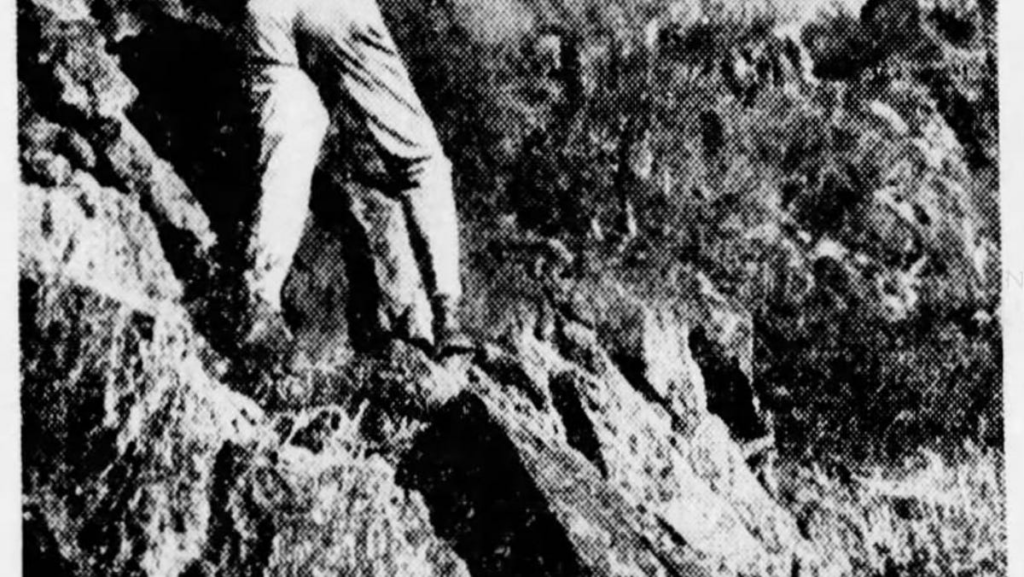
In a May 30, 1965, Republic column, Dedera writes about tagging along with the then-57-year-old Goldwater as he makes it up the mountain. “I haven’t climbed Camelback in 30 years,” Goldwater confessed.
Like RFK Jr., Goldwater chose unique hiking attire. “Goldwater was dressed in boondockers, a red shirt and frayed khaki trousers from World War II,” Dedera wrote.
Another hiker who ran into Kennedy on the mountain last month told The Republic that RFK Jr. acknowledged that tackling the mountain in jeans in July “was a bad idea,” but there’s no indication that Goldwater had any regrets about sporting long pants in May.
Goldwater also appeared at a Dec. 10, 1965, Save Camelback Teen Dance at the Arizona State Fair Exhibition Hall to help further the preservationists’ goal of raising $300,000 by Christmas 1965.
The program was a Phoenix garage-rock spectacular featuring the Door Nobs, whose “Hi-Fi Baby” was a local radio hit in 1965 and is now sought after by record collectors. Other acts on the bill included the Pendletons, Sounds Inc. (a Mesa group later known as Solid Ground), The Wanderers, and The Spectrums (later better known as Tom Parsons and The Spectrum).
Goldwater, who served two terms from 1953 to 1965 and would return to the Senate in 1969 for three more, got in on the entertainment. He famously rocked a Beatle wig and played “Silent Night” on the trombone.
“This old mountain is worth the fight,” Goldwater told The Republic’s Dedera. “A Camelback cluttered with roads and utility poles and bulldozer scars and houses would be the shame of the state.”
The preservation campaign ultimately proved successful.
During a May 28, 1968, visit to Phoenix, Lady Bird Johnson, the first lady, attended an afternoon ceremony at Camelback Mountain. She had made national beautification her top priority and applauded the Camelback preservation efforts.
At the event, Secretary of the Interior Stewart Udall, a former Arizona member of Congress, announced a federal grant to match the local money raised to buy and preserve 324 acres on the mountaintop.
“Mrs. Johnson, dressed in red linen, toured the grounds there and even took a short climb up Camelback Mountain, the latter at the request of photographers,” The Republic reported May 29, 1968.
“She’s sturdy,” Udall said.
Goldwater, the bitter 1964 rival of the first lady’s husband, Lyndon Johnson, also was on hand that day.
Johnson told “Barry” she was “delighted” to see him, The Republic reported.
“I’m sure, Mrs. Johnson, you would realize even, coming into this state, that if you find me and Barry Goldwater in intimate collaboration on some cause, it has to be a good one,” Udall said.
The mountain’s continuing allure
Camelback’s attraction to politicians has never worn off and likely never will.
In October 2011, then-Rep. Paul Ryan, R-Wis., headlined a political fundraiser in Paradise Valley for Republican Jeff Flake’s Senate campaign. In 2012, GOP presidential nominee Mitt Romney would tap Ryan as his running mate. He later would serve as speaker of the House of Representatives from 2015 to 2019.
“I went to Arizona on a weekend, away from my family, to campaign for Jeff,” Ryan told The Republic. “I got to climb Camelback Mountain two days in a row, which was cool.”
Dan Nowicki is The Arizona Republic’s national politics editor. Follow him on the social-media platform X at @dannowicki.