
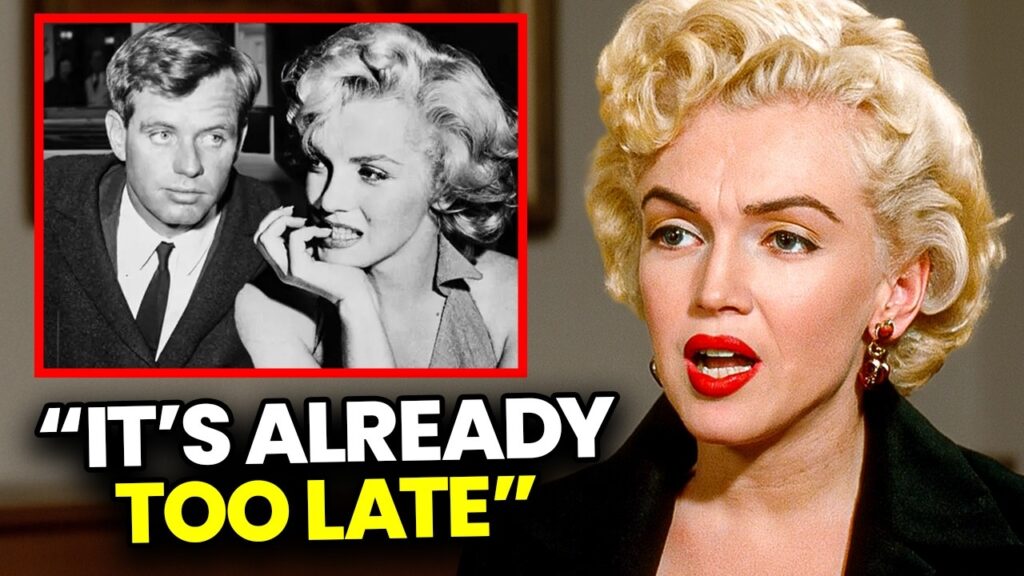
“Before I Die, Please Listen!” Marilyn Monroe Reveals What We All Suspected
Marilyn Monroe had everything; beauty, fame,
money, power. At least, that’s what the world believed. But before she died, Marilyn
left behind a chilling message. In her words lies the truth she carried, the truth
Hollywood never wanted told. Decades later, her story still shakes us, not as a fairytale,
but as a haunting confession of what she endured. The Making of Norma Jeane
Before Marilyn Monroe, there was a little girl named Norma
Jeane. Born June 1, 1926 in Los Angeles, her childhood was as unsteady as they come. She
had an absent father and a mother, Gladys, who worked in the film industry but struggled deeply
with her own mental health. That meant stability was something Norma Jeane never really had.
She spent her early years drifting in and out of foster homes. Sometimes she was cared for
by family friends, other times by strangers, and at one point, she even ended up in an
orphanage sometime in 1935. When Gladys was institutionalized, Norma Jeane was
placed with the Los Angeles Orphans Home, where she spent nearly two years. She later
described those days as lonely, though she remembered the strict daily routines clearly.
None of it gave her the lasting sense of home she wanted. To people on the outside, she might have
looked like any other little girl, but inside, she was carrying the heavy truth that she didn’t
really belong anywhere. She carried that ache for love and safety with her into the next few
years. And by the time she was a teenager, Norma Jeane was already learning how to survive in
ways that went beyond her years. At just sixteen, she had to make a life-altering choice. The
foster family she was living with was moving away, and the only way to avoid being sent back into
the orphanage system was to get married. So she did. She married a neighborhood boy named James
Dougherty. It wasn’t a marriage built on young love or dreams of a family, but it was simply a
way to have a roof over her head. James was kind, but when he joined the Navy and shipped
out, Norma Jeane was left alone again, still trying to find her place in the world.
Her life began to change so much during World War two. While working at a factory, she was spotted
by a photographer who was documenting women helping with the war effort. The camera loved her
instantly and soon she was posing for magazine shoots where her pictures caught the eye of more
and more people. For the first time in her life, she became someone people couldn’t look away
from. Modeling gave her so much confidence, that she lightened her hair, perfected
her smile, and leaned into the glamour that photographers encouraged.
But if you looked beyond the poses, she was still that girl who longed to be accepted.
She wasn’t chasing fame for its own sake, but for the feeling of finally being seen, finally
being wanted. And Hollywood indeed took notice. In 1946, she signed her first studio contract.
The deal came with certain conditions, such as getting a new name, new image, and a promise to
fit the mold of what a starlet should be. And so, Norma Jeane Mortenson became Marilyn Monroe. The
name was fitting, but it became the start of a life where the line between her real self and her
public image would blur more and more each year. Her early roles were small, but she still managed
to make an impression. Even in the background, she drew attention from directors and audiences. There
was just something about her that you couldn’t teach. Still, she knew beauty wasn’t enough,
and determined to be more than a passing face, she studied acting, read plays, and worked hard
to improve her craft. She wanted to be taken seriously, not just admired for her looks.
Sure, the world would come to adore Marilyn Monroe, but before she became Hollywood’s
sweetheart, she was just Norma Jeane, the little girl who wanted nothing
more than a safe place to belong. The Rise of a Star
When Marilyn first tried to break into Hollywood, the doors didn’t swing open
for her at first. She started at the very bottom, working long hours on sets where her face was
barely seen. In 1947, she got her first tiny parts. One film cut her role down to a single
line and another kept her in the background. Nobody thought much of her yet, but Marilyn was
watching, learning, and waiting for her chance. By 1950, she finally caught people’s attention.
In The Asphalt Jungle, she played a young woman tangled up in crime. The role was small,
but the camera loved her. That same year, she showed up in All About Eve, standing
beside stars much bigger than her, yet somehow managing to draw eyes anyway. For the first time,
Hollywood insiders started whispering her name. But she had her real breakthrough in 1953.
Niagara cast her as a dangerous wife with a plan, and audiences couldn’t look away. Marilyn
was electric on screen, and suddenly she became the actress people came to see and not
one of the minor characters. That same year, she danced and sang her way into history
with Gentlemen Prefer Blondes. Her number, “Diamonds Are a Girl’s Best Friend,” became
a symbol such that magazine covers, posters, and stage shows copied it for decades.
From that moment, Marilyn was everywhere. In How to Marry a Millionaire, she shared
the screen with Lauren Bacall and Betty Grable. In River of No Return, she played
a tough saloon singer in the wild west, showing grit that didn’t always make it into her
earlier roles. And there was The Seven Year Itch in 1955. Marilyn standing over a subway grate with
her white dress blowing upward became one of the most famous images in film history. People who had
never even seen the movie still knew that picture. But Marilyn didn’t want to be trapped as a pretty
face. She wanted respect so she fought to take roles that proved she had depth. In 1956, she
starred in Bus Stop, where she played a small-town singer who dreams of love and freedom. Here, she
didn’t play the glamorous character and it made critics who once brushed her off to praise her.
The Golden Globe nomination she earned showed she was forcing the industry to take her seriously.
Three years later, she took on comedy in Some Like It Hot. Acting beside Tony Curtis and Jack
Lemmon, she became the heart of a movie that is still called one of the greatest comedies of all
time. Audiences adored her and she even bagged a Golden Globe award for her role in the movie.
Her last complete film was The Misfits in 1961, written by her husband at the time named
Arthur Miller. She played the role of a woman filled with sadness, longing, and hope.
To the eyes of many, it looked like she poured pieces of her own life into that performance,
which made it even better. And just like that, Marilyn was able to achieve in 15 years
what many could not achieve in a lifetime. She went from being cut out of films to becoming
one of the most famous women in the world. The Double-Edged Sword of Stardom
Hollywood loved Marilyn’s body more than her talent. Executives knew how to sell
fantasy, and her curves became their golden ticket. They put her into tight gowns, told her
to sway a certain way, and wrote lines that kept her locked in the role of the dizzy blonde.
She played that character so well that people forgot it was an act. Marilyn often joked that she
could walk down a street unnoticed as Norma Jeane, but if she tilted her head just right and added
a wiggle to her step, crowds would swarm her. The act worked too well and the public saw
the mask, but not the woman behind it. For Hollywood’s power players, that mask
was all they wanted. They never asked if she dreamed of meatier roles or if she wanted to
study the craft of acting. They wanted a symbol, not a serious performer. And just like that,
she became labelled as a symbol of desire, and that label became more like a prison cell.
Marilyn fought that prison with every ounce of willpower. She studied at the Actors Studio
in New York, sitting in classes with method actors who treated their work as art because she
wanted the same respect. When she starred in Bus Stop in 1956, she pushed to play a vulnerable
character rather than a cartoon of seduction which made critics surprised. They saw layers in
her performance, glimpses of what she could do if studios gave her a chance. That same hunger drove
her work in The Misfits. She poured her pain into that film, showing an audience the fragility
and depth she carried inside. But Hollywood didn’t reward her effort. Instead, the machine
tried to pull her back into safer, sexier roles. Stardom gave her fame, but it also made her
an easy target for cruelty. On film sets, directors often mocked her struggles. She stumbled
with lines, sometimes freezing under pressure, and instead of helping her, men in charge
turned her mistakes into jokes. Crew members whispered about her lateness, her nerves, her
difficulty on set. Few bothered to ask why she was struggling. They didn’t see the fear
of failure gnawing at her or the pills she took just to sleep and function. They only
saw a star who made their schedules harder. The cruelty didn’t stop at her movie
sets. Ageism stalked her career, just as Joan Collins once described. In Hollywood,
a woman’s shelf life seemed brutally short. Twenty-five was the cutoff for ingénues. At
that age, Marilyn already heard whispers that younger faces waited to replace her. Thirty
loomed like a death sentence for female stars. Men in their fifties could still play romantic
leads, but women barely past twenty-five were dismissed as “too old.” Marilyn felt that
pressure every day. She admitted that studios valued her youth more than her talent, and she
knew what would happen once the shine faded. Behind the Glamour
When people look at most famous actresses today, it’s easy to imagine how perfect their lives
are. It was no different for Marilyn back then. She seemed to have everything anyone could ever
dream of. She was rich, beautiful, and loved all over the world. But in reality, everything was
not as it seemed because things were actually falling apart for her. The truth is, Marilyn
carried a lot of pain that fame only made worse. By the mid-nineteen fifties, she was everywhere.
Studios kept pushing her into movie after movie. There wasn’t much time for her to rest or
breathe. If she showed up tired, people called her lazy. If she argued about a role,
she was called “difficult.” Nobody cared that she was running on empty. They just wanted her to
keep performing, no matter how much it cost her. To cope, she turned to pills. Some were supposed
to help her sleep, others to help her wake up. Soon, taking those substances became a habit
and less of a choice. Studios and even doctors handed them out without thinking about the
damage. It made her dependent, and once that cycle started, it was hard for her to stop.
It wasn’t long before people on set started to notice the change. She was late more
often, sometimes hours late. She forgot lines and broke down in tears. Directors and
co-stars grew frustrated. The headlines said Marilyn was “troubled” or “unprofessional,”
but what the papers didn’t print was that she was exhausted and drowning in pressure.
Fame also made her feel cut off from the world. She couldn’t go outside without people staring.
She couldn’t sit in a café without whispers starting around her. Thousands of fans adored her,
but Marilyn still felt lonely most of the time. Even her marriages were more of hassles than
comforts. Joe DiMaggio, the baseball legend, loved her deeply but couldn’t handle her fame so their
short marriage ended in heartbreak. Arthur Miller, the writer she thought understood her best, also
grew distant. Marilyn wanted love that felt safe and lasting. But her relationships crumbled
under the same spotlight that made her famous. Hollywood didn’t make things easier either.
The men who ran the studios treated her like a product. They picked her roles, tried to dictate
her image, and expected her to obey. If she questioned them, they threatened to blacklist her.
Marilyn eventually fought back by creating her own production company. That was her way of trying to
take control. But instead of support, it only made the powerful men in Hollywood resent her more.
In her private moments, Marilyn often wrote in notebooks. Her diaries revealed a side of her
that nobody saw. She admitted feeling like a child trapped in an adult’s body. She wrote
about fears of being unloved, of being used, of never being truly understood. She could make
millions laugh on screen, but when she went home, she felt empty. People around her noticed
she was slipping. Friends tried to help, but many also admitted they didn’t know what to
say. The fact that some doctors kept prescribing her more pills instead of helping her break
free, only made things worse. The truth is, Marilyn didn’t have the right kind of support. And
for someone who felt as deeply as she did, having reliable relationships around her could have
made a world of difference for the beloved icon. Love, Power, and Politics
When Marilyn married Joe DiMaggio, it was front-page news. He was the chill baseball
legend, and she was the rising movie star every camera chased. Together they looked like a golden
couple. Fans wanted the fairy tale, but what they saw in public was not the same as what happened in
private. Joe loved her, no doubt, but he wanted a wife who stayed home, not a woman the world called
a symbol of beauty. The famous skirt scene in The Seven Year Itch may have thrilled moviegoers, but
for Joe it was too much. Witnesses said he grew angry during the filming of that scene, and their
fight afterward left her in tears. The strain only got worse as reporters followed their every move,
and Joe could not accept her career demanding so much of her. Their marriage lasted only nine
months, but it set a pattern that followed Marilyn through her life. Men loved her, but many
wanted to control her light rather than share it. Her second marriage, though, was kind of
different. Arthur Miller, the playwright, was seen as the great intellectual of his time.
Marilyn wanted that world too. She wanted to be taken seriously, to step beyond the shallow roles
the studios gave her. To her, Miller represented wisdom and stability. She supported him during
the period when he was publicly scrutinized for his testimony before the House Un-American
Activities Committee, even standing by him when others turned away. But once again, the weight
of her fame became a burden. His friends saw her as a distraction, not as an equal. She tried
to be “the devoted wife”, moving to quiet homes, trying to fade from the Hollywood noise.
Yet Hollywood never let her go, and Miller often seemed embarrassed by the very woman he
married. Their love burned bright for a while, but the cracks widened until it could not hold.
Still, Marilyn’s story does not only revolve around her marriages. There were a lot of men who
circled around her, drawn to her beauty, fame, and charm. She crossed paths with some of the most
powerful men in America, including presidents and business titans. Her name was mentioned in
the same breath as theirs. These connections were not mere gossip because they spoke to the
way women in Hollywood were often pulled into circles of influence, whether they wanted to be
or not. Proximity to power brought attention, but it also put her in dangerous positions. A
woman linked to a powerful man hardly seen as her own person. She became a prize and a possession,
something to show off, then cast aside. Marilyn felt the weight of this truth more
than most. She wanted love, safety, and to be understood. Yet what she often found were men who
wanted to own her image, not nurture her soul. The more famous she became, the harder it was to find
someone who saw Norma Jeane, not Marilyn Monroe. Marilyn’s Final Days
By the summer of 1962, Marilyn Monroe was living through some of the hardest
moments of her career. She had been fired from the film Something’s Got to Give after missing too
many days on set. Newspapers called her unreliable and splashed unkind stories across their pages.
Marilyn hated how she was being painted. She wanted people to see that she was still capable
of carrying a film, still ready to shine. In late July, she posed for photographer
George Barris on Santa Monica Beach, smiling in front of the camera and speaking about
her future. Barris later said she seemed hopeful about starting fresh. Around the same time,
she scheduled meetings with 20th Century Fox executives about possibly returning to finish
Something’s Got to Give. Friends recalled that she spoke about wanting serious roles and even
mentioned interest in working with directors she admired, proof that she still thought about
her career in big terms. Reports also confirm that she kept close contact with DiMaggio, who
had begun to talk about reconciling. Those who saw them together said he cared deeply for
her and wanted stability back in her life. Some who visited her in those weeks said she
looked upbeat and hopeful. Others thought she seemed fragile and worn down, and both
impressions were probably true. Marilyn was trying to hold herself together, but it
wasn’t easy. She had trouble sleeping and often relied on pills to get rest, which was a
habit that had grown stronger over the years. On August 4, 1962, Marilyn spent the evening at
her Brentwood home. Her housekeeper was there, and her doctor and psychiatrist both
checked in on her. She went into her bedroom later that night and locked the door.
Hours passed. When her housekeeper grew worried, she found the door still locked and no answer
from inside. Eventually the police were called and Marilyn was discovered in her bed, no
longer alive. She was just 36 years old. The official report ruled her death as likely
caused by an overdose of pills. But questions began almost at once. Some of the phone records
from that night didn’t match up. Witnesses gave mixed accounts of her last hours. Her
locked door became part of the mystery, since there were claims it may have
been opened before police got there. Rumors also spread because of Marilyn’s
links to powerful men. Some wondered if she had known things that others wanted
kept quiet. Nothing was ever proved, but the missing details and conflicting
stories made people doubt the official version. Marilyn Monroe’s death was a huge shock to the
world. Her beauty, talent, and fame made her seem larger than life, yet she left the world suddenly
and in confusion. More than sixty years later, we’re still asking the same questions. Did
Marilyn truly choose to end her life? Did she take too much by accident? Or did someone
else make sure her voice was never heard again? Hollywood’s Wolves
Marilyn never hid the fact that Hollywood could be dangerous. She called it a jungle full of wolves,
men who circled young actresses and waited for the right moment to strike. And fame didn’t protect
her. In fact, it made her more of a target. Norma Jeane walked into that world with wide
eyes, chasing her dream of acting. She thought hard work and talent would be enough. What
she found instead were doors guarded by men who demanded far more than auditions. They offered
contracts, roles, and publicity, but the price was often unspoken and cruel. Marilyn later admitted
that many women traded their dignity just to step onto a set. She hated how normal that system felt.
She warned people about it every chance she got. Marilyn said the wolves in Hollywood smiled
while they plotted. They promised the world, but they only wanted control. For them,
actresses weren’t artists but possessions. Once a girl lost her glow or refused to play
along, they tossed her aside and reached for the next hopeful face waiting in the lobby.
Marilyn knew this firsthand. Early in her career, she signed contracts that gave her almost no
power. Studios cast her in roles that sold her as a fantasy, not as a serious actress. They dressed
her how they pleased, told her how to speak, and laughed when she tried to ask for something
different. She later admitted that she walked into those deals too eager to please, too
hungry for a chance. And once she realized what she had agreed to, the regret cut deep.
Even after she became famous, the wolves never backed away. If anything, they sharpened their
claws. Marilyn told friends that producers and directors still treated her like a product.
They didn’t care that she wanted complex roles. They wanted the same “sexy blonde” they
could parade in magazines and splash across posters. She warned that once Hollywood locked
a woman into a stereotype, it became a cage. Marilyn pushed back when she could. On some
sets, when a director tried to humiliate her with a scene meant only for cheap laughs, she
argued. Sometimes she won, other times she didn’t, but her resistance showed that she understood
exactly what the wolves were doing. She once said she knew the game, but she despised playing it.
Her warnings carried weight because she spoke with honesty. She didn’t wrap her words
in pretty illusions. Marilyn said bluntly that Hollywood treated women like disposable
toys. She told stories of men who promised careers but left scars instead. She wanted
people to see that the glamour was only the surface. Beneath it stood a machine that fed on
youth and beauty until there was nothing left. Those words gave other women courage. Actresses
who came after Marilyn admitted that they felt braver to speak about their own struggles because
she had already cracked the silence. She showed them that even the most adored star in the
world could fall prey to the same dangers. If Marilyn Monroe had to fight
the wolves, then no one was safe. Joan Collins and the Hollywood Pattern
Marilyn often warned people about the wolves circling Hollywood. She told young actresses to
be careful, to watch for the men who promised everything but demanded far more than they ever
admitted in public. Her words were never born of bitterness, but from her own battles with the
system. She knew how ruthless the studio bosses could be and how quickly they could build
up a star and just as quickly discard her. Years later, Joan Collins gave an interview that
echoed Marilyn’s words almost perfectly. Collins remembered meeting Marilyn at Gene Kelly’s house
while she was filming The Girl in the Red Velvet Swing. Marilyn looked her straight in the eye
and said, “Watch out for the wolves in Hollywood, honey.” Collins thought she could handle it. She
told Marilyn she had already worked in British films and knew how men behaved. But Marilyn
shook her head and gave her a harsher truth: “Not the power bosses, honey. If they
don’t get what they want, they’ll drop your contract. They’ve done it to lots of girls.”
That warning haunted Collins later. She admitted that when she began auditioning for major
roles in Hollywood, the pressure was immediate. Executives dangled scripts in front of her
like bait, hinting that a simple “yes” to their private advances would secure her future. When she
refused, she noticed opportunities slipping away. Roles she had tested for disappeared overnight.
The wolves Marilyn had spoken about were real, and Collins experienced them firsthand.
This occurrence was not a coincidence. Marilyn and Joan were two women from different
backgrounds, yet their stories lined up in disturbing ways. Marilyn spoke of being used
and humiliated by studio heads who only cared about keeping her under control. Collins
described the same manipulation, the same consequences of saying no. When you hear both
women tell it, the pattern becomes undeniable. In Marilyn’s case, these battles defined much of
her career. Even as the most famous actress in the world at the time, she felt powerless
against the men who ran the studios. They gave her contracts that trapped her in typecast
roles, and when she asked for more serious parts, they brushed her off. If she resisted, they
threatened her with suspension. She once confessed to friends that she was constantly afraid of
being discarded the moment she lost her shine. Joan’s testimony years later showed that
Marilyn had been speaking the truth all along. Collins’s story about losing the role of Cleopatra
because she refused to entertain the advances of studio executives wasn’t just about her. It fit
into a larger system Marilyn had already exposed. These men weren’t only interested in talent.
They wanted power and ownership, and they used their influence to decide who rose and who fell.
The most haunting part is how normal this all seemed at the time. Joan said that even other
women in the industry sometimes helped usher young actresses into compromising situations,
as if it were simply part of the business. Marilyn had experienced the same thing. It wasn’t
just the men who enabled this culture of abuse; it was an entire system that protected their
behavior while punishing anyone who resisted. Looking back now, Joan Collins’s testimony doesn’t
just add credibility to Marilyn’s warnings, but proves them. When Marilyn spoke of
wolves, some people thought she was being dramatic. But Collins, who survived the
same era, confirmed every word. Together, their stories reveal a Hollywood that fed on
dreams while devouring the women who carried them. So what do you think? Was Hollywood built
to protect the wolves more than the stars? Did Marilyn know too much about how the
system really worked? And if she did, could that be enough reason to make
sure her voice was silenced permanently? Drop your thoughts in the comments below,
and don’t forget to like, subscribe, and share. If you enjoyed this video,
click on the next video on your screen.
“Before I Die, Please Listen!” Marilyn Monroe Reveals What We All Suspected
Marilyn Monroe had everything; beauty, fame, money, power. At least, that’s what the world believed. But before she died, Marilyn left behind a chilling message. In her words lies the truth she carried, the truth Hollywood never wanted told. Decades later, her story still shakes us, not as a fairytale, but as a haunting confession of what she endured.