
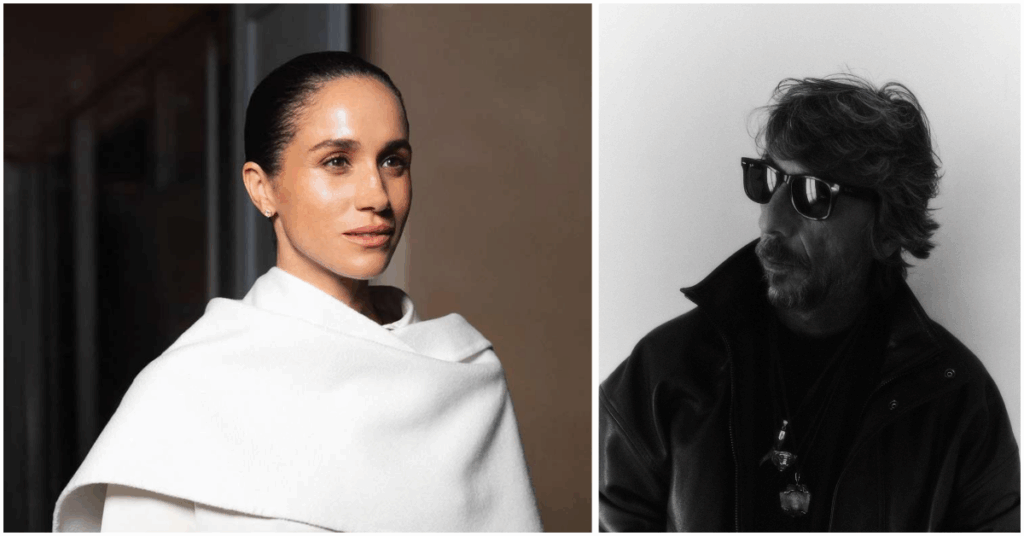
Pierpaolo Piccioli’s debut at Balenciaga signalled a clear shift in tone. Known for his romantic vision at Valentino, the Italian designer ushered in a new era of refinement at the historic house. Yet, it was not just the clothing that drew attention. Meghan Sussex’s appearance in the front row made a statement that rippled far beyond the runway.
Wearing a white cape layered over soft separates, the Duchess of Sussex arrived moments before the show began. Her entrance prompted audible reactions from those seated inside. The placement of such a high-profile guest, unannounced and central, revealed a strategic decision by the brand. Balenciaga has long relied on celebrity partnerships to shape its cultural direction. This moment marked a reset.
A Deliberate Departure from Demna’s Aesthetic
As observed by Louis Pisano, an American journalist based in Paris and contributing editor at SPHERES, Pierpaolo Piccioli’s debut at Balenciaga marked a clear shift in tone. Under Demna Gvasalia, the house embraced visual provocation and viral spectacle. The Georgian designer, a refugee of the Abkhazia conflict, became known for oversized silhouettes, meme-driven campaigns, and high-profile muses. Kim Kardashian’s appearances, masked, wrapped in caution tape, or cloaked in full-body latex, became shorthand for that era.
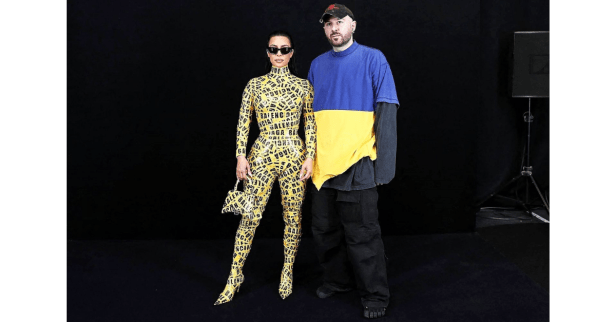 Kim wore Balenciaga tape as Demna, a Georgian refugee of the Abkhazia war, dedicated the show to fearlessness, resistance, and peace.
Yet Piccioli’s vision draws from a different register. His aesthetic, shaped by decades at Valentino, revolves around structure, silhouette, and softness. In his words, “There was a lightness… the way [Balenciaga] introduced space between the body and fabric. Because there’s no structure inside, there’s air.” His reverence for Cristóbal Balenciaga’s archive is not merely curatorial. It is interpretive. “Balenciaga never has to follow the rules,” he told Vogue. “It has to be a bit disruptive, ready for the times.”
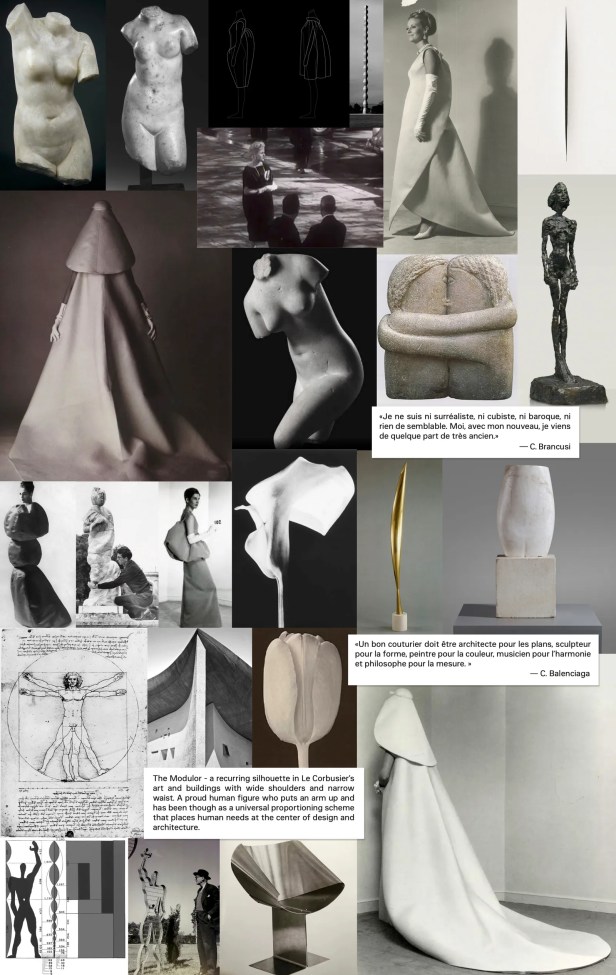 Piccioli’s Balenciaga moodboard fuses sculpture, silhouette and soul. Couture reimagined with care.
Meghan Sussex’s placement in the front row signalled more than star power. It aligned with Piccioli’s intention to ground the brand in elegance, human presence, and integrity. Her white cape ensemble echoed his preference for architectural simplicity and offered a deliberate contrast to the distorted silhouettes of seasons past.
There was no sign of the Kardashians this time. Whether by omission or intention, their absence gave space for a new figure to take symbolic prominence. As Pisano noted, both Balenciaga and Meghan carry the weight of public scrutiny, each seeking control over their respective narratives. Her presence, in this context, felt less like celebrity placement and more like a message.
Critics Revisit Old Scandals to Undermine a New Era
Meghan’s appearance in Paris has already prompted a familiar cycle of online vitriol. Within 24 hours, critics accused her of deliberately snubbing the UK, ignoring the well-documented challenges she faces obtaining adequate security there. More troubling were the false claims published by outlets including the Daily Mail and the New York Post, which alleged she had recorded herself travelling through the Pont de l’Alma tunnel, the site of Princess Diana’s fatal crash. She filmed herself passing the area in a chauffeured vehicle en route, likely returning to her hotel, a routine journey misrepresented by headlines.
Efforts to link Meghan to Balenciaga’s previous controversies are both inaccurate and misleading. She appeared under a new creative director, at a moment defined by change rather than continuity. With Piccioli, there is already an established relationship; Meghan has worn his designs during his tenure at Valentino, reinforcing the consistency of her support for his work rather than the brand’s past direction. Attempts to hold her responsible for a marketing decision made three years prior, and by a different team, are not grounded in fact.
Moreover, Meghan and Prince Harry have consistently advocated for child protection and online safety through their Archewell Foundation. Their work with organisations focused on digital health and youth welfare directly counters the narrative being imposed on her attendance. These facts have been overlooked in recent critiques.
Past Royal Fashion Choices Reveal a Double Standard
Adding complexity to the debate is the fashion history of other senior royals. Between 2016 and 2018, the Princess of Wales wore Balenciaga pearl clip-on earrings to several public events. This included state occasions such as the Trooping the Colour and the Centenary of Passchendaele. At the time, the designer behind the brand was Demna Gvasalia, the same figure at the centre of the 2022 scandal.
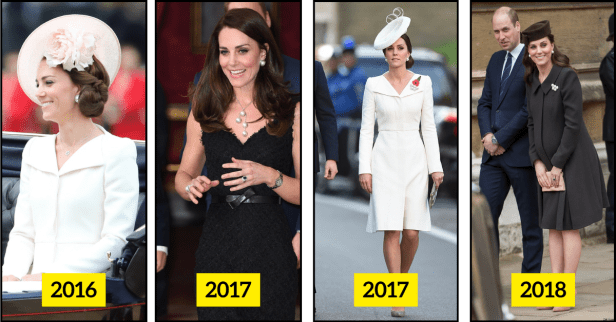 Kate wore Balenciaga earrings for years without backlash. Meghan attends one show and critics erupt. The double standard is plain to see.
Despite this, no public outcry followed. The association between Kate Middleton and Balenciaga passed without question. There was no pressure on Kensington Palace to comment, nor were there accusations of moral failure. The difference in treatment speaks to a broader pattern in how royal women are judged.
A Carefully Staged Image of Evolution
Pierpaolo Piccioli inherits a brand still reckoning with its recent past. His appointment, described as “organic” and grounded in “respect and care,” is no simple rebrand. “I think fashion never talks about intelligence,” he remarked. “We need to manage this moment with more intelligence… less about ego.” He sees his role not in terms of erasure, but transformation, keeping Balenciaga disruptive, but rooted in relevance.
He found in Meghan a muse of the moment, unofficial, but unmistakable. Her appearance at the Paris show was never about nostalgia or spectacle. It was not about redemption, but about reclamation. Both she and the house are asserting control over narratives that others have long manipulated, reframing perception on their own terms.
The symbolism was quiet but deliberate. A woman who has been publicly dissected, vilified, and, like the brand, misunderstood stepped into a moment of restoration. If Piccioli’s Balenciaga succeeds, it will do so not by denying the past, but by refusing to be defined by it.
Like this:
Like Loading…
Discover more from Feminegra
Subscribe to get the latest posts sent to your email.