
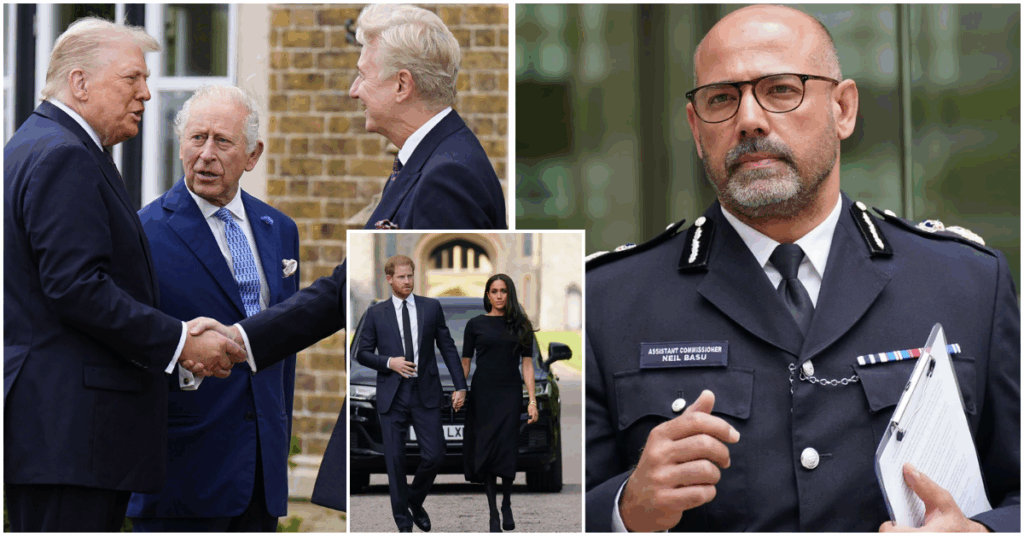
Britain’s former head of counterterrorism, Neil Basu, has said Prince Harry should be on the state-protected list. He described his exclusion as a mistake that leaves the Duke of Sussex exposed to unnecessary danger. Speaking candidly to Victoria Ward from the Telegraph about his time on the Royal and VIP Executive Committee, known as RAVEC, Basu explained that Harry once ranked among the highest-risk individuals in the royal hierarchy. His warning renews questions about how and why a system meant to protect Britain’s most visible figures decided to make an exception for one of its most recognisable.
Harry’s Risk Level Remains Among the Highest
Basu confirmed that Harry’s last formal risk analysis, completed in 2019, placed him second only to the late Queen. That assessment, he said, has never been properly updated, even as Harry’s profile grew with a polarising public. Factors such as his military service, online extremism targeting his family, and lingering hostility from segments of the media have amplified the risks he faces.
Former UK counterterror chief Neil Basu says Prince Harry should be on the protected list, calling his threat level “very high.” He told The Telegraph Harry ranked second only to the late Queen in 2019 and warned his risk has since increased, requiring full armed protection. pic.twitter.com/dAsM1KM8kA
— Feminegra (@feminegra) October 7, 2025
Basu made clear that threat and risk are not determined by popularity but by impact. In his words, Harry “was certainly one that did” meet the criteria for full armed protection. He added that many individuals on the current protected list face lower risk profiles, underscoring the inconsistency of the decision. The system’s logic, he argued, should not change because a royal chose to live abroad.
A Conflicted Palace and the Question of Influence
In a follow-up to his earlier remarks, Basu echoed Prince Harry’s long-held view that the removal of his security was wrong and politically driven. His comments align with claims that the decision stemmed from the upper tiers of the royal household rather than from policing assessments. Basu said the late Queen and King Charles never directly interfered in government or police operations, but other members of the household exert influence behind the scenes, reinforcing concerns about internal power.
Now back in 2023, documents cited in The Standard show that RAVEC, the body overseeing royal security, prioritised reducing the impact on state functions over public distress if Prince Harry were attacked. The reasoning, widely interpreted by commentators as aligning with King Charles’s reported position, suggested a belief that any harm to his son would not seriously disturb the British public.
That stance appears to conflict with the late Queen Elizabeth II’s wishes. According to The Independent, a letter written by her private secretary, Sir Edward Young, in January 2020 described continued “effective security” for Harry and Meghan as imperative. Her view underscored the Crown’s duty of care to those born into the institution, regardless of geography or personal choice.
Within palace circles, the King’s private secretary, Sir Clive Alderton, has been identified by former aides as a decisive voice in RAVEC discussions. Critics argue that his influence has hardened the Palace’s approach and kept the issue unresolved. For those watching from outside, it points to a monarch guided less by paternal instinct than by court politics.
Embed from Getty Images
Concerning optics: Clive Alderton meets Trump—a known Sussex critic—while driving efforts that endanger Prince Harry’s safety.
The divergence between Elizabeth II’s protective stance and the present King’s detached pragmatism underscores a wider question of moral leadership. At its heart lies a simple contrast: a grandmother who viewed security as obligation, and a father whose household allowed discretion to eclipse duty.
Harry’s Offer to Pay Highlights a Broken System
Basu also revisited Harry’s offer to personally fund his protection, a gesture largely absent from tabloid reporting. He said such an arrangement could never be accepted because it would create a precedent allowing wealthy individuals to buy state security. Yet the alternative, he warned, is no better. The current system forces local police forces to divert officers and budgets each time Harry visits Britain, a method Basu called inefficient and costly.
He argued that a proper, specialist team would serve both public safety and financial prudence. As he put it, “Think of the cost of something happening to him.” His comments echo a wider unease within policing circles about fragmented protection and inconsistent policy.
Final Thoughts
Neil Basu’s remarks lay bare the uneasy mix of discretion, duty, and palace politics shaping Britain’s royal security decisions. His assessment supports what Prince Harry has long argued, that his protection was withdrawn without a fair risk review or precedent. Yet the revelations now go beyond procedure. Reports state that King Charles overrode the late Queen’s wish for “effective security” for the Sussexes and decided an attack on his son would not “significantly disturb the British public.”
To many, that stance shows a deeper moral failure. To critics, it paints the portrait of a monarch perceived as unwilling to challenge his advisers and detached from his own family’s security concerns. Sir Clive Alderton, the King’s private secretary, has faced growing scrutiny from observers who see him as instrumental in shaping Harry’s bespoke arrangement.
The system now in place is “risky, inefficient and costly,” driven not by evidence but by resentment.
Lastly, the symbolism is unmistakable: a father who shields one son yet exposes another, a palace that speaks of service while tolerating harm. Basu’s warning was unambiguous, the threat to Prince Harry has not diminished, only the will to defend him has.
Like this:
Like Loading…
Discover more from Feminegra
Subscribe to get the latest posts sent to your email.