


“Love being the hero, as well. It was very exciting.”
Keira Knightley is the first one to say her new film The Woman in Cabin 10 (Netflix) is “rather tense.” That said, “part of the joy of making something that’s sort of so tense and twisted and strange is when you’re working with really lovely people, you can also have a bit of a giggle.” Knightley plays Laura Blacklock, a journalist on an assignment on a superyacht with billionaires who don’t believe her when she stumbles on a gruesome secret. She says the film is “definitely playing with the idea of, like, women are not believed,” but that gave her the opportunity to do something she’s never done before. “Love being the hero, as well. It was very exciting.” In fact, she joked about telling a co-star, “I don’t care that you can run that fast. You don’t get to catch me because I’m the hero, OK?” [laughs] While she doesn’t have the nostalgic relationship with her past films that many fans have, she does look back on quite a few fondly, particularly Bend It Like Beckham. “There is still not another film about women’s soccer. And it did have a place in that cultural landscape. And I think it did help to tell girls that it was OK to like…and play soccer.”
Loading generic content…
SUBSCRIBE TO THE PARTING SHOT WITH H. ALAN SCOTT
ON APPLE PODCASTS OR SPOTIFY AND WATCH ON YOUTUBE
Editor’s Note: This conversation has been edited and condensed for publication.
Newsweek: This movie, watching it, it felt like it was fun to make. Was it fun for you?
Keira Knightley: That’s nice. I mean, the people were wonderful. And I think it was really fortunate because we were trapped on that yacht for at least three weeks. And you know, the story is rather tense. I think if we’d had difficult people as well, that may have made me jump overboard. And fortunately, I did not, and they were all lovely. And I think, you know, part of the joy of making something that’s sort of so tense and twisted and strange is when you’re working with really lovely people, you can also have a bit of a giggle as well. So I think we did absolutely manage to do that. It was quite tricky filming on a yacht. And I think when I first heard about it, the reason I wanted to do this was because of [director] Simon Stone; I’d seen his film, The Dig, and I’d seen lots of his theater that was so brilliant. And, I thought, “wow, it’s really interesting that he wants to make this kind of a thriller.” And I’ve always been a fan of a thriller, I love a thriller, so I was really excited about it. But I did think, “Great, it’s a luxury yacht. That’s going to be nice.” And I hadn’t quite factored in the English Channel of it, which made it cold, wet and windy. And also, you know, the fact that this was a yacht that’s always got to have 25 crew members to actually sail the yacht. And then it’s built for like 12 guests. So we had the 25 crew members, we had 70 film crew and then about 20 actors. And because the boat was so expensive, we weren’t allowed to touch any of the walls, we weren’t allowed to step on any of the carpets, we weren’t allowed sit on any of the furniture, we weren’t allowed eat or drink anywhere. You know, so we were all kind of crammed together in the middle trying desperately not to touch anything. And the actors, we were allowed to sit on the furniture during the scenes. But as soon as they said “Cut,” you’d have a crew member from the boat coming up going, “Sorry, could you get off?” You knew that you were worth so much less money than the chair. I mean, I had sort of PTSD over this, there was this one gray carpet that just looked like a gray carpet. But if you stood on it, you’d immediately be told to get off the gray carpet, and somebody would run along fluffing up this unbelievably expensive gray carpet so I think as a place to make a film, it presented challenges, but I’m sure it would be lovely to have a holiday on.
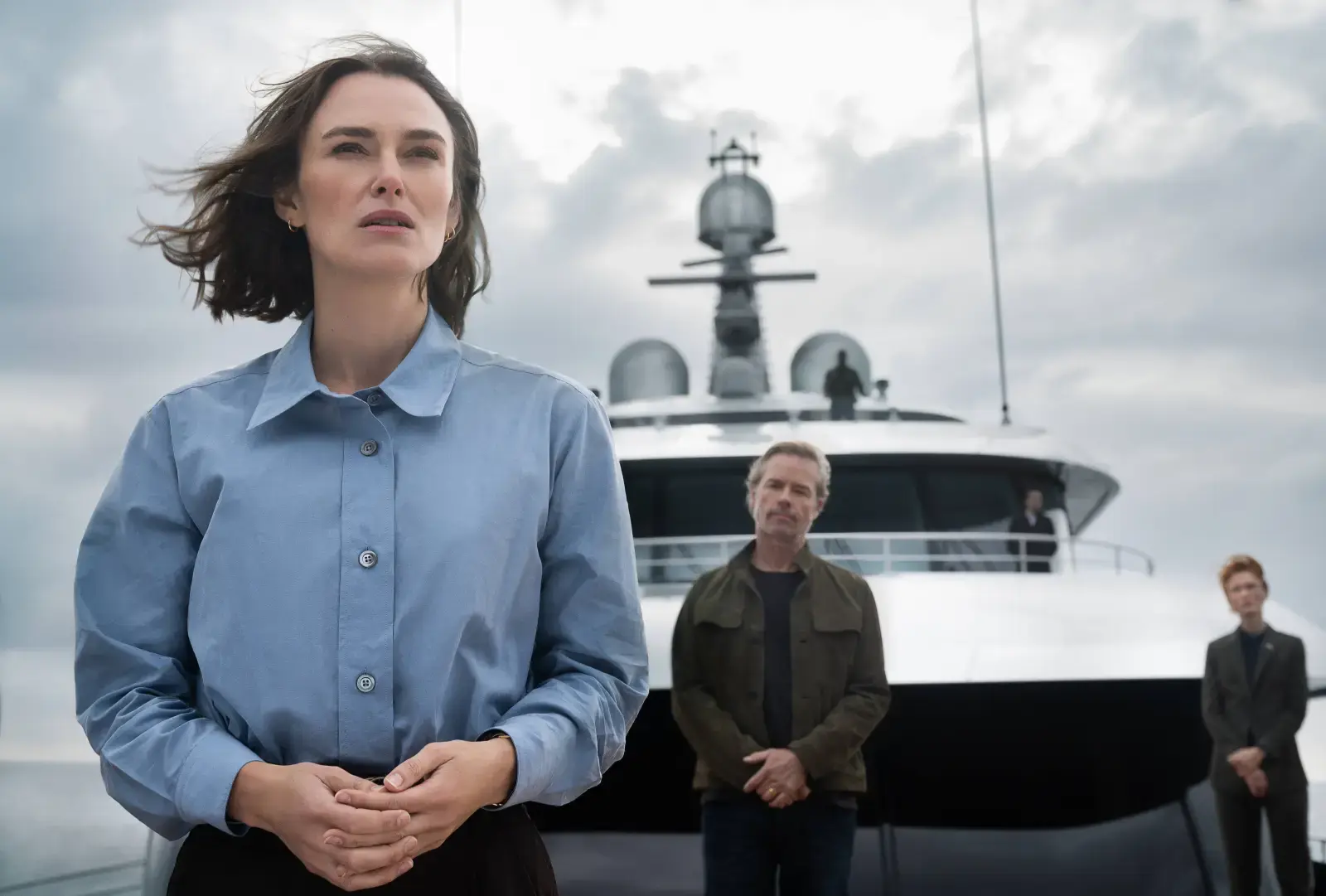
There’s a moment at the beginning of the movie where your character is getting on the boat and you’re sort of surprised you have to take off your shoes. I feel like now, knowing that’s how the shoot went, I feel like you were your character during the entire film because you had to be so careful on this yacht.
We definitely were not allowed to wear shoes anywhere. And if your character wore shoes, then they had to make sure that they were shoes that had never touched any other surface apart from the yacht’s surface. I mean, there’s a moment in the film where I’m being chased. People are trying to kill me, and I’m getting chased and I throw myself down this stairway and everyone came running up to me going, “But don’t touch the walls! Don’t touch the walls!” Somebody’s trying to kill me! Surely I’m allowed to touch the walls! Yeah, I mean, it was it was challenging. But I think the reason that we’re on it, you know, it looks extraordinary. And I think what I really loved about it was that you get this object that is sort of this symbol of power and aspiration and you turn it into this claustrophobic nightmare. So it turns into a prison. And I was really interested in how that thing that you think of as this sparkly, luxurious thing can suddenly twist into a nightmare. Yeah, I thought that was really fun.
As I was watching the movie, it felt like the yacht was a supporting character, the monster even.
Yeah, I mean, it’s definitely crazy in itself. I mean there’s no doubt that it’s definitely a crazy thing. And I think also just that sense of however luxurious a boat can be, you are trapped in the middle of the ocean. There’s no way off. And if you happen to be trapped with a murderer, you know, then it’s not an ideal situation. So I thought the whole thing was like a really interesting psychological play. And then you add the other, I think truly nightmarish thing, of not being believed. You’re standing in a room full of people and you’re saying exactly what the truth is and you are either being called a liar or you’re being called insane. I mean, for most of us, that is a nightmare scenario. So I think, again, the boat turns into this sort of metaphorical version of what’s happening to her amongst these people and this whole thing.
I mean, yes, it’s a nightmare scenario to not be believed in general settings. But when someone has potentially been murdered, especially.
It’s much worse.
It’s much worse.
It’s much worse and nobody even believes that anyone’s been murdered, which is really confusing. [laughs]
I will say, as a journalist, we’re not getting stories like that these days.
The luxury cruise job? It’s a shame, isn’t it?
I would take it. Even if there was some sort of crime, I’d still be down.
I still want the cabin and the champagne.
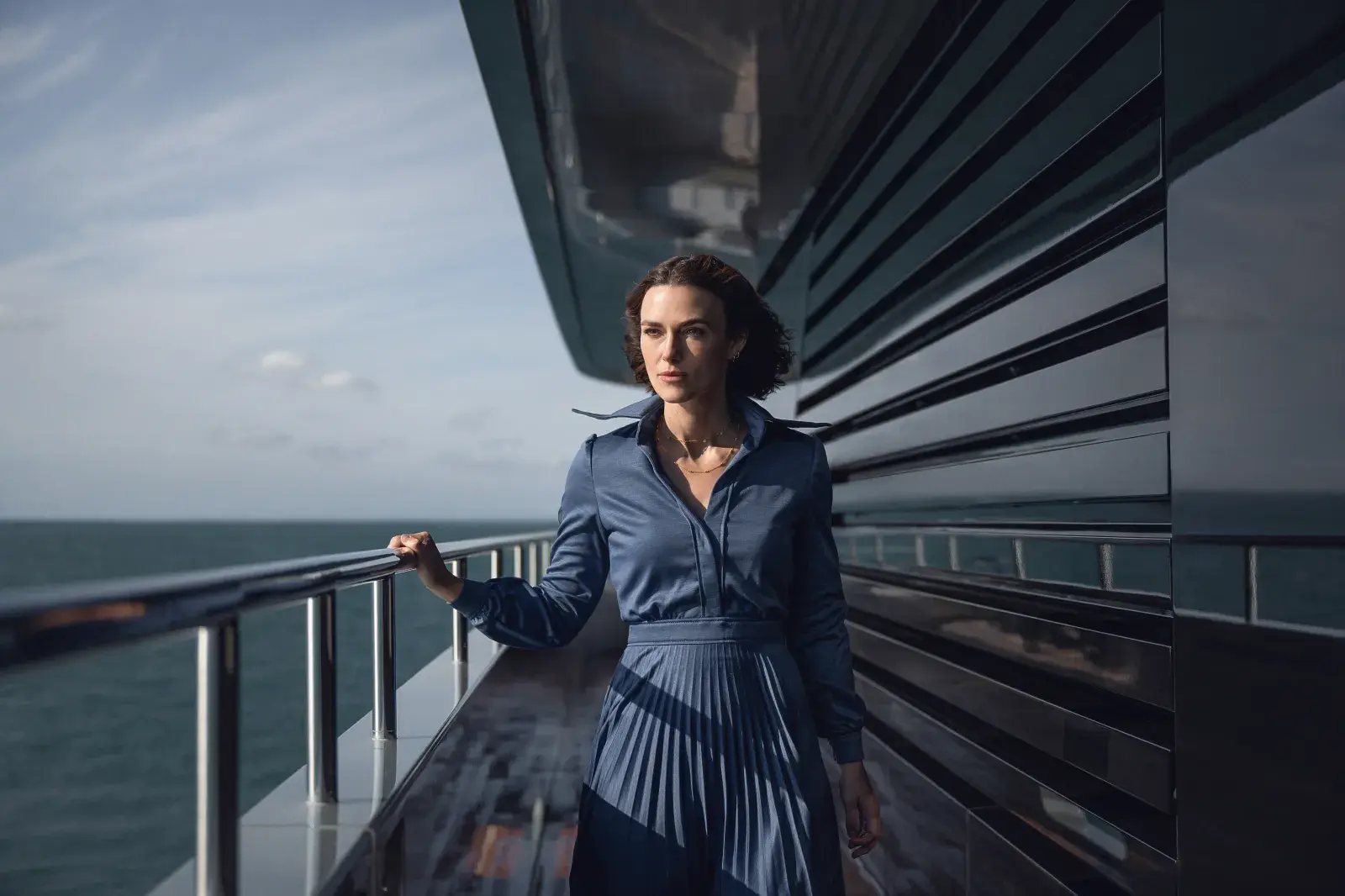
What about this story appealed to you?
So I haven’t read the book. And, actually, I didn’t know it was based on a book. So I just got the script and knew that Simon Stone was attached to do it and wanted to do it based on that. And I think, again, I’m a fan of the genre. I really enjoy a thriller. I really enjoy those kind of ‘70s thrillers. You’ve normally got a male lead, you know, they’re kind of cool, but they’re trapped in this thing. They’re trying to figure it out. They’re always shot beautifully. It’s always been just on my bucket list of things to do within my career. It’s like, yeah, I want to be Warren Beatty in Parallax View. That’s what I want to do. So when I was talking to Simon Stone about this, he was like, “Look, I want Warren Beatty in Parallax View, I want Robert Redford in All the President’s Men.” And I’m like, “Yes, I never get to play these guys. This is really fun.’ So I think it was also just the opportunity to do that. But also you rarely play characters that are so certain. I mean, normally they’re not certain. Normally, actually, the fact that they’re not certain is what makes them interesting. But actually, I think it’s her certainty faced with all of these people saying “You’re wrong.” And the fact that she just keeps going and keeps going like a dog with a bone. It was nice to play somebody so certain.
Her gender, I think, is also a part of what makes the thriller so good because it’s standing up to this rich, powerful man. And the social dynamics of that are fascinating.
Yeah. But it’s also, you know, I think we are definitely playing with the idea of like, women are not believed. And I know, in the book, a lot of people have said, you know, she’s a much more sort of damaged character, right? She has PTSD, she has insomnia. And we’re sort of playing with bits of that. But I think what we really wanted to do was, this was this was Simon’s take on it. He was like “I want to play her that she should be believed. I want to play her that she has absolute certainty, because even when she has absolute certainty, they’re not believing her.” And that dynamic is a really interesting one. And she’s also—this a strange way of putting it—but we haven’t played the kind of sexy femininity with her. She’s actually quite a straight kind of character. It’s a buttoned-up shirt. She’s not playing any feminine wiles. So it’s also taking that away. And yet she still isn’t believed. So, it’s sort of playing on all of those kind of gender stereotypes within it, but also just putting it in a scenario where whether you’re a man or a woman, if you’re standing in the middle of somebody and you’re telling your truth and everybody’s saying you’re lying. I mean, that’s a nightmare scenario, whatever gender you are. But I think the kind of lovely thing about this is it’s also playing with that. The fact that she’s a woman in the center of it does make it kind of slightly stranger and more awkward.
I mean, when your character brought only one piece of luggage onto this thing, I can’t relate to that.
Well, you see, I’d be a one piece of luggage person.
I can’t do it.
Oh, can you not? Oh, the joy of only bringing one piece of luggage.

The mark of a good thriller is you’re watching it and [you] can’t even sit down. I found myself just standing in front of my television. Do you hope to do more thrillers in this vein? Because you’re so good at it.
Oh, thank you very much. I do love it. I mean, I really do love a thriller. I just think they’re fun, and I think this is a part of my career where I’m sort of looking for stuff that is fun. I mean, I found that with Black Doves as well. Yes, it’s violent and it has darkness and it has all the rest of it. But as far as things that I like to watch, it’s fun. And I think the same as this, they’re exciting, they’re gripping. Yeah, there’s a dark heart to it, there’s a noir kind of stuff. But, you know, that’s life. And there’s an intensity that I find thrilling to watch. So yeah, I do want to do more of these. It’s great. Love being the hero, as well. It was very exciting. There’s a whole chase sequence. You know, I’m running around the boat and there’s a lovely man called John [Macmillan] who was playing the captain, and he’s running after me. He’s bigger than me and much faster. And I got to turn around to him and be like, “John, I am the hero. I don’t care that you can run that fast. You don’t get to catch me because I’m the hero, OK?” [laughs] I mean, it’s just great.
That’s the great thing about being an actor, I guess. You can live that fantasy.
I win, guys.
There’s these rich people who are just so out of touch with reality in a lot of ways, who are kind of existing in their own sort of realm. And you are all of us. Your character is all of us reacting to how these rich people exist in this way. So I look at you as an actor, and I’m like, Keira Knightley knows some rich people.
I mean, I have met some rich people. I’ve never been on a superyacht, though. This was my first superyacht. I might know some rich people, but they’re not that rich. This was a whole new level of rich for me. So, yes. Yes and no, not that rich.
Do you encounter people like these characters? I mean, I don’t encounter people like this in my everyday life. But the characters in this film, I feel like, are people that we see of as these super rich people who are out of touch with the regular person.
Yeah, I mean, I think that’s the case. I think if you’re living in these lives, these are floating castles. If you’re living in this kind of thing and you presumably you’ve got the security guards around you. I don’t think you’re existing in the same world that most other people are existing. And I’m very aware I’m saying that as a very successful actress. I’m aware I don’t exist in that, you know, but this is a whole other level of that. You are looking at it going power corrupts and absolute power corrupts absolutely. I don’t know that as much as you start this going, “This is an aspirational object. Don’t we all want to be on a superyacht?”
Can’t touch the walls.
You can’t touch the wall. And honestly, who wants a carpet you have to hire somebody to fluff up? That’s ridiculous.
I also need to ask about [actor] Guy Pearce because Guy Pearce plays evil so well in a way that is unsettling. So what was it like working with this cast in general, but particularly Guy Pearce being evil?
It was great. Guy Pearce does do evil very well. It’s so nice to work with him being evil because he’s such a nice man. But, he’s a wonderful actor. And all of the actors, we had such a great cast in this, and it was it was lovely to be amongst a proper team where you could kind of trust everybody and we could have a laugh, but also kind of go into these very dark places. But I think, Guy is a wonderful actor. He’s also a very handsome man. And charismatic and I think that brings, when he’s being evil, it brings a sort of certain level to it, which is really interesting.
What I love about this movie is that I literally did [gasp] and it came so quick. Existing in that and then having your character react to all of these things. Do you ever feel like you were just on panic mode for the entire shoot?
Most shoots feel like that anyway. You’re always up against it. You’re always slightly panicking that you’re not going to make the day, you know. But I think with this, because of the way that Simon works, he’s very quick. So he’s very like, go, go go go go go. I think with all of the panicky stuff, you actually can’t hold that energy for that long. So it was very much like get in and, boom, the shock has to kind of happen quite quickly. So it didn’t come home with me. I was like, “Oh, this is horrible. But it’s okay. Now I can turn around and chat to somebody. It’s all right. It’s not real.”
But did you go home and were like, I got to jump off the side of a boat today. Let’s have dinner.
I mean, yeah, I didn’t because that was my stunt double. But I was like, “Wow, Jess is jumping off the side of a boat today. Let’s have dinner.”

Like you were saying, you acknowledge that you are a very successful actress. You do exist in different circles. Yet for you, and for us as fans of yours, you’ve always been very relatable from the beginning, particularly for my generation, a millennial generation. Your work has been a part of our growing up experience, from Bend It Like Beckham to Love Actually, of course, to all the Pirates of the Caribbean films and Atonement and Pride and Prejudice. There’s quite literally so many nuggets that have defined my young adolescence into my adulthood. How does it feel to be such a part of our pop culture social conversation?
You know, it’s funny because you make work, and you hope that people enjoy it and you hope it exists in the world. But my only relationship with my work is when I’m making it, right? When it goes out into the world, it kind of has nothing to do with me anymore. I mean, I don’t watch them again. All of the films that you’ve mentioned, I watched them once when we first made them, which is now, with those ones, about 20 years ago. Some of my films I don’t watch at all because the experience is the experience, and that’s what I have the relationship with. But I don’t have a relationship with it as it goes on. Now, what’s amazing is that other people do, right? I mean, you take Love Actually. And I literally saw it once. I think I was 18 when it came out, and I saw it once at the premiere and I’ve never seen it again. And yet, it has become this thing for so many people. And how amazing, right? It’s an amazing thing that it has a life and it means something to people. And I think that’s what you make work for, right, you hope that it exists for other people in a world outside yours. But yeah, it’s always a little strange for me because I can’t join people there. I don’t have the Love Actually experience that this is part of my Christmas experience. I have, like, I was 18 and [writer] Richard Curtis is still a lovely friend of mine. So it’s a separate thing, but it’s not that thing. But I feel very, very fortunate. You make work so that people enjoy it. So how amazing it’s found audiences and that people have enjoyed it and that they still get something from it. It’s why you do what you do. So it’s amazing.
Because your work does persist over the years and people do, especially with a film like Love Actually, come back to it every single year, you must have interesting fan encounters. You must because your films range in fan bases.
Yeah, they do. You know, mostly people don’t recognize me. I’m quite good at being scruffy. I mean, I’m dressed. I’m doing press today. So I’m very fancy. But I’m normally a pretty scruffy person that can kind of like dodge and weave. I’m not that big. You know I can kind of disappear in a crowd. So I don’t really have that many fan experiences. Mostly I have people think I’m Natalie Portman. And I can safely say that her fans are big fans of hers apart from that they think that I’m her. [laughs] Maybe they’re not that big. So no, I mean, occasionally I get people coming up, and I’d say that Bend It Like Beckham is a perfect example of that. You know, there is still not another film about women’s soccer, right. And it did have a place in that cultural landscape. And I think it did help to tell girls that it was okay to like soccer and play soccer. And it had its place. So I think that one still for young girls is one where people will be like, “I love that.” Or “You were in that film” and “I play football” or whatever. And that’s totally lovely.
I’m just imagining people coming up to you with cardboard stuff and saying things on signs.
Actually, it’s only happened once. Once in a traffic jam. It was quite awkward because we were stuck in the traffic jam and it was it was a builder’s truck. It was a group of builders with the signs next to it. And I was sitting in my mom’s car. She was driving. And at the point, she had a really nasty car. It was like this funny little yellow bubble thing. I was not a fan of the car. And there I was stuck in traffic sitting next to her with these builders next to me. This isn’t my movie-star car. This is not a movie-star moment.
You really are a regular person. You really do blend in with the crowd, I guess.
It was a bit too regular. [laughs]