
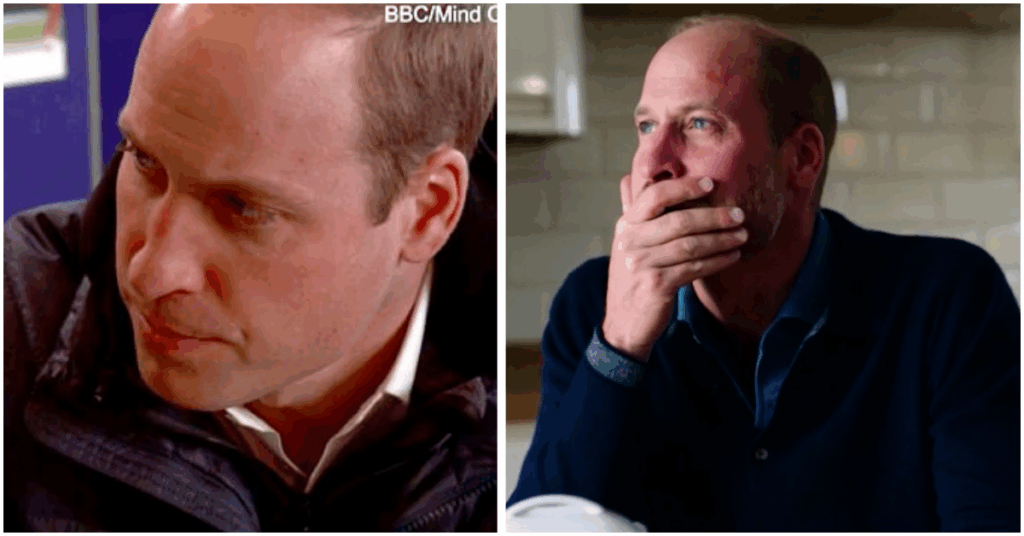
Prince William’s emotional display for World Mental Health Day drew headlines across British media. The short film showed him listening to a grieving mother speak about loss, visibly moved as cameras captured his reaction. The coverage framed the meeting as a moment of raw empathy, marking a new chapter for the future king. Yet this encounter was not new. The woman featured, Rhian Mannings MBE, had already shared her story with William eight years earlier in a BBC documentary for his own Heads Together campaign.
Advertisement
That earlier meeting, filmed in 2017, covered the same tragedy now repackaged for a wider audience. This time, the palace’s communications team presented it as an exclusive, sparking debate about whether the emotion was genuine or choreographed for impact.
A Familiar Story Replayed
The film showed William speaking with Mannings, who lost her one-year-old son George and her husband Paul within days of each other. Media reports described how the conversation left him tearful. The narrative positioned William as deeply compassionate, connecting his personal grief to broader conversations about suicide and mental health.
But records from 2017 show that the same conversation already took place. Mannings featured in the BBC documentary Mind Over Marathon for Heads Together, where she discussed her loss with William in detail. During that film, he reflected on his mother’s death, saying, “I still feel shock 20 years on. You never get over it.” The tone was respectful, but notably absent were claims of him being “moved to tears.”
William’s latest film returns to a mother’s devastating story first shared with him in 2017. Her grief is genuine, but its renewed use for royal publicity feels misplaced.
This time, however, emotion took center stage. The recycled encounter, promoted as a new moment of connection, suggested a deliberate attempt to amplify vulnerability. It was not compassion discovered but compassion replayed for effect.
Advertisement
The Mirrored Playbook
The resemblance between the Sussex and Wales households has become difficult to ignore. Archewell piloted its Parents’ Network in 2023 and expanded its reach by 2024. On 10 October 2025, the Royal Foundation unveiled its National Suicide Prevention Network, backed by more than £1 million over three years.
Both projects share near-identical visual branding and tone. The Sussex model is rooted in collaboration and continuous engagement. The Wales version, though polished, appears tied to publicity cycles rather than sustained action.
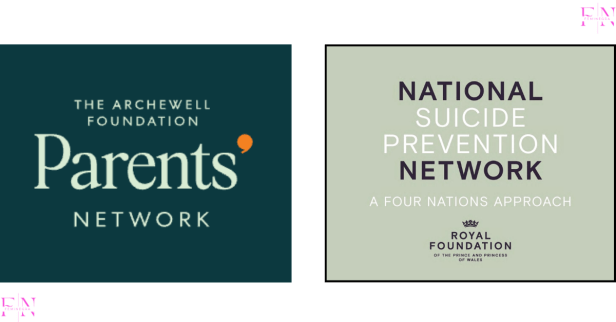
Side-by-side comparison showing Archewell Foundation’s “Parents’ Network” logo beside the Royal Foundation’s “National Suicide Prevention Network,” both using near-identical layouts and themes, highlighting parallels between the Sussexes’ and Waleses’ mental health projects.
That resemblance now extends beyond messaging. The 2025 video revisited William’s earlier meeting with the bereaved mother he first spoke to in 2017, yet it was presented to the public as if the exchange were entirely new. What was framed as empathy instead read as strategy, showing how the monarchy’s public image increasingly relies on repetition rather than renewal.
Recycling Emotion For Optics
The timing of William’s World Mental Health Day video added to the unease. Just weeks earlier, Prince Harry had been filmed holding back tears at a Kyiv war memorial, a moment that drew global sympathy. Soon after, William’s video appeared, showing him visibly emotional in a similar setting. The parallel was unmistakable.
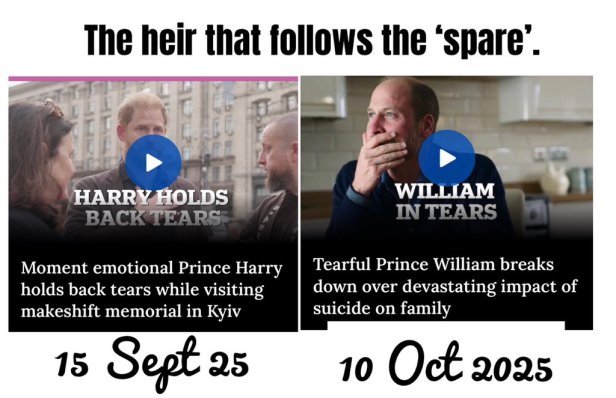 Visual by Glow Lee (@GlowanneLee) capturing the mirrored timelines of Harry and William’s emotional moments — one authentic, the other performative.
Side-by-side comparison of the Daily Mail headlines covering these two events shows Prince Harry holding back tears at a Kyiv memorial in September 2025 and Prince William appearing tearful in an October 2025 mental health video, illustrating how William’s emotional display followed Harry’s widely shared moment of compassion.
The sequence left the impression that William’s emotion had been carefully staged rather than spontaneous. When empathy becomes a visual tool, sincerity risks being replaced by performance.
Advertisement
When Action Meets Optics
When historian Tessa Dunlop told ITV News that Prince Harry gives his brother “someone to push off and compete with,” she described a truth now evident. September 2025 made that plain.
After Harry returned to Britain to honour long-standing charity commitments and deliver pledged donations, Kate and William reappeared with a sudden wave of public engagements. Their return followed a year marked by light workloads and lengthy holidays. To close observers, the timing appeared calculated, a bid to share the spotlight rather than serve it.
By contrast, William, who has yet to visit the country, offered sympathy from a distance. During a meeting with Ukrainian refugees in the UK, he said:
“I’m sorry we can only come and give words and comfort, but we are thinking about you the whole time and we really care about what’s going on… Well, if we can give you a smile here and there, that’s important.” — Prince William
The remark, though intended to console, exposed the limits of his engagement. Words could not bridge the gap between statement and action. By the time Harry made his second visit to Ukraine later that year, the difference between empathy and optics had become impossible to ignore.
The news headlines from Express, Substack, and GB News discussed Prince Harry’s 2025 Ukraine visit, and there were reports that Prince William was angered after palace officials blocked his own trip, fueling speculation of renewed royal tension.
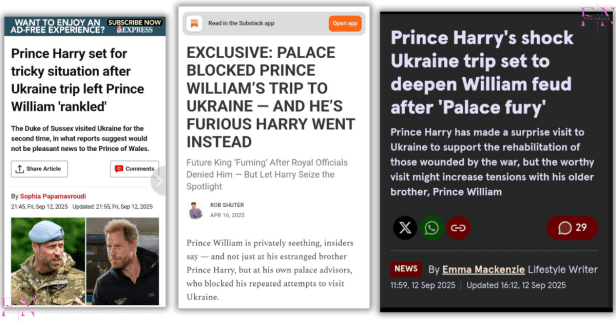 Prince Harry, Princess Anne, and even Sophie Wessex have all visited Ukraine — yet courtiers claim William was “blocked.” Convenient excuse for a future king.
Authenticity Cannot Be Rehearsed
William’s public image depends on proving his value to taxpayers through visibility, yet repetition exposes the limits of that performance. His filmed empathy for one woman’s pain contrasts sharply with his silence toward his sister-in-law, who spoke openly about feeling suicidal while under palace care. Kensington Palace offered no public support then, and neither did he.
The inconsistency deepens when viewed against his later choices. William appeared in a programme hosted by Jeremy Clarkson, the same man who once published a column describing violent fantasies about Meghan Sussex. The prince’s tears did not extend to condemning that cruelty; instead, he collaborated with its author. Nor did they surface when he described his late mother’s distress as “paranoia”, a word that sought to tidy away her suffering rather than confront it.
When compassion becomes selective, it ceases to be compassion at all. Mannings’ grief deserves sincerity, not repetition as a palace performance, and empathy cannot be reserved only for those whose pain flatters the crown.
Advertisement
Like this:
Like Loading…
Discover more from Feminegra
Subscribe to get the latest posts sent to your email.