
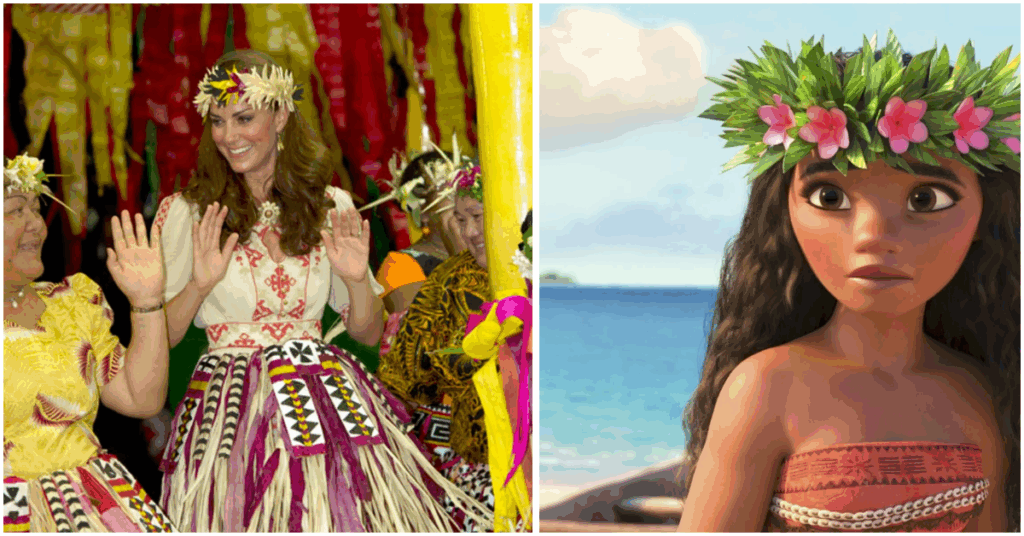
On October 14, the Daily Mail published two royal stories that could have come from separate worlds. One article, titled “Kate Middleton’s Magical Disney Princesscore Moments,” praised the Princess of Wales as a living fairytale. The feature described Kate Middleton’s gowns as “enchanting” and “magical,” comparing her to Cinderella, Aurora, and Elsa. Her wardrobe became a tool of mythmaking, a reminder that the monarchy’s glamour still functions as a form of soft power.
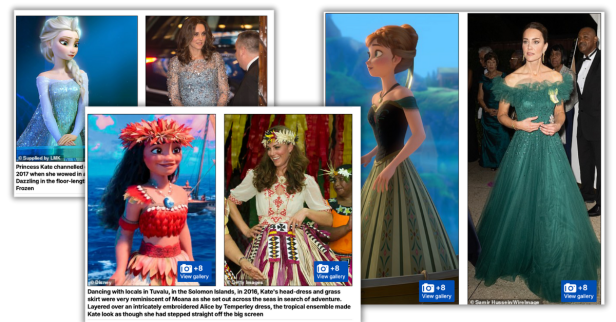 Daily Mail turns Kate’s wardrobe into colonial cosplay, selling fantasy as cultural grace.
Every photograph served that purpose. Kate’s ice-blue Phillipa Lepley gown mirrored Cinderella’s ballgown, while her pink Gucci dress recalled Sleeping Beauty’s flowing silhouette. Even her tropical attire from a 2012 Tuvalu visit, the Daily Mail outlet paired with an image of Moana. The Mail called it “adventurous yet gracious,” ignoring how such framing turns a colonial photo-op into a fantasy.
This portrayal sustains a royal ideal built on nostalgia. In a year when the monarchy faces dwindling enthusiasm, the paper’s choice to spotlight Kate as a modern princess is not frivolous. It is strategic. Through her, the royal image remains luminous and familiar. The story asked readers to suspend reality and find comfort in the spectacle of monarchy as magic.
Advertisement
The Duchess and the Double Standard
Only hours later, the same website accused Meghan Sussex of being “out of touch.” The headline followed her new Instagram highlight reel from New York, a post that featured a few personal moments, rows of shoes, clothes on a rail, and Prince Harry in grey track pants. The Mail framed the video as evidence of excess, calling the trip “lavish” and “luxurious.”
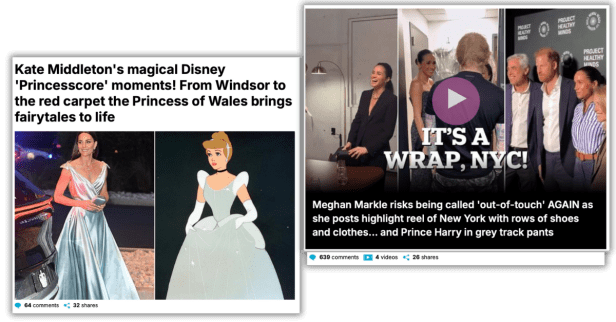 Same day, two headlines—one worships whiteness, the other punishes visibility. That’s the game.
The language shift was immediate. Kate “enchants.” Meghan “shows off.” Kate “embodies grace.” Meghan “risks backlash.” The difference is not tone alone; it defines who the paper believes deserves admiration. The article layered unrelated details about Meghan’s yoga classes, Montecito home, and SUV to create a portrait of indulgence. By the final paragraph, the focus had shifted from a lifestyle post to a moral lecture.
Advertisement
The Business of Bias
The results are measurable. The Kate feature drew sixty-four comments. The Meghan story reached over six hundred and carried a poll asking readers if she had “lost touch with reality.” Outrage sells faster than admiration, and the Mail understands this formula well. One woman sustains royal fantasy; the other sustains the revenue model.
The pairing of those two stories was no accident. Together, they reveal how British tabloids profit from contrast. Kate represents reassurance, a perfect princess in satin light. Meghan remains the convenient foil, a reminder of rebellion and difference. The imbalance reinforces the hierarchy that the monarchy depends on.
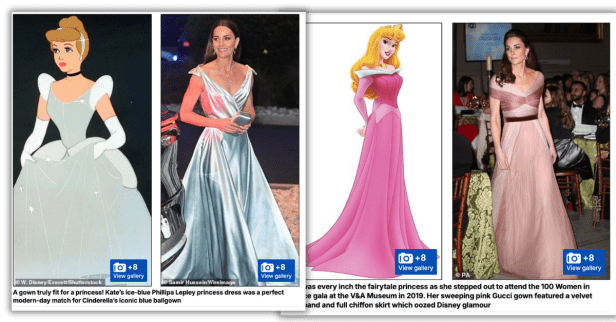 Daily Mail turns Kate’s wardrobe into colonial cosplay, selling fantasy as cultural grace.
Who Really Pays for the Princess Lifestyle
It bears repeating because the British media avoid acknowledging it: Meghan is independently financed. She earns her living through her own work—media production, brand ventures, and public speaking. Kate, by contrast, is supported by the British taxpayer through the Sovereign Grant, which totalled £86.3 million for 2024–25 and is expected to rise to £132 million next year, drawn from public funds via the Crown Estate. Her husband, Prince William, receives an additional annual income of £23.6 million from the Duchy of Cornwall, an estate valued at more than £1 billion.
Advertisement
It is striking that public opinion has been shaped to resent the royal who works for her income while excusing the one whose luxury depends on theirs. Kate can forgo official duties, take extended holidays, and live across multiple estates, yet outrage remains absent. You would think, reading the coverage, that it was Meghan’s yoga classes, Montecito home, and SUV being funded by the British taxpayer.
The racial subtext remains visible to those who look. Kate’s whiteness becomes purity and grace; Meghan’s biracial and American identity becomes spectacle and scrutiny. The paper’s use of fairy-tale language to sanctify one woman while questioning another is not only old-fashioned—it is profitable.
Final Thoughts
The Daily Mail’s dual coverage reveals a familiar pattern. Kate’s fairytale feature offered polished escapism that even its own readers barely engaged with. Meghan’s lighthearted post, by contrast, drew hundreds eager to criticise a woman they believe should not enjoy that lifestyle. Both stories served the same purpose—to preserve the royal ideal by deciding who is allowed to live it.
The paper may call it entertainment, but the pattern is deliberate. The more one woman is praised, the more another must be diminished.
Advertisement
Like this:
Like Loading…
Discover more from Feminegra
Subscribe to get the latest posts sent to your email.