
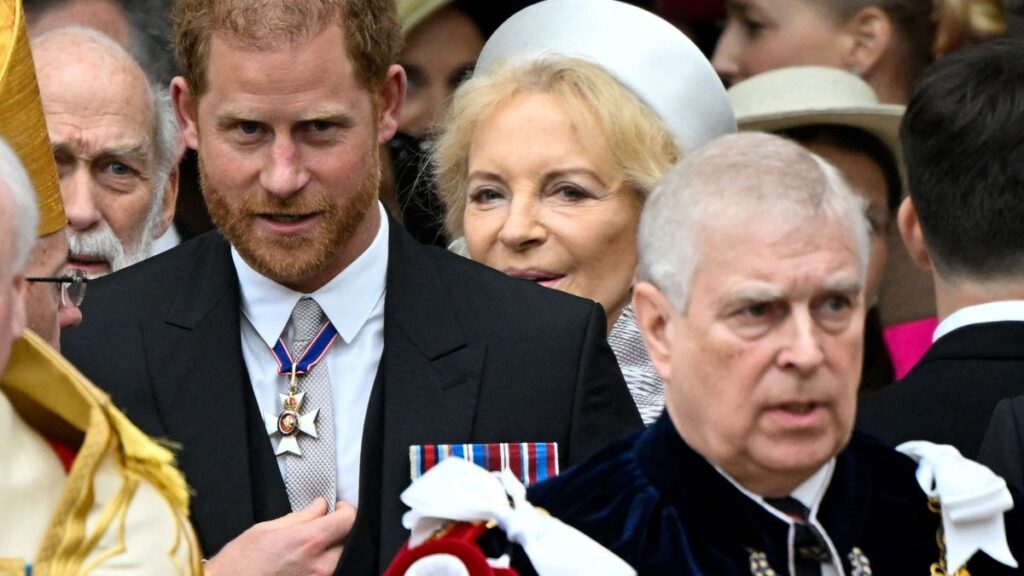
Anyone who thinks the consequences of Andrew Mountbatten Windsor’s royal defenestration will end with a scrap over which particular house on the Sandringham estate catches his eye and a – likely probably fruitless – trawl through his evasions about dealings with Jeffrey Epstein, may be missing one the most intriguing things this unsettling royal tale leaves in its wake.
This abrupt corporate “reset” brings the Harry and Meghan side-story back into focus, by virtue of the fact there are now alarmingly few high-profile royals who are not in some way either out of the picture in the great Andrew rout – or still of school age. The monarchy is running on a very thin bench of public faces, which makes the absence of Harry – for all the controversies and quarrels – more keenly felt.
Admittedly this would have been hard to envisage when the duo committed their “Megxit”, racing off to Montecito, California and dumping on the folks back home in a wrathful Netflix documentary and memoir.
But the light has changed on the royals in the past year in an unforgiving way. The resurgence of the Andrew story, which the royal household had clearly hoped would dwindle into shabby reminiscence, was not only a humiliation for a plainly impenitent, foolish and spoilt (ex) prince. It throws the judgment of the whole “firm” into question. The order of succession does matter – it is a symbol of royal resilience – and a glance at the royal “charts” right now is sobering. Aside from William as a bankable heir, the next three in line to the throne are his children – headed by Prince George who is 12.
The next adult in line remains Harry, followed by his two US-raised offspring and then Prince Andrew and his children. This places an immense burden on the Prince and Princess of Wales – and also a huge weight of expectation on his eldest, George, the next in line. Rightly, as protective parents, they want to shield a young man child on the brink of adolescence from intrusion and the pitfalls of the kind of rarefied upbringing which has often done such fateful damage.
This all means there is a lack of inventory of adult royals to appear as events (people do still like to see them show up, particularly in times of national and wider international stress, of which this is undoubtedly one).
But because Harry is “sulking” – as the critical narrative in the US puts it – and fighting endless legal cases about press intrusion and his right to protection, the stockpot has dwindled to the point where too much rides on the ageing King Charles and Queen Camilla, neither of whom is in robust health, along with William and Kate (who has had her own alarming brush with cancer), the Wessexes and Princess Royal. Andrew has long been undeployable – and the recent shame and his churlish response means that an associated role for his daughters would be difficult.
William is a natural forward planner and believes his own children will grow up to fill the gaps in a much smaller core institution. But if recent history shows us one thing, it is that relying on people in this fissile mix is a mug’s game. Diana was supposed to “go quietly” after being the People’s Princess, most adored by the public and global media. She didn’t and the tragedy of her downfall is still a topic of worldwide fascination and deluges of fake news.
Harry, who has an approachability many of his relatives lack, was supposed to settle into stardom with a glitzy, pliant American wife who would invigorate the family – but leave it fundamentally unchanged. That did not happen either. Andrew was supposed to simply melt into the background like a disconsolate Cheshire cat. More calculations have turned out wrong than right in all of this.
That brings us to tentative steps by Harry, whose stardom looks to be on a waning lease on the West Coast, to reconnect to his family, with the option of at least spending more time in the UK. That may be a more realistic option than a return to “working royal” duties, which would essentially place him back in the slipstream of a father and brother he does not get along with.
Putting aside the emotions involved, there would be sound reasons to have Harry back on the scene. As loathed as he and Meghan are by older parts of the UK demographic, they have high popularity among the young – on whom the survival of the monarchy ultimately depends. In a YouGov survey earlier this year, he enjoyed just under 50 per cent approval ratings in the under-25s and even midlifers give him more benefit of the doubt that the over-60s, who dislike him.
If this really were a royal “firm” as it sometimes styles itself in its corporate language and hirings of “CEOs” and the like, Harry might well be seen as a kind of marketing embellishment, with a “You do you” roaming brief.
The reason this is tempting but highly unlikely to happen is that because the personal dynamics involved are so poor; that even details of a tentative rapprochement by staffers in meetings before a short reconnection of Harry and King Charles were leaked to the press.
This may be no one’s fault – leaks do happen – but it certainly undermines any sense of confidentiality. And Harry enraged the Palace after his bid to have his police security reinstated was rejected in court by giving the BBC a long “stream of consciousness” interview, much of which still seemed more about anger with his kin rather than the UK courts.
The Meghan factor is alas unignorable and a stumbling block . The Duchess of Sussex’s reaction to her time in the UK and poor relations with Kate and William make it hard to see a royal readmission working out – and the Prince of Wales now is not a man who easily forgives slights. The only thinkable way Harry might return, says one former friend, is “in a divorce scenario” from Meghan – of which there is no real sign outside tabloid ill-wishes.
So the likelihood is that as the post-Andrew era dawns, the royal recalibration will foreseeably be limited to a “doing more with less”, thinner royal roster. And yet royal history is long and winding. It would be rash to bank on any Harry comeback at some unspecified point. However, it might, given the recent tumultuous story of the monarchy, however, it might not be a scenario to entirely rule out either.
In a monarchy with a great history and now an uncertain future, stranger things have happened.
Anne McElvoy is executive editor at Politico and host of “Politics at Sam and Anne’s” podcast