
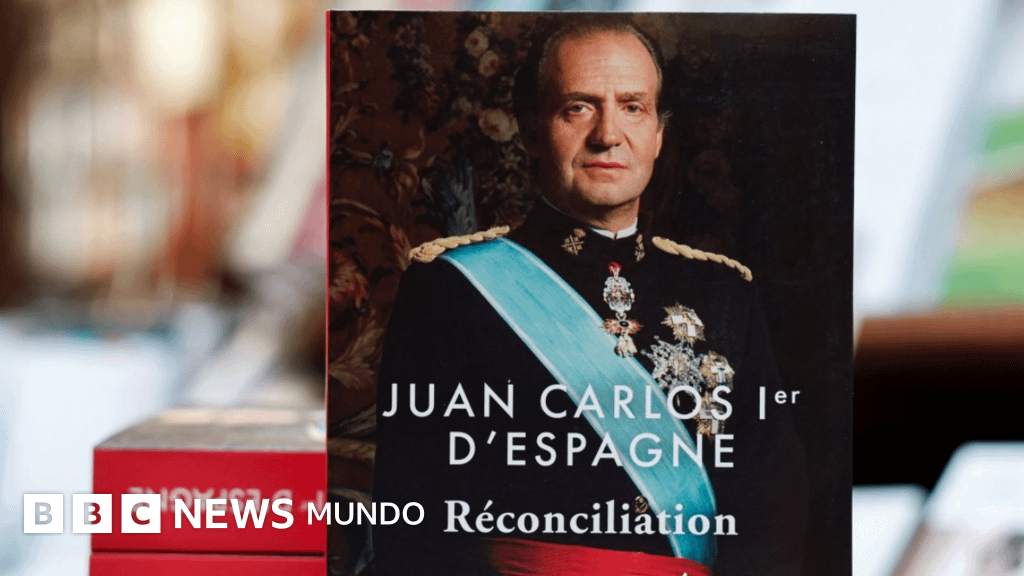

"Kings don't confess, much less in public."
Juan Carlos de Borbón, who reigned over Spain for almost four decades as Juan Carlos I, has broken this unwritten rule of monarchs by publishing his memoir, "Reconciliation," which went on sale this Wednesday in France.
The transgression should come as no surprise: the former sovereign has defied, intentionally or not, numerous monarchical norms throughout his life.
In November 1975, he was proclaimed king, ahead of his father, who was the natural successor according to the dynastic line, and he obtained his crown thanks to Francisco Franco's decision to choose him as his successor years before his death.
"I have the feeling that my history is being stolen from me," is the justification the emeritus king gives in the prologue to "Juan Carlos I of Spain: Reconciliation."
With this book, he attempts to rehabilitate a legacy tarnished by a series of romantic and financial scandals that forced him into self-imposed exile in Abu Dhabi in 2020, after being sidelined from public life by his son, the current King Felipe VI, who also withdrew his budgetary allowance.
The 500-page book arrives weeks before Spain commemorates the 50th anniversary of his accession to the throne following the death of Francisco Franco.
Its publication in Spain has been delayed until December to avoid overshadowing a complex commemoration, for which no major events or the attendance of the now-King Emeritus are planned.
Although recent polls indicate that a majority of Spaniards (52%) would vote to maintain the current parliamentary monarchy if a referendum were held, republican sentiment remains high in the country (43%), and most citizens do not forgive the former head of state for his mistakes.
But what does the emeritus king have to say? Here's a summary of four key points, drawn from recent reports in the Spanish media.
1. Franco and democracy
The relationship between Juan Carlos I and Francisco Franco, the Galician dictator who ruled Spain with an iron fist for 36 years, has generated interest for years.
The former king dedicates a chapter to these ties, which he describes as close.
"Did I have a filial relationship with him? We were 46 years apart in age. He had no sons. Perhaps he projected a paternal feeling onto me. He didn't hide his sympathy for me, even a certain tenderness," reveals the former king, according to reports in the Spanish and French press.
Juan Carlos I first set foot in Spain in 1948, when he was 10 years old.
His father, Juan de Borbón, agreed to send the then-prince to study and be educated in the country, under the watchful eye of the dictator, as part of a plan for the eventual restoration of the monarchy.
"If I was able to become king, it was thanks to him," he states elsewhere in the book, as quoted by the media, where he admits that "I respected him enormously, and appreciated his intelligence and political acumen."
In 1969, Franco decided to designate the then-prince as his successor, disregarding the dynastic rights of the prince's father.
On November 22, 1975, two days after the dictator's death, Juan Carlos de Borbón was proclaimed king by the Francoist Parliament, receiving not only a title but all the powers held by the deceased autocrat.
However, to the surprise of many, he did not cling to these powers and, with the help of politicians who came from the Franco regime, such as Adolfo Suárez, Torcuato Fernández-Miranda, and others, he promoted a political reform in the following months that allowed for the first democratic elections in more than four decades to be held in 1977.
This led to the approval in a 1978 referendum of the current Constitution, which enshrines the merely symbolic nature of the monarchy.
"Your Highness, I only ask one thing of you: maintain the unity of the country' (…) He did not ask me to preserve the regime," Juan Carlos states in the book, according to the excerpts that have been made public.
In recent interviews with the French newspapers Le Figaro and Le Point, the former king, who abdicated in favor of his son in 2014, defended his role in building Spain's current democratic system.
"After 40 years of dictatorship, I gave the Spanish people a democracy that is still alive; it is my legacy," he asserted.
2. Coups d'état and abandonments
Another chapter is dedicated to the failed coup attempt of February 23, 1981, which the former monarch describes as a three-way conspiracy.
"There wasn't one coup, but three," he explains in the book, alluding to the takeover of Congress by a group of rebel officers, the maneuvers of a general close to him to seize power, and the stance of Francoist politicians.
The televised address he delivered that morning, in which he condemned the insurrection and asked the military to return to their barracks, earned the king respect and admiration both within and outside the country.
"They set up an emergency studio in my office. I put on my general's jacket, but not my trousers, to get things done faster," he recounts.
He also reveals that he asked his son, then 13 years old, to accompany him that night.
"His training as king began that day. It seemed essential to me that he experience those tense moments by my side, and not just that I tell him about them years later," he explains.
"That night my political legacy was at stake, and the fate of the Spanish people was in my hands," he adds.
In another chapter, the former monarch takes several jabs at his relationship with his son, Felipe VI.
"He turned his back on me out of a sense of duty," he says, according to excerpts published by the Spanish media, describing the meetings they held in 2020 after the Swiss investigations into Juan Carlos's multimillion-dollar accounts came to light.
"I understand that, as king, he must maintain a firm public stance, but I suffered from his insensitivity," he admits.
He also claims that he warned him: "Don't forget that you are inheriting a political system that I built. You can exclude me on a personal and financial level, but you cannot reject the institutional legacy in which you grew up."
The emeritus king blames the estrangement from his son on the current Spanish government led by the socialist Pedro Sánchez.
"When the current government discredits me, it weakens our Constitution, it calls into question the progress of the democratic transition and our reconciliation," he states in his book, as reported by the Catalan newspaper Ara.
3. Love and financial scandals
Juan Carlos I, who made history in 2012 by publicly apologizing for going elephant hunting in Botswana just as Spain was experiencing a severe economic crisis, is once again offering a mea culpa. This time, it's for his numerous emotional and financial "weaknesses."
He describes his relationship with German Princess Corinna Larsen as a "grave error" because, he says, "it had an unfortunate impact on my reign and my destiny."
He also apologizes to his wife, Queen Sofia of Greece, for this and other infidelities.
"Spain could not have had a more dedicated and irreproachable queen," he writes.
However, he takes the opportunity to deny romances that have been attributed to him over the years.
"The media have attributed to me a dozen extramarital affairs, most of them completely fictitious," and among them, he mentions Princess Diana Spencer and the Spanish actress and singer Sara Montiel.
The monarch also admits to having made poor judgment regarding money and surrounding himself with "unscrupulous businessmen."
Another "serious mistake" that Juan Carlos I acknowledges was accepting the US$100 million gift he received in 2008 from the then King of Saudi Arabia, Abdullah bin Abdulaziz al Saud, for which he faced legal proceedings in Switzerland and Spain that forced him into self-imposed exile.
"It was an act of generosity from one monarchy to another," he says, while noting that all investigations against him have been dismissed.
With his decision to write his memoirs, Juan Carlos I joins the small group of monarchs who have narrated their lives in the first person, among whom the former King of England, Edward VIII, stands out.
In 1951, Charles III's great-uncle published A King's Story: The Memoirs of the Duke of Windsor, in which he detailed how his abdication in December 1936 came about so that he could marry the American divorcée Wallis Simpson.
4. The king who told Chávez to be quiet
Juan Carlos I also refers to Latin America in his memoirs and describes himself as "a Spanish king who loves Latin America," AFP reported.
According to the former king, his relations with all Latin American leaders were "respectful, except for one": the one he had with the late Hugo Chávez.
In the book, the monarch recalls the notorious clash he had with the then-president of Venezuela during the Ibero-American Summit held in Chile in 2007, where he snapped at him: "Why don't you shut up?"
Chávez was engaged in a verbal sparring match at the time with his Spanish counterpart, José Luis Rodríguez Zapatero.
Despite not sharing his political views, Juan Carlos highlights his "almost familial" relationship with Cuban leader Fidel Castro.
"He would send me a good box of cigars every year until I quit smoking… It always moved me," he writes.
"I'm no saint," the former king concludes, reiterating his desire to return to Spain and hoping his memoirs will help "people get to know me and dispel misunderstandings."
Time will tell if Juan Carlos I achieved his goal of rehabilitating his image among his compatriots.
Posted by anon1mo56