
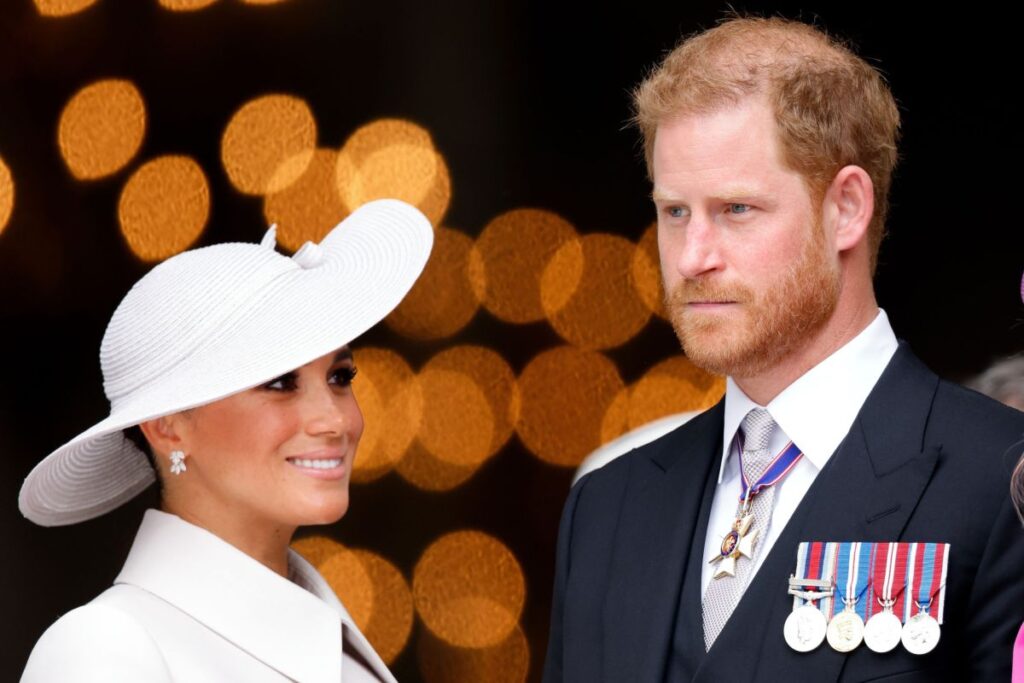
Prince Harry is being given a new threat assessment by the British Government for the first time since quitting palace life—in a puzzling move that brings his relationship with the U.K. back into the light.
The Duke of Sussex had his police protection team stripped from him in 2020 after announcing his move to North America. He has been fighting to get the armed officers back ever since, including through the U.K. courts.
And he has been pushing for a particular risk assessment, which he hopes will deliver a threat level high enough that Government officials will consider him to need a police team again during trips to Britain.
Harry sued the government to try to force them to give him a Risk Management Board [RMB] assessment and lost—but they are bizarrely now giving him one anyway, raising questions about why officials would suddenly change course.
Some in the media have argued it must be a product of warming relations with King Charles III, but the Home Office always insisted it was never about the royal rift. That raises another hypothetical possibility, which is far more simple.
Officials appeared to say Harry’s risk assessments were stopped simply because he left Britain. So one thing that could trigger a new risk assessment would be if Harry was planning to move back.
Some, though, may think that stretches the boundaries of believability given Harry’s enviable life in sunny California. Either way, the assessment should be concluded next month, meaning royal watchers may not have long to wait to find out.
Why the British Government Stopped Harry’s Risk Assessments
Decisions on who gets police protection are made by RAVEC, a committee of the U.K. Home Office which also contains senior police and royal household aides.
Sir Richard Mottram was its chair in 2020 when the decision was made to strip Harry of his team. Mottram gave a witness statement to the High Court suggesting it was Harry’s decision to move abroad that triggered the end of his risk assessments.
This evidence was summarized by Judge Sir Peter Lane in 2024: “As regards RMB assessments, the witness statement explains that one consequence in the change of [Harry’s] role and his decision to live mainly abroad was that the assessment of risk that the RMB had conducted in respect of the claimant in April 2019 had been overtaken by events. Moreover, the methodology underpinning the assessments of the RMB [redacted text].
“Sir Richard Mottram ultimately saw no merit, therefore, in conducting a formal RMB process for [Harry]. The decision to consider the case for [redacted text] was, in Sir Richard’s view, a flexible and tailored approach, which better matched [Harry’s] revised circumstances.”
RAVEC’s decision was never presented in court as a product of Harry not being at risk but rather the risk assessment process being designed for U.K. residents. Instead, RAVEC created a new system where they would assess whether to give Harry police protection on a case-by-case basis for each visit.
The judgment in a later Court of Appeal case, handed down in May, read: “RAVEC had not considered commissioning a risk analysis from the Risk Management Board after February 2020, in essence because that was, in the opinion of the relevant experts, unnecessary.”
Sir Richard felt “it made much more sense to assess the threat and risk issues” from Harry’s U.K. trips “by reference to their particular context; rather than conduct [a risk analysis] for a principal who was no longer based in Great Britain and whose activities when he was present were not likely to be regular.”
It all makes the current decision to back down and conduct a RMB assessment a peculiar one, particularly given the Home Office won the case.
Alternative Theories
Ignoring everything known about Harry as a person, a clean and simple explanation would be that the prince returning to Britain would likely trigger a new RMB assessment.
That is very hard to marry though with everything known about Harry, who appears on the face of it to be enjoying life in America even if the current president is not exactly his cup of tea.
Ingrid Seward, author of My Mother and I, told Newsweek: “I think its highly unlikely because why would a 40-year-old man want to come and live in this country when he’s living the good life in California. It doesn’t make sense. The only thing that makes me wonder is Trump.”
Seward cited a recent drama over Prince Harry’s visa in light of his revelations in his book Spare that he had taken recreational drugs. Right-wing think tank The Heritage Foundation appealed for Donald Trump to strip Harry of his visa, though the president has not taken them up on the request.
“There’s then also the possibility that Harry might want his children educated here,” Seward said.
There are other theories too. Security expert Alex Bomberg, the chief executive of private security firm Intelligent Protection International, told Newsweek this week: “It probably is a change of circumstances. It would be a change in the risk profile, if there’s a sense of urgency to it.”
However, his primary theory was the police may have picked up new information about a threat to Harry.
One more orthodox argument in the British press is that Harry simply managed to sweet talk his way into getting what he wanted through a letter to British Home Secretary Shabana Mahmood, who only recently came into post in September, replacing Yvette Cooper.
There is an argument for saying both Labour Party politicians may have been more favorable to Harry’s cause than the Conservative Party predecessors in post during Harry and Meghan Markle’s early years in America.
After all, Cooper and Mahmood both signed a 2019 letter of solidarity in defense of Meghan, which did not bear the names of their Tory predecessors, Suella Braverman, Priti Patel, James Cleverly and Grant Shapps.
“As women MPs of all political persuasions,” the letter read, “we wanted to express our solidarity with you in taking a stand against the often distasteful and misleading nature of the stories printed in a number of our national newspapers concerning you, your character and your family.
“On occasions, stories and headlines have represented an invasion of your privacy and have sought to cast aspersions about your character, without any good reason as far as we can see.
“Even more concerning still, we are calling out what can only be described as outdated, colonial undertones to some of these stories.”
It concluded: “You have our assurances that we stand with you in solidarity on this. We will use the means at our disposal to ensure that our press accept your right to privacy and show respect, and that their stories reflect the truth.”
Of course, there remains Harry’s perspective that his father had been standing in the way of him getting an RMB assessment, as he told the BBC in May: “I’ve never asked him to intervene—I’ve asked him to step out of the way and let the experts do their job.”
And he argued that he was denied police protection in an effort to stop him leaving: “This, at the heart of it, is a family dispute. And it makes me really, really sad that we’re sitting here today, five years later, where a decision that was made most likely, in fact I know, to keep us under the roof.”
From this perspective, it might be argued that improving relations with Charles could give rise to a softening of the hard line stance at the Home Office, though that would fly in the face of the sworn testimony of officials during Harry’s lawsuits.
Whatever the cause, the stakes are high for Harry who believes it is not safe for him to bring Meghan and his children, Prince Archie and Princess Lilibet, back to Britain without police protection.
Do you have a question about King Charles III and Queen Camilla, Prince William and Princess Kate, Meghan Markle and Prince Harry, or their family that you would like our experienced royal correspondents to answer? Email royals@newsweek.com. We’d love to hear from you.