

Key Points
Cuban sold MicroSolutions for $6M in 1990 and co-founded Broadcast.com, later acquired by Yahoo for $5.7B.
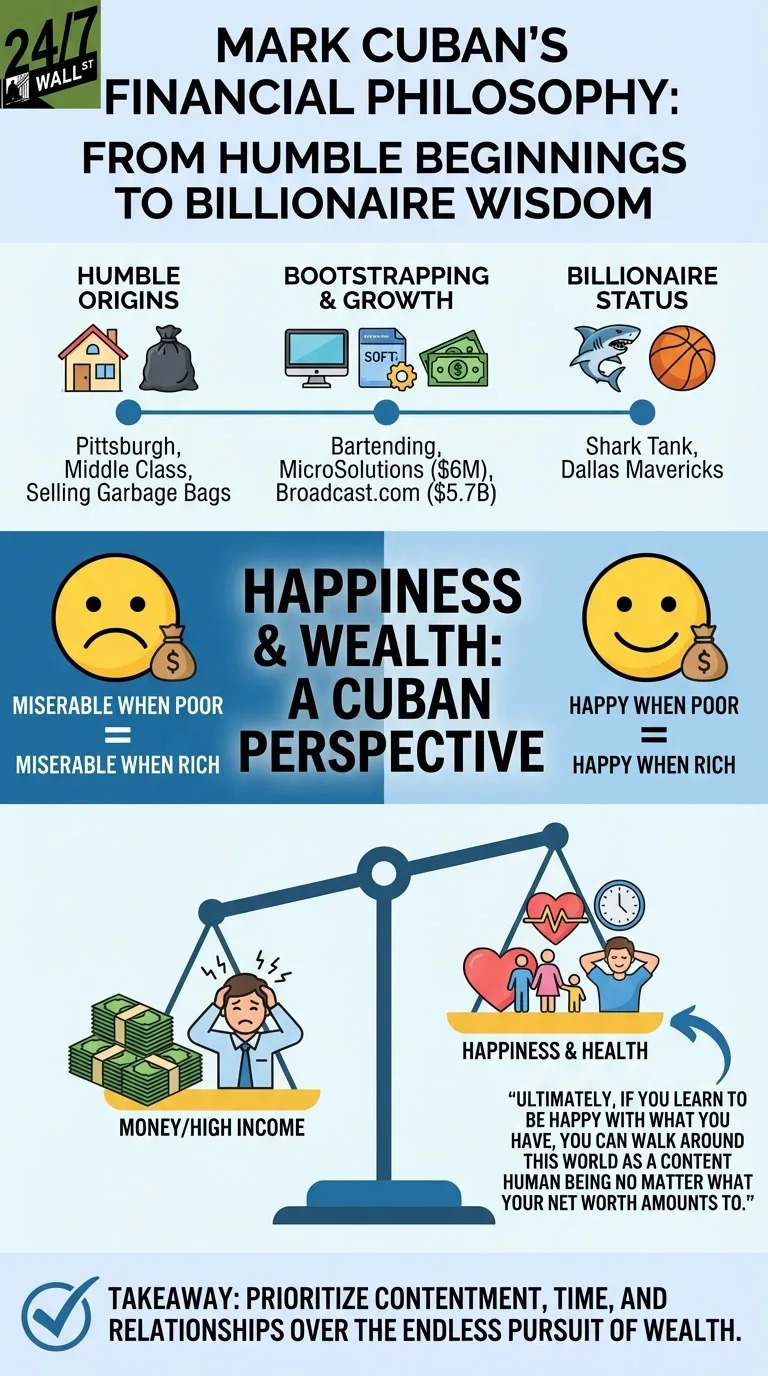
Cuban believes happiness depends on outlook more than wealth. Being miserable when poor often means being miserable when rich.
A recent study identified one single habit that doubled Americans’ retirement savings and moved retirement from dream, to reality. Read more here.
Mark Cuban is well-known today as a billionaire entrepreneur and investor, famous for his role on Shark Tank and ownership of the Dallas Mavericks. But he wasn’t always rich.
Cuban’s origins are fairly humble. He was raised in a middle-class family in Pittsburgh and once had a job selling garbage bags door-to-door around his neighborhood (yes, you read that correctly). He bootstrapped his way up, starting with bartending and software sales before founding MicroSolutions, which he sold for $6 million in 1990, and later co-founding Broadcast.com, acquired by Yahoo for $5.7 billion in stock during the dot-com boom.
Of course, we all know how Cuban’s story played out. But because he didn’t grow up wealthy, he learned to appreciate money once he had it. And he also has some sage advice for people who are trying to better their financial pictures.
24/7 Wall St.
Being wealthy isn’t everything
It’s true that money can make our lives easier. It can also buy us nice things, which can lend to some degree of temporary happiness.
But ultimately, if you learn to be happy with what you have, you can walk around this world as a content human being no matter what your net worth amounts to. And that’s an important skill to learn.
Cuban himself has said that if you’re able to be happy when you don’t have a lot of money, you’re going to be happy when you’re rich. But there’s a flipside to that.
Cuban also says that if you’re miserable when you’re poor, you might end up just as miserable when you’re rich.
What he’s trying to say here is that your happiness probably depends on your outlook more so than anything else. And while it’s certainly not a bad idea to work on growing your net worth, that’s not the only thing you should be focusing on.
Make the most of your time on the planet
Some people work brutally hard jobs all their lives that cause them stress and result in strained relationships with the people they care about. Then, at the end of their lives, they often regret pushing that hard despite having accumulated a lot of money.
It’s not a bad thing to work hard and save well so you can get to a place of financial stability. And being financially secure can lead to you feeling more content.
But at some point, you do need to step back and ask yourself what’s most important — money or your happiness and health? And if the pursuit of money is getting in the way of either, then it may be time to make changes.
Say your job pays $400,000 a year, but you work 12-hour days on top of weekends and you can’t remember the last time you spent two hours in a row with your spouse and kids. Switching to a job with a $100,000 salary might force you to make some spending cuts and lifestyle changes. But it might also make you happier on a whole.
So rather than keep plugging away, think about what you want out of life and what’s most important to you. And then make changes as needed to get to that point.
If that involves a big hit to your income, sit down with a financial advisor to get help on making it work. But ultimately, learning to be content with your life is apt to lead to happiness more so than the amount of money in your bank or brokerage account.
The New Report Shaking Up Retirement Plans
You may think retirement is about picking the best stocks or ETFs, but you’d be wrong. Even great investments can be a liability in retirement. It’s a simple difference between accumulating vs distributing, and it makes all the difference.
The good news? After answering three quick questions many Americans are reworking their portfolios and finding they can retire earlier than expected. If you’re thinking about retiring or know someone who is, take 5 minutes to learn more here.