
It wouldn’t be Christmas Day without the British monarch’s annual address to the Commonwealth.
The Christmas Broadcast, as it is officially known, was delivered by Queen Elizabeth II for 70 years before her death in 2022.
Since then, King Charles has taken up the tradition, which was started by his great-grandfather way back in 1932.
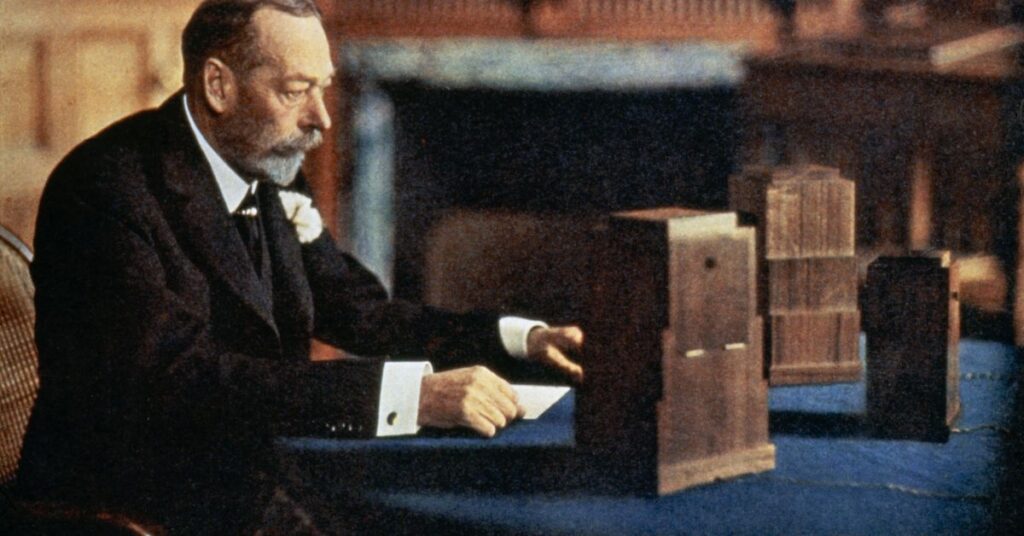
 The first royal Christmas message was delivered by King George V in 1932. (Getty)
According to the Royal Family’s official website, the very first Christmas Broadcast was delivered by King George V at the Sandringham estate in 1932.
The original idea for a Christmas speech by the Sovereign was mooted by Sir John Reith, who was the founding father of the BBC.
He wanted to inaugurate the Empire Service, now the BBC World Service, in a special way – but first he had to convince the King.
According to the Royal Family’s official website, the King was originally hesitant about using the relatively untried medium of radio in this way.
READ MORE: Inside the royal family’s Sandringham estate
READ MORE: New portrait released to mark King Charles’ birthday
READ MORE: Why we have the royals to thank for Christmas trees
 The King and Queen Mary with granddaughters Princess Elizabeth and a barely visible Princess Margaret. (Getty)
It was only after he visited the BBC in the British summer of 1932 that he was reassured enough by the technology to agree to take part.
And so, on Christmas Day, 1932, King George V used a ‘wireless’ to address his Empire from a small office at Sandringham.
The time for the historic address – 3pm in Britain – was chosen, as it was thought to be the best time to reach most of the countries in the Empire.
The first broadcast was late, starting at 3.05pm and running for two and a half minutes.
The broadcast was preceded by an hour-long program of greetings from all parts of the Empire.
The first part of the speech was written by poet and writer Rudyard Kipling and began with the words: “I speak now from my home and from my heart to you all”.
It continued, “To men and women so cut off by the snows, the desert, or the sea, that only voices out of the air can reach them”.
The King then acknowledged the unifying force of technology in his historic speech.
“The transmission was an exercise of contemporary logistic brilliance,” according to the Royal Family’s website.
“Two rooms at Sandringham were converted into temporary broadcasting rooms.
 Author Rudyard Kipling (left), pictured with George V in 1922, wrote the opening line of the King’s first Christmas broadcast. (Getty)
“The microphones at Sandringham were connected through Post Office land lines to the Control Room at Broadcasting House.
“From there, connection was made to BBC transmitters in the Home Service, and to the Empire Broadcasting Station with its six short-wave transmitters.”
The General Post Office was used to reach Australia, Canada, India, Kenya and South Africa using short waves from the transmitters in Britain. The message was then delivered by short waves from transmitters in Britain.
The broadcast made a huge impact on its audience of 20 million people.
Impressed, King George V decided to do it again the following year.
 The scene in the relaying room at BBC Broadcasting House during the relay of the King’s speech in 1933. (SSPL via Getty Images)
A photo (above) shows operators at the switchboard in the relaying room at BBC Broadcasting House on Christmas Day 1933 during the relay of the King’s Speech from Sandringham to the Empire.
King George’s last Christmas Broadcast took place on Christmas Day 1935, just weeks before his death on January 20, 1936.
Despite a weakening voice, he spoke of his people’s joys and sorrows, and his own, and even mentioned his children.
Following his death, King George V’s eldest son Edward acceded the throne, becoming King Edward VIII.
But just months later, he announced his plans to abdicate and signed the papers on December 10, 1936, paving the way for his younger brother, Prince Albert, to become King George VI the next day.
 King George VI continued his father’s tradition, but skipped the broadcast in 1936 and 1938. (royal.uk)
However, with a nation in shock and turmoil, and the new King suffering from a stutter, a decision was made not to have a Christmas Broadcast that year.
Instead, King George waited until the following year to resume the annual broadcast, during which he thanked the nation and the Empire for their support during the first year of his reign.
He skipped the broadcast again in 1938, only bringing it back in 1939 following the outbreak of World War II.
Dressed in the uniform of the Admiral of the Fleet and sitting in front of two microphones set up on a table at Sandringham, his landmark speech offered a message of reassurance to his people.
He continued the broadcasts, which were delivered live, throughout the war to boost morale.
After the war ended, the broadcasts continued.
His final address was delivered on Christmas Day 1951, but was pre-recorded as the King, who was by then very unwell, could only speak in small intervals.
He spoke of his recovery from illness and the goodwill messages he had received.
“From my peoples in these islands and in the British Commonwealth and Empire – as well as from many other countries – this support and sympathy has reached me and I thank you now from my heart.”
He died on February 6, 1952, at 56, paving the way for his eldest daughter, Princess Elizabeth, to become Queen.
 Queen Elizabeth II pictured making her first Christmas broadcast from Sandringham House in 1952. (Getty)
The new Queen carried on the tradition started by her father and grandfather, whom she mentioned in her first Christmas Broadcast in December 1952.
In 1957, she made her first televised broadcast from Sandringham’s Long Library.
Dressed in a gold lame dress, she read a passage from the book Pilgrim’s Progress during the address, which also marked the 25th anniversary of the first Christmas broadcast.
For a daily dose of 9honey, subscribe to our newsletter here.
She made radio broadcasts in 1959 and 1963 because of her pregnancies.
All of her broadcasts were live until 1960, when they became prerecorded.
 The Queen during her first televised broadcast in 1957. (PA Images via Getty Images)
She only ever missed one broadcast during her reign. In 1969, a decision was made not to record one because a documentary about the Royal Family had aired that year and there were fears of ‘over-saturation’.
Instead, a written message was released, but she returned to the tradition in 1970, and never missed another broadcast again, delivering her last in 2021.
This year will mark King Charles’ fourth address, and he is expected to follow the same broadcast ‘formula’, which carefully reflects current issues and concerns, and shares the Monarch’s reflections on what Christmas means to them and their listeners.

All the best Christmas Day photos of the royal family
FOLLOW US ON WHATSAPP HERE: Stay across all the latest in celebrity, lifestyle and opinion via our WhatsApp channel. No comments, no algorithm and nobody can see your private details.