
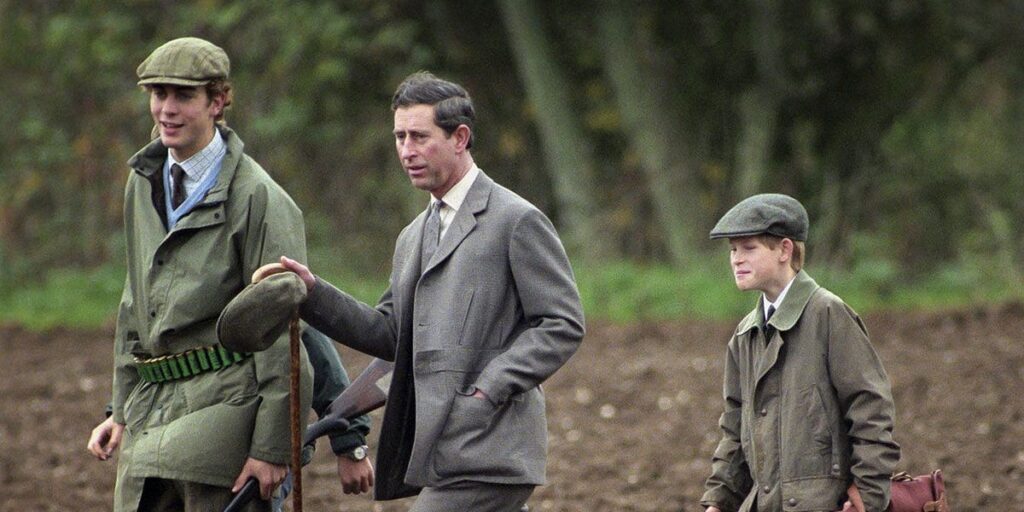
The holidays are among the few times each year when the royal family retreats (really retreats) into its private rhythms. Sandringham House and Balmoral fill with family; traditions resurface; familiar headlines reappear. The royals aren’t concerned with charitable engagements, but might instead spend their time shooting, stalking, or fishing.
 Prince Charles, Prince William, and Prince Harry out stalking in 1995.
For the rest of us, an annual debate reemerges over what these rituals say about a modern monarchy.
Across centuries, field sports have been woven into the very fabric of royal life. In earlier eras, they were tools of governance, land management, and public display. For medieval monarchs, hunting was an assertion of sovereignty over land itself.

Hunting shaped court culture, reinforced social hierarchies, and even served as a diplomatic stage when foreign rulers were invited to join the chase.
Royal forests such as Woodstock and the New Forest (set aside by William the Conqueror) were rigorously protected landscapes in which only the monarch and those granted permission could hunt.

Forest laws were so severe that poaching could result in imprisonment or mutilation. These same restrictions later ensured that prime timber remained available for naval shipbuilding, tying royal leisure directly to state power.
By the Georgian and Victorian periods, field sports had become elaborate social rituals. Monarchs like George V devoted weeks each year to grouse and pheasant shoots, while royal estates were managed with increasing scientific precision to maximize game populations.
The late Victorian era saw the rise of driven shooting (a highly choreographed style still practiced at Sandringham and Balmoral) where beaters drive birds toward strategically placed guns. Preservation and sport became deeply intertwined. Scotland’s heather moorlands, England’s woodlands, and even waterways were maintained in ways that prioritized game species.
 A shooting party of the 1890s, including the future King Edward VII.
Yes, the monarchy quite literally shaped entire ecosystems around these traditions. And today, they persist as deeply personal traditions that increasingly evoke public controversy.
For the royals themselves, outdoor sports remain tied to personal relationships.
Boxing Day at Sandringham still involves a traditional pheasant shoot on the estate, following a hearty breakfast. Although modern family members such as Prince Harry and Meghan have made a point of skipping the shoot, other outdoor activities (like riding or nature walks) are offshoots of age-old hunting traditions.
And the grounds of Balmoral provided one of the backdrops against which Andrew Mountbatten Windsor entertained—you guessed it—Jeffrey Epstein and Ghislaine Maxwell. Recently released files in the United States included a photograph of Andrew, Epstein, and Maxwell shooting on the estate’s vast heathlands:
 Biographer Andrew Lownie noted of this photo: “Epstein and Maxwell were given the opportunity to go anywhere and Andrew appears to have been too stupid to notice he was being taken advantage of in this way.” Yikes.
At Balmoral, especially, stalking red deer is still treated as an annual ritual in which patience, skill, and stewardship are tested. But some elements sit uneasily with modern audiences, particularly blooding: the practice of smearing the blood of a “first kill” on a novice hunter’s face.
Criticism of the ritual is not new. As early as 1914, humanitarian Henry Stephens Salt condemned blooding as “loathsome,” arguing that it revealed the darker impulses behind so-called sport.
But within the royal family, the practice persisted well into the late twentieth century.