
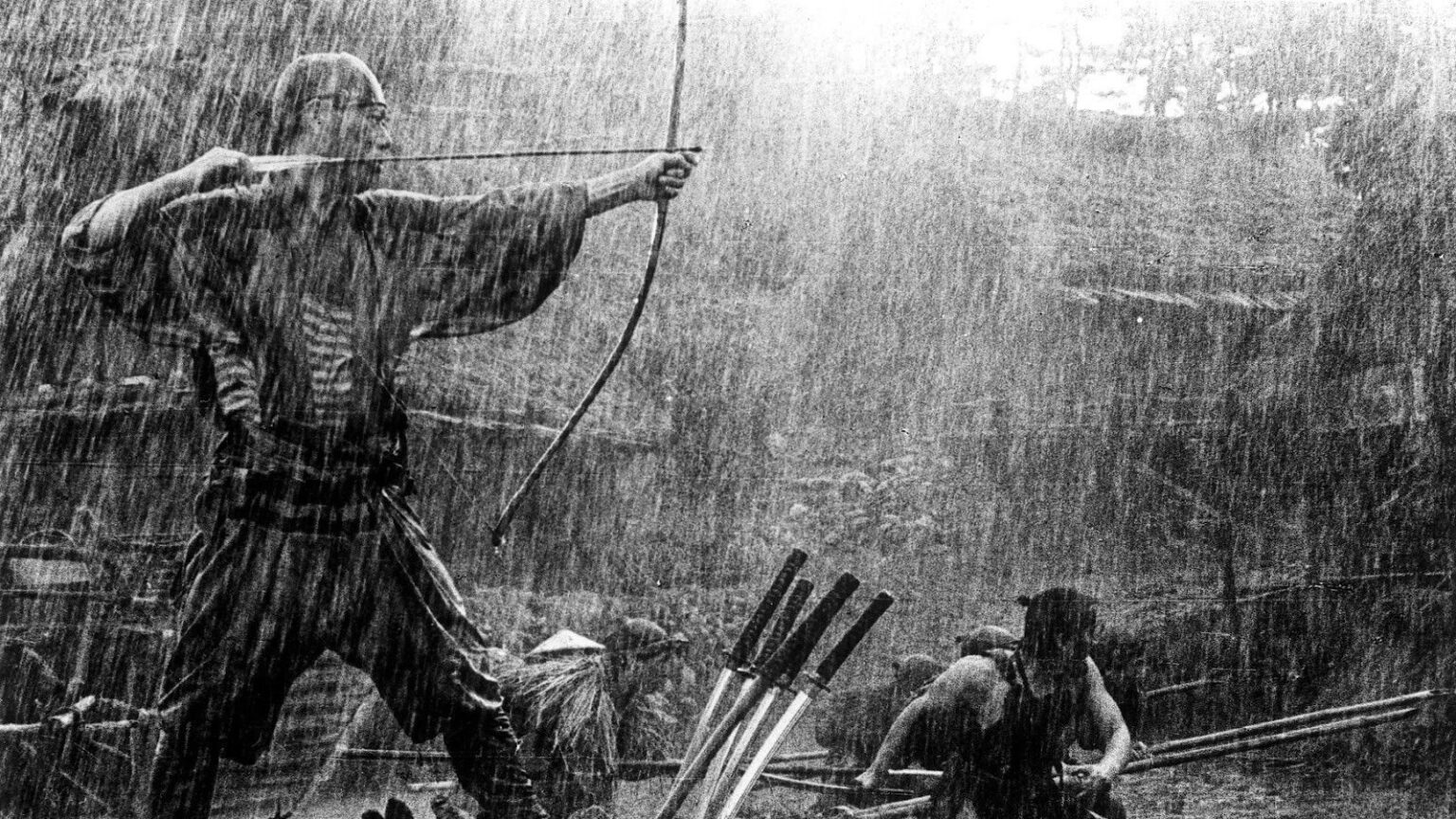
A review requested by Benjamin, with thanks to supporting Alternate Ending as a donor through Patreon.
“Seven Samurai is a great movie” is such a disgusting thing to claim, like the 1954 epic that has disproportionately defined “Japanese cinema” outside of Japan for all 71 of its years on this earth, might somehow cease to be a great movie if I didn’t type out those words. It is possible that this is the most self-evidently great movie ever made. And note that I am not calling it a self-evidently great film, though it’s that also; it’s a great movie, a rip-snorting bit of chomp-on-your-popcorn popular entertainment that blazes through a monumental 207-minute runtime like it was half that length, as it mixes crude humor, violent action, and aphoristic moralizing into a perfect exemplar of media designed for mass consumption that assumes that mass audiences want to be respected and treated like thinking people. I don’t know what one could say that would feel hyperbolic in over-praising it: I guess since I don’t think it’s the best film ever made, “this is the best film ever made” ought to feel hyperbolic, but in looking for ways to shoot that claim down, I found myself wondering why I don’t think that.
It’s certainly a defensible position to hold, at least. Especially if you think, as I generally do, that the fundamental unit of cinema is the cut: what makes movies movies, in a way that no other medium is movies,* is the ability to place one image in front of the viewer’s eyeballs directly following a different image, generating a meaning present in neither image in the contrast or comparison between them. And also the filmmaker controls the duration of each of those images, so the rhythmic movement between images is fixed and, in principle, outside of the viewer’s control. And there are other options for the fundamental unit of cinema that we could argue about, but if you’ll indulge me by sticking with editing, then that’s the argument right there that Seven Samurai actually is the best film that I’ve seen, because what I earnestly do believe is that it’s the best-edited film that I’ve seen, and aren’t they sort of the same thing?
Let’s not go down that rabbit hole any farther than we have to, because it’s ultimately kind of stupid: at the very least, Seven Samurai is a powerfully great work of cinematic art, as good a one-stop argument in favor of the unearthly skills of director (and editor!) Kurosawa Akira as you’d ever need, and among the most influential films in the medium’s history, if by “influence” we mean that a very large number of movies directly copied its story about a rural community being threatened by a gang of bandits hire a team of seven trained warriors to defend them. There are the direct, official remakes, most famously 1960’s The Magnificent Seven and its three sequels and its own 2016 remake, plus a 1998 television series; less-famously, there’s a 2004 animated television series, Samurai 7, which is a direct remake down to having the same character names. There’s 1980’s Battle Beyond the Stars, which isn’t an official remake but which contains unsubtle references to Kurosawa as a “thank you” for the plot it has stolen. There’s an Italian peplum version, 1983’s The Seven Magnificent Gladiators, and there’s a Hindi war movie version, 1998’s China Gate, and there’s a Pixar animated children’s comedy, 1998’s A Bug’s Life. There’s an Adam Sandler parody, 2015’s The Ridiculous 6. Back home in Japan, there’s a soft-core pinku eiga version, 1972’s The Naked Seven. And that’s just grabbing some of the ones where it’s obviously a Seven Samurai riff. It has been argued, and I can’t come up with a way to disprove it, that Seven Samurai is more broadly the wellspring for every movie in which a team is assembled one at a time by a seasoned old veteran who wants to pull off an impossiblewho task but needs a demographically-pleasing blend of experts and novices to get the job done. And if that’s true, that surely puts Seven Samurai behind only Psycho, the progenitor of every subsequent movie where somebody gets stabbed on camera and is thence covered with stage blood, as the film with the most descendants.
Not that we need a long list of rip-offs, copycats, and echoes to make the argument that Seven Samurai is a great film. It makes that argument entirely on its own. This is a consummate mixture of everything that goes into narrative filmmaking: that exquisitely simple and appealing elevator pitch, for a start, but then everything about how Kurosawa and his unimprovable filmmaking team built out that basic idea is amazing. To begin with the story, since we have to begin somewhere and I’m having a hard time picking, the script (which Kurosawa co-wrote with his frequent collaborators Hashimoto Shinobu & Oguni Hideo) does an excellent job of expanding the scale of the narrative gradually and not without pauses and reversions, so that it constantly seems to be refreshing itself across those 207 minutes (in its most complete cut, which has also been the easiest one to watch since it supplanted all of the “we need to make it shorter for audiences” cuts starting in the 1980s), always inventing new ways to make use of that opulent running time without repeating itself or slowing down when it oughtn’t (though it permits itself to slow down when it ought). It’s especially crafty in the 112 minutes preceding its intermission, as it feels like multiple different movies all chasing each other, building on each other, expanding the film’s palette while focusing on the colors it likes the most. It starts out… well, it starts out as a heavy mood piece, right from its opening credits, written at chaotic skewed angles in stark white on black while a dismal, throbbing drum pounds on with insistent, threatening martial presence. And then the film pitches us into the violent days of the late Sengoku period – later on, dialogue allows us to pin the film precisely to 1586 – when Japan had collapse into constant conflict between local warlords, pays off that ominous music immediately with some expository text that seques into shots of horse-riding bandits emerging over a hill as black silhouettes against a thin slash of daylight in a dark grey world, popping up from the ground like something crawling its way from the dirt. It packs a lot of gravity right into the opening beats of a film whose outlook will eventually prove to be highly pessimistic, ensuring that throughout all that follows, we have that feeling of gloom hanging over everything.
But once we’ve met our bandits, and heard their plot to return in a few months to steal the newly-harvested barley from an isolated farming village in the mountains, then the film properly starts when the villagers decide, on the advice of Old Man Gisaku (Kōdō Kuninori), to send an envoy of four men to the nearest big town to hire four samurai – the mercurial young man Rikichi (Tsuchiya Yoshio), curtly pragmatic Manzo (Fujiwara Kamitari), nervous Yohei (Hidari Bokuzen), and Mosuke (Kosugi Yoshio), who’s mostly there because at one point they need to send somebody back home and the screenwriters didn’t want to waste one of the villagers they’d invested with a real personality. And for a good 15 or 20 minutes, this is what the film feels like: the confusion of these four farmers trying to find their footing in a world that only wishes to do them ill. Only after several missteps do they find one samurai, Kambei (Shimura Takashi), risking his life to save a child from a desperate criminal, and they successfully appeal to his good nature, after which point the film gradually adjusts itself: now the farmers are no longer the protagonists, Kambei is, as he takes on the task of finding a team of samurai willing to take on such a thankless job for no meaningful reward other than the deadly work itself – he estimates that seven samurai, including himself, will be enough to do the trick. And he finds them, bit by bit: Katsushirō (Kimura Isao), a young rich kid who desperately wants to prove himself and adopts the reluctant Kambei as his mentor; Shichirōji (Katō Daisuke), a former colleague of Kambei’s; Gorōbei (Inaba Yoshio), a skilled archer with a mind for tactics who quickly establishes himself as Kambei’s second-in-command; Heihachi (Chiaki Minoru), who isn’t terribly skilled but has a good sense of humor and who is brought along mostly so that at least somebody on the team has happy, good vibes; Kyūzō (Miyaguchi Seiji), who has no sense of humor but is the most talented swordsman Kambei has ever seen, and wants nothing other than a chance to practice his art even without decent pay; and lastly, and even kind of least, Kikuchiyo (Mifune Toshiro), who isn’t a samurai at all, just a slightly manic wannabe with a stolen sword, a stolen identity, and a lot of swagger to go along with his almost bestial crude humor and erratic physicality. None of the other six even particularly want Kikuchiyo around, but he won’t leave them alone, so on the team he goes.
And then, once Seven Samurai has justified its title, then the film gradually adjusts again, and instead of having Kambei as its focal point, the “protagonist” expands out to be the group of seven as a collective force. It’s not so much that the film seems to be restarting as that it keeps pulling in new storytelling options, expanding itself to find different ways into one story, and as such gradually bringing in a sense of epic spread – and quite a self-conscious epic it is, too, an extraordinarily costly production (the most expensive Japanese film made up to that point!) with a complicated location shoot went over-schedule, the kind of movie that ends up being three and a half hours as much because that’s how long it takes for something to be “epic” as because it’s impossible to imagine it telling its story any more efficiently. And, I mean, it’s not efficient, though it’s damn effective. One of the film’s most unexpected but useful gestures is, once the samurai arrive at the village they’re set to defend, the film hits the brakes for a long, slow sequence that follows them as they survey the village and surrounding topography, figuring out what the enemy’s attack might look like and discussing strategies. It’s a counterintuitive choice – slowing the very long film down right when it looked like all the pieces were in place and it was about to start picking up steam – but it’s the right choice, giving the viewer an opportunity to learn the environment in a way we haven’t previously, so that for all of the action and combat that’s coming in the second half, we’ll have a good understanding of the geography involved, and an opportunity to learn it through the samurai rather than just as a flat plop of exposition, so we begin to identify with the big ensemble protagonist right at the moment it starts to assert itself as the central focal point of the movie.
So maybe it is efficient, I don’t know. It’s densely packed with information, at any rate, which is true of much of this movie. Not just the script, either. If I had to pick the one characteristic gesture of Seven Samurai, it would be the film’s consistent, assertive use of mismatching audio with video: there are so many moments when we hear a sound that has no onscreen source, and it’s often several seconds before this resolves. When the village first confronts the impending arrival of the bandits, almost all the way at the start, we see crowd shot after crowd shot, all accompanied by a woman’s wailing cries; it’s only after several cuts that we finally see her heaving body as she weeps, and we never see her face. The film does this throughout: noises of action, or of speech, or planting songs, any number of things happening in counterpoint to the image. If editing creates a third meaning between two shots, the soundtrack here is basically creating a fourth meaning, a new layer of information not present in the image. Seven Samurai didn’t invent this technique, which is literally older than than synchronized dialogue in movies, and I’m not going to be so rash as to say that it “perfected” this technique (this was the exact same era that Robert Bresson was coming into the height of his powers in France), but given how immaculate the picture editing is, it is very noticeable how much hard work the sound editing is doing here, expanding and embellishing the world, adding emotional tones not found elsewhere, elaborating on the story by giving us two lines of action simultaneously.
But let’s not short-change the images. I will go out on a very secure and stout limb in saying that Kurosawa was an extraordinarily gifted composer of cinematic images, but even by his elevated standards, this film (shot by his most frequent cinematographer, Nakai Asakazu) is an extraordinary achievement. I tend to be the most excited by Kurosawa’s anamorphic widescreen compositions – he’s my favorite director ever at work in the 2.39:1 aspect ratio – but this is still outstanding work in the earlier 1.37:1 ratio, Kurosawa’s finest in that format. Having so many people to fit into such tight, box-like frame means that Seven Samurai has to put a premium at arranging bodies onscreen, and it has an absurd number of compositions that find way of nesting people into different planes, often giving one or two characters the foreground and letting another four or five to spill around them in the background, almost always in deep focus so that there’s never a clear indication whether the foreground or the background is the part we’re actually supposed to be watching most intently. Often, the elements that are “around” the main subject are used as an important way to add information, like marginal notes in a text that offer nuances or ways to interpret things. So we frequently see both an action and a reaction happening simultaneously, or we see different emotional states in response to the same development, or we are given access to the physical arrangement of characters that not all of them possesses, to increase tension as we wait for the imbalances between characters to resolve. Not every frame is crammed this full of information – the film would be unendurably exhausting to watch if it were – but a very large number of them are, and the amount of visual parsing Seven Samurai expects us to do while it clips along at a fairly crisp speed of editing is exciting in its own right, giving the film a sense of urgency and complexity that maps onto the central conflict and the speed with which Kambei has to get everything ready to defend the village.
And that’s just one thing going on in the film’s visuals, certainly not the only one. There are other ways that the film uses imagery to tell its story: all those impeccable compositions are mostly used in static shots, and most of the pre-intermission sequence is static, but increasingly as the film proceeds, the camera seems to be infected by the increasing anxiety about the impending battle. Even very near the start, there’s a moving camera that follows different samurai back and forth in town, mimicking the farmers’ perspective as they cluelessly glance back and forth wondering how to approach the warriors: the camera follows one walking right, then jerks back to follow one walking left, then a third samurai overtakes the second and the camera speeds up to follow him. The film isn’t schematic enough to have a simple “camera movement = increased nervousness” relationship that defines every moving shot, but it’s true of a lot of the camera movements, and it consistently works well to give the movie a heightened charge of tension.
And sometimes, the images are just about pictorial beauty. One of the repeated images in the film looks down at the village from a hilltop, emphasizing the placidity but also the vulnerability of the village and its tiny toy-like houses, but beyond its emotional resonance, it’s simply a beautiful composition, gently discombobulating a sense of spatial orientation enough to call attention to how interestingly eccentric the shot is. Many of the shots are simply showing off the arrangement of people in beautiful patterns, waves in front and behind, or diagonal lines defining the spaces in the village and its associated fields, or simply establishing the overstuffed liveliness of the community. The lead-up to an offscreen sex scene covers the actors with the flickering reflection of firelight in a quietly expressionist gesture, a little cutesy but also lovely to look at as the lovers are figuratively consumed by the fire inside them. And sometimes the beauty is snapped: there’s a particular composition that arranges the five “real” samurai in a perfect shape, their eyelines defining a pentagon shape, and its geometrically perfect and precise, except that Mifune is jammed into the bottom right corner, destroying the beauty of the moment, right at the point in the narrative where he goes on a tirade about the wantonness and violence of life in such evil times as these, disrupting the image as a prefiguration of disrupting the heroic code the movie has been mostly acting as though it’s subscribing to up to that point.
Mifune is, in general, a strong disruptive influence in the movie: the intrusion of caustic modern nihilism into the film’s stately tone, with the actor flailing around eccentrically and often in very ugly ways that keep unsettling the historical tone. He’s also often accompanied by the strangest bursts of music in Haysaka Fumio’s score, not exactly “jazz” though I can’t come up with a closer word: little bursts of anachronistic instrumentation and melody that, in concert with Mifune’s performance, forcibly drag Seven Samurai into the post-war 20th Century, pressing some righteous anger into the film and elaborating on its pessimistic attitude about the persistence of destructive violence. The film is too kinetic and attractive and full of richly-sketched human types played by actors who look and move distinctively enough to make those characters burst with vitality to feel dour, but it is a grave treatment of grave themes, from those first drumbeats to the last, uncomfortably long pause on a grim final shot before the fade to black. In the first half of the film, every time we see a death, it’s rendered in slow-motion, a shocking choice for 1954 that reiterates that this is never trying to be exciting in its portrayal of samurai action; when Mifune screams at his new friends that they’re complicit in the woes of the world, the movie agrees with him, and once the big action sequences start in the second half, what’s consistently true about them is that they’re never fun to watch, but messy and mean and full of some unexpectedly brutal touches for the time this was made (lots of arrows penetrating bodies, a horrifying scene of farmers bouncing on a single bandit and surround him with spears that they plunge into him until we can only imagine what sort of pulpy mass is left). It’s a mass entertainment, when all is said and done, but it’s not escapist; it’s consumed with the belief that the world is capable of great cruelty and translating that into some of the most impeccable filmmaking in the medium’s history.
Which brings me back to the big thing I left dangling: golly jeeze, this is some pretty terrific editing. Some of the most celebrated cuts in the history of the artform happen here: it was so long ago that I first had some of these pointed out to me that I don’t even remember when or who first pointed out to me the great moment when the villagers are starting to bristle and split apart over the question of how to deal with the bandits (before the idea of hiring samurai is raised), and Rikichi storms away from the crowd only to have an edit to a different angle, through a telephoto lens, gracefully force him back into the community. Possibly it was the same time that I first was shown the moment where there are graphic matches between four of the samurai running through tall grass, a moment that emphasizes the anxious urgency of their run towards danger, while also smudging out the differences between them, four people visually tied together so that we understand them to be a single unit working together. Even beyond the big teachable moments, though, the editing in Seven Samurai just works: Kurosawa carefully meting out delays to create pauses when one character or another is unsure, speeding up the cuts almost to the point of choppiness when characters can’t keep up. It’s very rhythmically-focused editing, that is to say, though the more conventional editing to preserve spatial relationships is just as good: a particular favorite trick of the film, which works so well with those extremely dense compositions, is to use a cut to focus in on some component of the greater space we just saw, redirecting the story from the broad to the specific in the act of swiftly tightening down on a single character or single beat. None of this is new: like many great films, Seven Samurai’s excellence lies in deploying established techniques well more than in inventing new techniques. Though “well” hardly covers it: this is perfect, I think without a single poorly-timed edit in 207 minutes, which is just outright miraculous.
*Except I guess for television, but really what is television other than a worse version of cinema that assumes you’re distracted while you’re watching it?