
Professor Reiko Hillyer has taught at Lewis & Clark College in Portland, OR for over 20 years, but it’s a course she conducts away from campus that has put her at the center of an award-winning documentary, the Oscar-shortlisted short film Classroom 4.
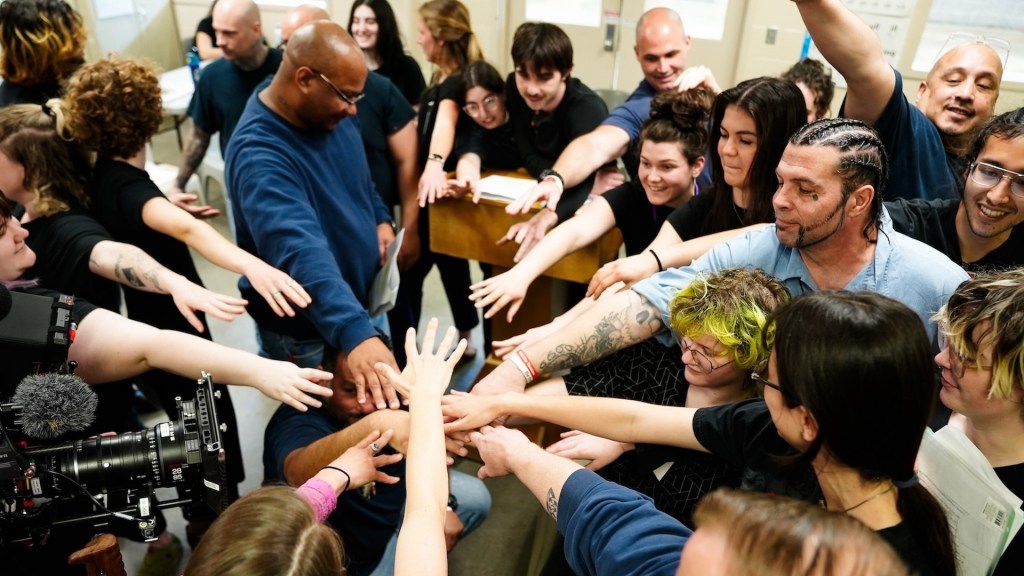
The classroom of the title is located within the walls of Columbia River Correctional Institution in Portland. There, Prof. Hillyer leads a group of 30 students — 15 from “inside” (that is to say, inmates) and 15 undergraduate students from “outside” (in other words, free) in a semester-long exploration of the history of crime and punishment in the United States.
The film, winner of the Jury Award for Best Documentary at the Aspen Film Shortsfest and Best Documentary at LA Shorts International Film Festival, is directed by Eden Wurmfeld, who first met Hillyer when they were 7th graders in New York City.
“I’ve been hearing about this program since [Reiko] started participating in it [in 2012],” Wurmfeld tells Deadline. “It’s called the Inside-Out Prison Exchange Program. And it’s actually an international program, and teachers of any discipline can take the training and offer classes… I think for me, the film is as much about the encounter between these two groups, these two unlikely groups — and they’re learning from each other and with each other — as it is a testament to the power of incredible teaching and the gift of that.”
As the first class begins, students take seats in plastic chairs arrayed in concentric circles (the undergrads on the inside circle, facing students from the correctional facility). Prof. Hillyer opens with ice breakers, asking students to “fill in the blank” to various sentences, including “You might be surprised to learn that I ___,” and “The quality I value most in a friend is ___.”

Joey, at right, with a student from “outside.”
PBS/POV Shorts/Eden Wurmfeld Films
In a sense, this serves as an ice breaker for the audience as well, who may, at first glance, find the inmates a bit intimidating (one prisoner, Joey, reveals that he deliberately got tattoos once behind bars to look tougher – as a form of self-protection).
“I really wanted to be able to show the relationship between the two groups of students and how separate and how anxious, fearful everyone was at first,” Wurmfeld says, “and how they grew to be a unified group of students studying history and learning from each other and with each other.”
Prof. Reiko Hillyer teaches in ‘Classroom 4.’
PBS/POV Shorts/Eden Wurmfeld Films
Each class – held on successive Fridays for 15 weeks – explores topics that for outsiders might be comfortably academic, but that speak directly to the concerns and experiences of “insiders” – topics like mercy, and the “myths and realities of prison life.” As the film progresses and the discussions deepen, we learn more about the men and what got them incarcerated – their history of abuse as children, for instance, or of drug addiction in adulthood. The seeds of empathy germinate. The men in prison blues come to appear as individuals, as human beings, not as monsters to be feared.
Nick (holding pen) with fellow students in ‘Classroom 4.’
PBS/POV Shorts/Eden Wurmfeld Films
“The voices of the men, to me, were so powerful and I really wanted to have as much real estate as possible for their voices,” Wurmfeld notes. “You go on this transformative ride. I know that even if the film never reaches ‘outside the choir,’ if you will, of people who tend to watch documentaries — and that is a self-selecting group, and I’m definitely in that choir — that this shifted my own preconceived notions that maybe I didn’t even know I had.”
Among those touched by the documentary is multiple Oscar nominee Edward Norton, who serves as an executive producer of Classroom 4.
“The thing that kind of blew me away about the film was the degree to which it refuses to let you dehumanize anyone,” Norton tells Deadline. “It insists that you see the complex humanity and even the shared empathy between people across these structural divides that we’ve created. And to me, ultimately, it’s so hopeful. It reminds you that we shouldn’t give up on the hope of finding commonality between people… I haven’t watched it with anybody who wasn’t pretty much moved to tears by it.”
Students bond in ‘Classroom 4.’
PBS/POV Shorts/Eden Wurmfeld Films
Norton continues, “It’s a weird phrase, but to me, it made me almost grieve. I think part of why it’s emotional is because you’re grieving for all this lost potential in people and you grieve for the whole society and the way that we’re missing the opportunity in so many ways to connect with each other. I think maybe the thing I think is the most valuable about [the film] is that it has an actual catalytic effect. When you watch it, I think you end up saying to yourself, ‘What opportunities am I missing to be empathetic?’ Here’s this professor, she’s taken her work in American history and she’s turned it into an opportunity to liberate people and open them up and make them think deeper, feel deeper. And it does make you look at yourself in the mirror and say, ‘Am I looking at people reductively and shutting them out? How can I be opening myself up and seeing people?’”
In a voiceover interview in the film, Prof. Hillyer acknowledges that she’s generally brought to tears at least once per class. Her capacity to see potential in people typically dismissed by society may put the professor at odds with the zeitgeist – an era in American life where cruelty seems to have been privileged.
Director Eden Wurmfeld
Sonia Recchia/Getty Images
“We’re living in a time where often compassion is seen as a weakness,” Wurmfeld observes. “And one of the things that I really value about what the film became is that it underscores that empathy can be resistance. And I just believe in that so deeply, and it’s the way I want to carry myself in the world and the way I want to engage. And it does make living in these times maybe all that much harder, but I’m certainly not giving up on it.”
Classroom 4 can be watched for free on the PBS website. Norton praises the documentary for its economy in achieving one of the central missions of cinema – in a total running time under 40 minutes.
“I think the greatest aspiration in film is always to create a feeling of empathy and shared humanity between an audience and each other,” he says. “It’s almost like to bind people together or make people feel their common humanity in one way or another.”