
SubHL: with 22% of consumers relying on creator recommendations, while celebrity influence has dropped sharply to just 3%.
India’s consumption-led growth is entering a decisive new chapter—one that is no longer anchored to its largest metropolitan centres. Tier 2 and Tier 3 cities, emerging urban clusters, and small towns are now at the forefront of incremental demand, entrepreneurship, and long-term economic momentum. Capturing this structural shift, Rukam Capital, an early-stage venture capital firm focused on consumer brands, has released a detailed consumer research report titled Beyond Metros: The Real Story of Bharat’s Next 500 Million.
The report arrives at a time when India’s economic centre of gravity is visibly moving beyond metros. Nearly 65% of the country’s population resides in Tier 2, Tier 3, and rural regions, supported by GST-led formalisation, improving affordability through tax rationalisation, and the rapid expansion of digital public infrastructure—from near-universal 3G/4G access to the deep integration of UPI into everyday transactions. Together, these forces position Bharat as the primary engine of India’s next phase of consumption growth.
A Distinct Consumer Logic Outside Metros
Moving away from metro-centric assumptions, the report highlights that consumption in Bharat follows a fundamentally different behavioural logic—shaped by context, community influence, value discipline, and digital-first habits. Today’s non-metro consumer is not impulsive or easily swayed by advertising. Instead, they are increasingly informed, research-driven, and trust-led, demanding proof, relevance, and reliability from brands before committing to a purchase.
Commenting on the findings, Archana Jahagirdar, Founder and Managing Partner, Rukam Capital, said that Bharat has long been viewed through a metro lens, limiting how brands understand its consumers. “What we saw through this study is a far more confident and deliberate consumer—one who researches deeply, relies on community validation, and values consistency over hype. The opportunity lies in building trust early and designing for real, local use cases,” she noted.
From Advertising to Evidence-Led Discovery
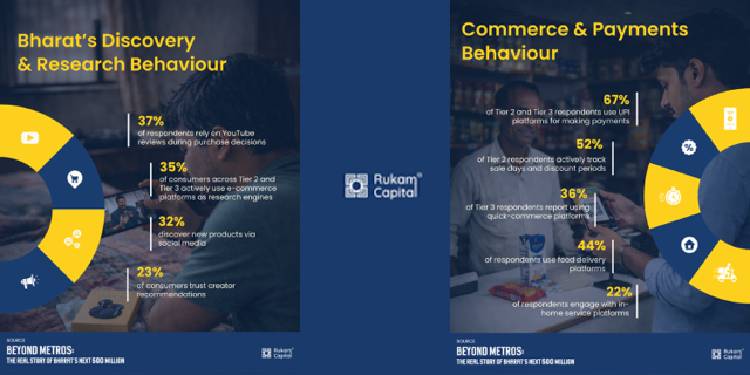
One of the report’s most significant insights is the shift in discovery patterns. In Bharat, discovery is now decisively video-first and social-led. YouTube has evolved from a validation platform into a primary discovery channel, especially in Tier 3 markets. Around 37% of consumers rely on YouTube reviews, while 32% discover products via social media. Importantly, 35% of Tier 2 and Tier 3 consumers use e-commerce platforms as research engines, well before the point of purchase.
This evolution has also reshaped influence dynamics. Creator-led recommendations now influence 23% of consumers, while celebrity endorsements have dropped to nearly 3%, challenging long-held beliefs around aspiration-led advertising in non-metro India. Relatability, real-world demonstration, and lived experience matter far more than star power.
Trust as the Core Currency
Trust emerges as the single most decisive driver of consumption in Bharat. Word-of-mouth influences 22% of consumers, underscoring the role of community validation. Verification behaviours are equally strong: 43% of Tier 3 consumers check official brand websites before purchasing, and 32% factor customer service interactions into their decision-making.
Rising awareness around safety, ingredients, and sustainability further reflects a more conscious consumer. Nearly a quarter of respondents are influenced by eco-friendly claims, particularly when reinforced through peer reassurance rather than marketing narratives.
Value-Driven Commerce and Digital Discipline
Bharat’s spending patterns reflect intention rather than impulse. UPI has become the default transaction layer, used by 67% of consumers across Tier 2 and Tier 3 markets. While over half of Tier 2 consumers actively track discounts and sale periods, festivals continue to play a stronger role in discretionary spending in Tier 3 regions.
Instant gratification remains limited. Quick-commerce adoption stands at 36% in Tier 3 markets, food delivery at 44%, and in-home services at 22%, indicating uneven maturity across service-led categories.
Platforms, Media, and the Rise of Utility
The report positions WhatsApp as Bharat’s digital backbone, with nearly 90% penetration, functioning simultaneously as a communication tool, discovery channel, and commerce enabler. OTT consumption is driven by mass moments and vernacular relevance, with JioHotstar leading usage across Tier 2 and Tier 3 markets. Vernacular OTT platforms resonate strongly, particularly in Tier 3 regions, reinforcing the need for language-first engagement.
Gaming also emerges as a high-intent influence channel, with over half of consumers in Tier 2 and Tier 3 markets responding positively to in-game advertising—highlighting its potential as a credible, high-attention medium for brands.
The Growth Story Ahead
Conducted in collaboration with YouGov, the survey spans over 5,000 respondents across 18 states, representing both urban and semi-urban India. As the country moves toward a $1 trillion retail economy, the report underscores a clear reality: Bharat’s next 500 million consumers are no longer emerging—they are already shaping demand, narratives, and markets.
For brands, startups, and policymakers, the next decade of growth will belong to those who understand how Bharat discovers, validates, spends, and defines aspiration—on its own terms, far beyond the metros.