
A Knight of the Seven Kingdoms is a different kind of Game of Thrones show, and Ira Parker is a different kind of Thrones-verse showrunner.
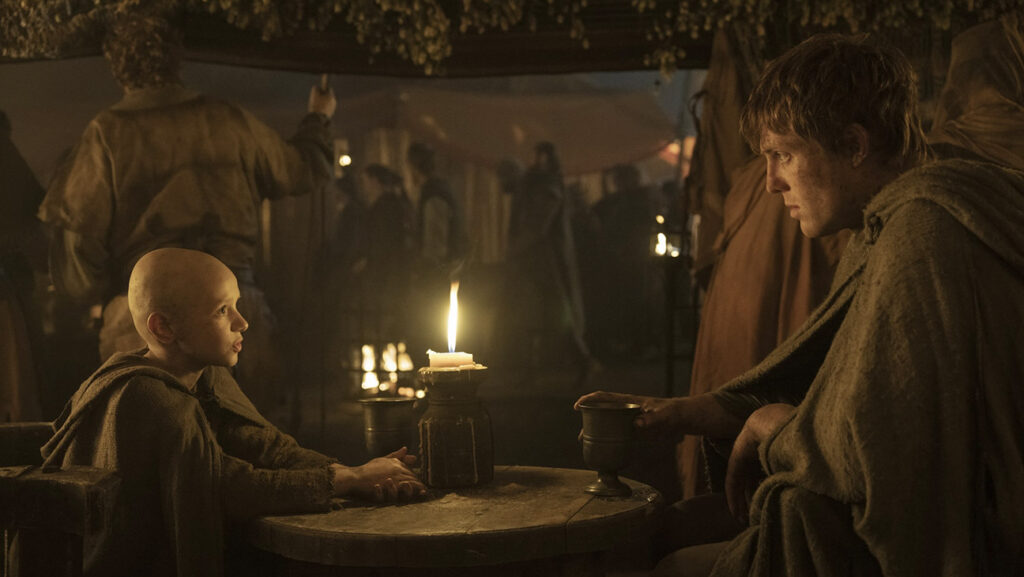
As you’ve probably heard, the new HBO drama series tells the story of a penniless wandering “hedge knight,” Ser Duncan the Tall (Peter Claffey), and his 10-year-old squire with a secret, nicknamed Egg (Dexter Sol Ansell), as they enter a jousting tournament to try and improve their fortunes. The series doesn’t have magic, dragons or big battles. The tone is lighter than the original show or House of the Dragon. Also, at just six episodes, the season is quite short — and goes by faster than you might think as many episodes are less than 40 minutes long.
Parker’s credits include the first season of House of the Dragon and Better Things. He comes across like a massive fan of George R.R Martin’s fantasy world who feels humbled and fortunate to have gotten the keys to HBO’s next Westeros kingdom — and really doesn’t want to muck it up.
The resulting show is a real charmer (read The Hollywood Reporter‘s review) and a slow burn. Unless you’ve read series co-creator Martin’s novella The Hedge Knight, you’re not going to know how its assortment of characters and story threads relate to one another. But at a certain point along the way, the story elements suddenly come rushing together and the result is thrilling.
“We’re not throwing a kid out of a window in the very first episode,” Parker says. “But just, like, give us a second.”
THR spoke to Parker for this week’s cover story profile of Martin. Below is a more expanded version of some of his spoiler-free comments about the show — and how he knows of 12 secret Dunk and Egg tales for potential future seasons.
When you pitched your vision for this to HBO, what did you say that you think helped get you the gig? Aside from, presumably, “It won’t be expensive.”
I actually don’t think I pitched for this. They just gave it to me. [HBO drama head Francesca Orsi] sent me a text or email at four o’clock in the morning: “What do you think about Dunk and Egg?” And I spent a week just getting everything together. I had 15 pages of things that I was going to pitch to them and have this big, long conversation. Then when I got on the phone with them and realized I already had the job. I just immediately shut my mouth.
The biggest thing that was very helpful was learning the show didn’t have to be 10 episodes, one hour each. Being able to do six episodes, anywhere between 30 or 40 minutes, was perfect for us. It meant we didn’t have to stretch the story. It meant that we could do a faithful adaptation of this – which obviously is very much what George wanted, and what I was very keen to deliver one because I’m a big fan of these novellas. This way, the stuff we did add doesn’t feel tangential. It feels like it’s filling out these novellas in a way that hopefully George would have done if he had just written them as novels instead of 80-page nuggets.
It feels like just the right length. What kind of insight did George give along the way that was valuable?
First, just having George be available whenever you need him is very helpful. He and I had a lot of conversations early on. I spent a weekend in Santa Fe with George when HBO had brought this up to just have a conversation and see how he feels about all this. After that went well, I came back for a full week.
Yes, George puts together these writer summits for all the potential shows.
Yeah it’s George and some of his favorite authors. We spent some time together, just breaking it all out and throwing ideas around. It was one of the most fun, creative weeks I’ve ever had in my whole career. Then I went away to write the pilot and George was there any every step of the way. He was very supportive and he read the first drafts of every episode, and he gave me pretty timely feedback — he didn’t pull any punches. He was always very open to conversations. In my very first meeting with George, even before I officially had the job, I promised him I wouldn’t put anything in that he didn’t want. But it’s never come to that. He’s pushed back on a lot of things. I just explained the reason why I wanted to do something, and then he would explain his reasons why I’m an idiot.
So the first season had a modest budget for a Thrones show. Do you think with season two — based on Martin’s second Dunk and Egg novella, The Sworn Sword — you’ll be allowed to expand the scope a bit more? Will it still be six episodes?
It’ll still be six episodes. I think the scope will be same, maybe even smaller. The budget has stayed the same, but everything is more expensive due to inflation. Plus, book two takes place in a drought, so we can’t shoot exteriors in Belfast. We have to go to a sunny location with no water, which costs money — that’s a major expense that we did not have in season one. I’m having a lot of fun season two. It’s going to be a different season, and, I hope, for the better.
I sure you’re going to be happy not to be freezing in Belfast in a field for three months though.
I’m in Belfast right now and, yeah, it’s cold. But I’m from Canada and I get a couple weeks every winter where it’s minus 30 degrees. This is pleasant!
When I was talking to George, he was stressing about how he’s only written three Dunk and Egg novellas which would cover three potential seasons. So are you concerned that, like with the original show, that Knight will get ahead of the books?
Even though we don’t have the ins and outs of every story, we know canonically the major beats of Dunk and Egg throughout their lives. So we wouldn’t necessarily run into the same trouble as the flagship did. And George has outlined 12 more of these stories that he’s shared with me. These stories take them all the way through their lives. Some of these are just a paragraph, but they give you a sense of where they’re going to go and the people who come back in and out of the story.
And, look, I hope everybody likes this and I hope we get to do more. But I don’t have a crystal ball. I actually don’t know — in spite of how long I’ve been doing this — what it is that audiences really respond to. Everybody likes to think they know, right? But at the end of the day, we are Game of Thrones without all the stuff. We have some trees and we have some horses. What was it [that made the original show a hit]? Was it the dead coming to kill mankind? Was it the dragons? Was it the politics? Seeing a different family every week? Or just the epic-ness of the original and of House of the Dragon?
Or is it the hope that I have? We have one of the ingredients: Two unusual characters — like Arya and the Hound, or Brienne and Podrick — who are paired together and having conversations. I hope that’s what [made Thrones work]. It’s a big part of what it was for me. So I hope we get to make as many of these as possible. I would say HBO’s plan is for us to do the three novellas, and that’s it. But I would do 12 of these. I would do four now, then four more 10 years from now, and then four more 10 years after that — take them all the way through their lives and just like [Richard Linklater’s Boyhood].
To me, Dunk and Egg is one of those concepts in the canon where you can go on and on because the story is not intensely serialized. Each is a stand-alone, anthology style adventure.
Yeah. Is there anything else you want to know about George? He’s just the loveliest. Honestly, I think of him like a friend now. He’s really sweet and been nothing but a benefit. He cares about his people.
Yes, he definitely cares a lot about his characters.
Yeah, and that’s probably why these shows have done so well. He really does push people in a good way. But I actually meant he care about his people — not his characters. The people around him. He’s just got a lovely group of people. He really wants everybody to do well and succeed.
For more on A Knight of the Seven Kingdoms, see this week’s Hollywood Reporter cover story: Heavy is the Crown: Inside George R.R. Martin’s Triumphs and Torments.