
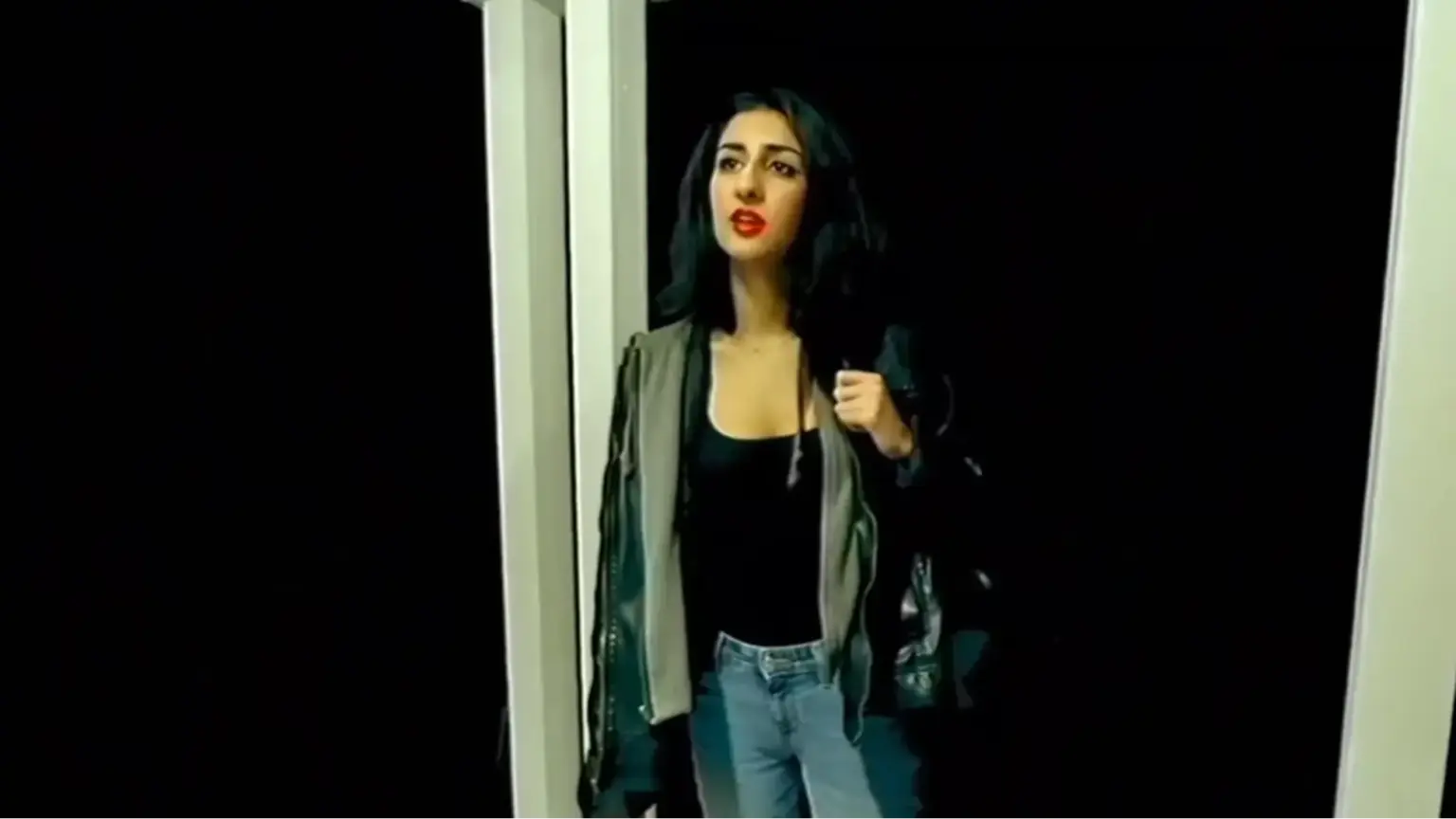
Amna Mehmood as Amna in Dooba Dooba. (Image via Dark Sky Films)
Dooba Dooba starts like a simple babysitting job, but it quickly reveals itself as a controlled nightmare built around surveillance. Written and directed by Ehrland Hollingsworth, the found footage horror film uses in-home security cameras to track every move Amna makes inside the Jefferson house.
Amna Vegha plays Amna, an aspiring singer taking the gig for quick cash, while Betsy Sligh plays 16-year-old Monroe, a teen her parents insist cannot be left alone. Erin O’Meara and Winston Haynes play Taylor and Wilson, Monroe’s parents, who sell the story that Monroe has severe anxiety after witnessing her brother Roosevelt’s murder.
What makes the night feel “off” right away is the family rule that Amna must announce herself by yelling, “Dooba Dooba.” It is presented as a comfort tool for Monroe, but the repetition soon feels like permission-based movement in a house that is always watching. By the end, Dooba Dooba stops being about a rough shift with a troubled teen and turns into a trap that was never meant to let Amna walk out.
What happens in Dooba Dooba, and who is chained outside? Full recap and ending explained from Amna’s arrival to the “switcheroo” twist
Dooba Dooba opens like a compiled tape instead of a normal movie scene, mixing presidential imagery, static-filled shots of a suburban home, and a title card that frames the footage as Monroe’s final project. That setup matters because the film constantly reminds the viewer that someone is shaping what is being shown, and the cameras are not neutral. The house is introduced like a specimen, with exterior angles lingering in the backyard and a small shed that looks insignificant at first, but becomes the most important location later.
Amna arrives at the Jefferson home on a tense Friday night, greeted through a door camera view that already makes her feel observed. Wilson and Taylor act overly polite, but the conversation slips into discomfort when Wilson fumbles her name and blurts, “It’s these ethnic names,” before trying to smooth it over with, “Think of it as reparations.”
They explain the security system as a trauma response, saying Monroe saw her brother, Roosevelt, killed by an intruder years earlier. They also teach Amna the safety rule that controls the whole night, telling her to call out “Dooba Dooba” whenever she moves through the house so Monroe will not panic.
Monroe does not appear at first. She stays hidden, forcing Amna to speak the phrase again and again just to cross a hallway. When Monroe finally comes out, she feels less like a scared kid and more like someone performing fear on demand. She is awkwardly intimate, asking questions that prove she has researched Amna online, including her music dreams and personal life.
The dynamic shifts fast when Monroe starts pushing a game like an interrogation, turning bonding into control. During “Truth or Dare?”, the house stops feeling like a workplace and becomes a locked set where Amna is the target. Monroe’s mood swings become the weapon, switching from apologetic to violent without warning, and at one point, she lashes out physically. Her sudden vulnerability only makes it worse, because it keeps Amna emotionally stuck in the room.
As the night escalates, the footage itself begins “misbehaving.” Cameras skip forward, rewind moments, and cut away at the exact second something important happens. The film keeps dragging attention back to the property lines, especially the backyard angles facing the shed.
The first time the ending clue lands, it is easy to miss. A figure appears outside, chained and contained, seen in fragments through grainy distance shots. Later, the film confirms it more clearly, showing a captive boy held near the shed, as if the house has been hiding a secret in plain sight.
That prisoner’s reveal flips the Jefferson family story. If a boy is chained outside, then the “Roosevelt was murdered” explanation starts to sound like a cover, or at least an incomplete truth. The ending makes it feel possible that the chained child is Roosevelt himself, kept alive and hidden rather than buried. It also leaves room for a darker option, that the family cycles through captives, and the “murder” story is just the version they tell outsiders to justify their control and surveillance.
Amna’s last desperate move is the “old switcheroo.” She gets a call that could change her career, a chance to meet a music connection that might finally move her out of struggling mode, and she tries to take it as an escape hatch. Since she cannot safely leave Monroe alone, she calls her identical twin sister Ana and asks her to cover the rest of the shift. On paper, the swap sounds like a clean exit, but the ending makes it clear the house is built around replacement. Doubling is not a loophole here. It is the entire design.
So did the switcheroo save her? The final stretch strongly suggests no. The doubling turn only feeds the machine, because the Jefferson setup is not about one babysitter or one night. It is about trapping someone inside a system where cameras control the narrative, and bodies become interchangeable. Whether it is Amna or Ana who ends up stuck, the ending lands on the same conclusion. Someone is always meant to stay.
Dooba Dooba ending explained: Why the Jefferson “trauma” story unravels once the prisoner is revealed
The prisoner outside is the clearest proof that Monroe’s anxiety story is not the whole truth. The family frames Monroe as fragile, but her behavior reads differently once the captive child is seen. She is not simply reacting to fear. She is rehearsed, manipulative, and often one step ahead, like she knows exactly what the house is meant to do to a visitor.
The film also quietly implies Monroe is filming beyond the security system, collecting her own angles and reactions, which matches the “final project” framing from the opening. That means Amna is being watched, tested, and documented from multiple layers at once. The parents leaving, the cameras glitching at key moments, and the shed shots returning as a warning all build toward one conclusion. The house is not protecting Monroe from an intruder. It is protecting the family’s secret from getting out.
By the time the parents return early, the tone changes again. The night stops being a teen horror spiral and becomes something closer to a controlled capture. The presence of a chained child outside confirms that the Jefferson home is not a safe space gone wrong. It is a system that has been running for a long time.
What does Dooba Dooba really mean in the ending? The codeword twist and the movie’s real message
In the beginning, “Dooba Dooba” is sold as a harmless safety call, a sound that helps Monroe feel secure. By the end, it becomes the opposite. The codeword is the house’s control mechanism, forcing Amna to announce herself as if she were requesting access to each room. Every time she says it, she is following rules made to manage Monroe’s emotions, but also to track Amna’s presence like a subject in an experiment.
That is why the movie keeps cutting to presidents and power imagery. The Jefferson family’s names and the film’s montage choices underline authority, entitlement, and ownership, with the house acting like a miniature version of institutional control. The “switcheroo” twist fits that message because it proves the trap does not depend on one person. It depends on the idea that someone can be swapped in, contained, and kept.
The ending leaves one haunting image behind. Someone is chained outside, and the cameras keep rolling, which suggests the cycle continues long after the footage stops feeling like a movie.
Stay tuned for more updates.