
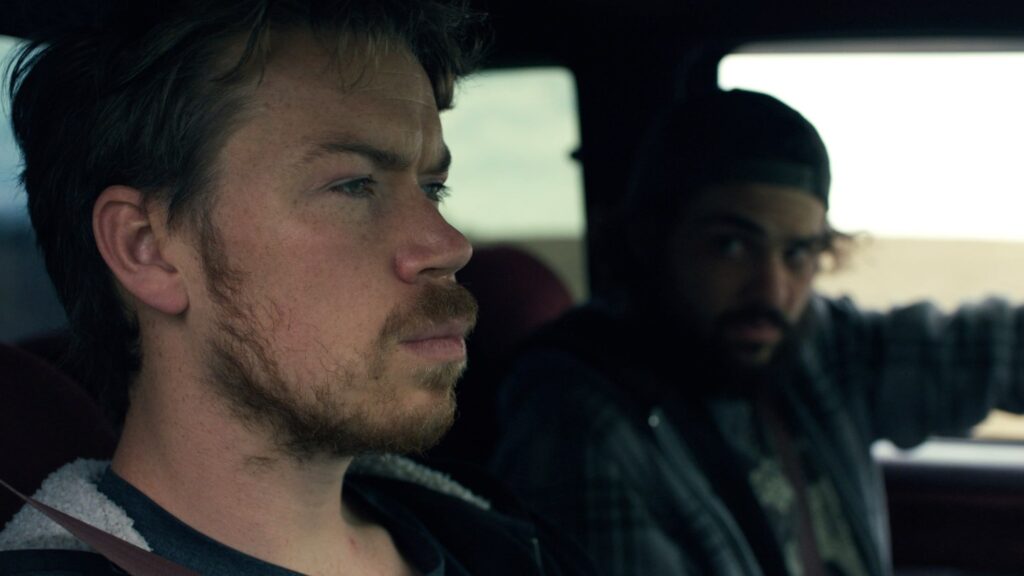
Playing brothers who represent two contrasting types you might find at a Narcotics Anonymous meeting — the taciturn young man burdened by bad choices and resolved this time to stay clean; and the twitchy extrovert whose spark-plug energy suggests his dedication to recovery might be more tenuous — Will Poulter and Noah Centineo fully immerse themselves in the bleak, slice-of-life world of Union County. Writer-director Adam Meeks builds on his haunting 14-minute short film from 2020 with skill, care and binding empathy for rural Ohioans battling opiate addiction.
Does the feature-length version add significantly to the more succinct drama of a very similar story in the short? Yes and no.
Union County
The Bottom Line
Low-key to a fault, but bristles with authenticity.
Venue: Sundance Film Festival (U.S. Dramatic Competition)
Cast: Will Poulter, Noah Centineo, Elise Kibler, Emily Meade, Annette Deao, Danny Wolohan, Kevin P. Braig
Director-screenwriter: Adam Meeks
1 hour 37 minutes
Scaling up has allowed Meeks to deepen our exposure to a blue-collar milieu and smalltown setting not far from where he grew up, to which he clearly feels a strong connection. It provides greater access to the unselfconscious nonprofessionals telling their stories as part of an 18-month sobriety support program. And it makes an affecting showcase for the actors seamlessly woven in among them, with Poulter and Centineo — both part of the ensemble in Alex Garland’s Warfare — at the top of the list.
On the downside, stretching the run time creates pockets of inertia in which the moroseness becomes draggy and one-note. There’s a lot to be said for the skill required to tell a multidimensional story with dramatic, thematic and emotional substance in under a quarter-hour. Meeks achieved that in the short, with a transfixing balance of trenchancy and poetry that’s only intermittently matched here — and sometimes diluted.
Still, this is an admirably serious-minded attempt to go inside a troubled community that most of us would go out of our way to avoid — showing compassion for a struggle that can frequently be one step forward, two steps back.
With a loping gait and hunched shoulders that point to rock-bottom self-esteem, Poulter plays Cody Parsons, who turns up for his first court session in the program looking relatively clean-cut and respectable among a bunch of messier stoner types. Submitting without complaint to the required weekly urine test for drugs or alcohol, Cody seems ready to do the work. He has secured a job at a local lumber mill and is saving to get himself out of his car, where he’s been living, parked in an isolated spot in the woods, and into stable housing, which the judge (Kevin P. Braig, whose day job is on the bench) points out is a program requirement.
One of the first things you notice in Meeks’ sensitive handling of this encounter between lawbreakers and court authorities is the absence of the usual Us vs. Them tension. While it’s conducted under judicial supervision, the program is very much community-based, with the aim being to give and receive help, having seen too many lives broken by the opiate epidemic. That includes people losing their homes, jobs and children, as well as fatalities.
Playing a version of herself with genuine warmth, recovery liaison counsellor Annette Deao speaks up on Cody’s behalf to say that both the men’s shelter and the homeless shelter are full, and they are looking into other housing alternatives.
While Cody is subdued in the court, his brother Jack (Centineo) is the opposite. Wild-eyed and scruffy whereas Cody has made an effort to tidy up, Jack is a jokester who tends to crack wise, making light of the fact that he’s only one week out from a positive drug test and risks being kicked out of the program or sent back to a rehab facility. While he claims to be putting aside part of his wages from the lumber mill to pay off a fine, week after week he admits he has made no progress.
Jack is a party boy who was always close with their sister Kat (Emily Meade) while Cody was the quiet outsider. At a gathering of locals around a fire in the woods, Cody sits shyly chatting with new acquaintance Anna (Elise Kibler) while Jack is furiously making out with her friend. But for reasons that become clear later in the drama, Cody feels guilt and responsibility toward Jack even at his most out-of-control, while his history with Kat includes things she finds hard to forgive.
Union County takes some predictable steps as characters relapse, one of them with tragic results. But it builds real pathos with some shattering moments, and without any big wordy arias, the movie illustrates just how much effort and commitment the struggle requires. Some people just don’t have it in them to beat the illness when a fix is only a quick stop to a supplier away.
Meeks makes restrained use of Celia Hollander’s gentle, chiming score as the story moves through setbacks and promotions, all shared in the courtroom or in recovery group meetings and prompting sad but sympathetic understanding or encouraging applause. The brief snippets in which program participants give an update on their situations are so engaging it’s a shame Meeks didn’t include more of them.
But the movie’s chief strength is the lead actors. Centineo plays a good-time dude all of us have encountered at some point, and while he’s a frustrating figure, he’s also a moving case study whose failings are a pattern he’s unable to break — or perhaps doesn’t want to.
Cody feels things more deeply even if he tends to keep them inside. Still trying to find atonement for past mistakes, he occasionally messes up and is forced to start almost from scratch again, with a sense of shame that Brit actor Poulter conveys with infinite sadness. His scenes with Kibler’s Anna are lovely, showing how rigorously aware people in recovery need to be about their choices, and the awkward tension of his exchanges with Kat are nicely countered by his sweet playfulness around his young nephew.
Meeks is so focused on avoiding melodramatic movie moments that he lets the drama drift and become lethargic from time to time. It’s hard to know exactly who the audience is for glum addiction stories of this nature. While the main actors are excellent, the gains from not just making a documentary instead of this hybrid form, or from multiplying the running time by 10, are open to debate. That said, the community-minded sincerity behind Union County cannot be questioned.