
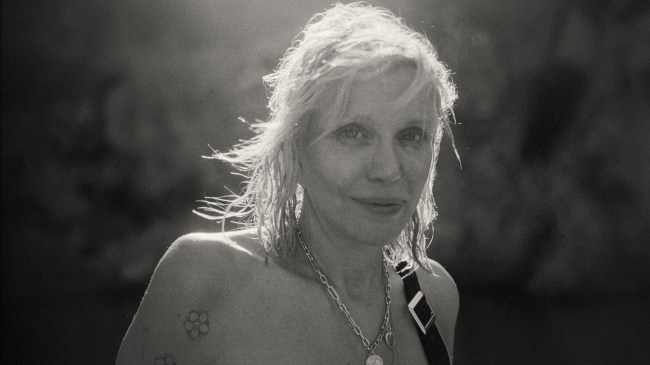
By all accounts, or at least the account according to the new documentary “Antiheroine,” 61-year-old Courtney Love should’ve been dead by now. In Edward Lovelace and James Hall’s calculatedly intimate and honest biography film, it’s revealed she took LSD as a child, started drinking on Christmas at age 10, smoked crack, and had a marriage to Kurt Cobain that mostly involved “a lot of drugs in bed.” Known for her brash, outré stage persona in performances and interviews — like taking her top off on David Letterman’s desk in 2004 — Love gets a chance to come back to the party with “Antiheroine.”
The film, which traces her life from early stardom and her relationship to the Nirvana frontman to present-day Love after two unsuccessful aughts records and 15 years out of the spotlight, also doubles as a companion piece to a forthcoming album that features vocals by her friend Michael Stipe (of R.E.M.). But “Antiheroine” is more than that: It’s a gripping portrait of a mercurial talent who likens herself to Medusa, Nancy Spungen, and the Wicked Witch of the East. It’s scratchy and messy in the right places, though occasionally smoothed over in key details about her legal entanglements. The three editors on the film — Jinx Godfrey, Dan Setford, and Daniel Lapira — work from a wealth of home-movie material, concert footage, and archival interviews to tell Love’s story in intimate terms.

That footage also includes new, on-the-fly interviews with Love in London, where she’s recording her new record and where her beloved Pomeranian Bell has just died. Brash confessional moments at home are intertwined with recording sessions in the studio, where Love is electrified by the creative impulse or a new turn of phrase or rhyme scheme. (She balks at her producer’s suggestion that she rhymes “parade” with “charade.” Come on now!)
“You think you can get away with everything, including hanging by a fucking thread,” says Love, and “Antiheroine” certainly reveals a life spent on the edge of one. She grew up with a mother who needed “a mad, lunatic child to feed her narcissism” — and the same one that enabled her drinking at such a small age — and by the time she moved to L.A. to pursue a music career, she was stripping at Jumbo’s Clown Room to pay the bills. Love eventually formed and led the iconic grunge rock band Hole, producing successful albums including “Pretty on the Inside” and “Live Through This” — the latter of which came out the week Kurt Cobain died.
She’d met him in Portland in 1990, and they eventually married in 1992. Her relationship with the Nirvana frontman was tender and intimate, as this documentary movingly reassembles through self-recorded footage of the two. Especially after they fled California for Seattle in the wake of a damning, exploitative Lynn Hirschberg profile of Love in Vanity Fair, where the cigarette the singer/songwriter was holding while pregnant was airbrushed off the cover, but not inconspicuously enough. The LA County Department of Child Welfare went after Love, who went with Cobain to Washington, where they wouldn’t be extradited. It was in those moments, “Antiheroine” shows us, that their relationship was at its peak — but also at its most vulnerable point on the precipice of ruin.
While “Antiheroine” mostly brushes past many of the specific legal issues, including misdemeanor charges, Love faced in the post-Cobain era, this documentary does whet viewers’ curiosity about the events surrounding Cobain’s suicide. Her image as an onstage bad girl was weaponized against her, with fans threatening her life at concerts, leaving at one point shotgun shells on the stage during Hole performances, referring to the manner of Cobain’s death. The whole “was it actually a suicide, or did she have him killed?” mythology gets replayed in mostly cursory terms here, as the filmmakers likely know it’s what many audiences want to see. Heartbreakingly, though, Love reveals that a phone call from Cobain she missed might have been the moment he decided to kill himself in 1994.
So in many ways, “Antiheroine” perversely denies your curiosity elsewhere about the tawdriest bits of Love’s life, including a brief section that references Frances Bean Cobain’s emancipation from her mother in 2009. Most compelling is the section between those two tragedies, Cobain’s death and their daughter’s rejection of Love, when filmmaker Miloš Forman picked her up off the floor and started a war to get her cast in “The People vs. Larry Flynt.” There was Oscar talk for Love’s raw performance as Hustler co-publisher Althea Flynt, though “Antiheroine” shows how fame went to her head, leading her to disband Hole at its artistic apex after the self-referential, radio-friendlier album “Celebrity Skin” in 1998. B-roll of Love on set and during takes on “Larry Flynt,” which was produced by her then-crusader Oliver Stone, proves what a promising actress she was. But not promising enough to drown out her tastes for the bottle, drugs, and more notoriety. Fame is a drug, after all, and Love was a drug addict.
“Antiheroine” reveals what a uniquely sublime wordsmith Love can be, even if witticisms often circle back to substance use: “I don’t want to be everything for everyone. I don’t want to be Budweiser,” she says. The quality of the new music she’s working on throughout the film is open to your interpretation, and the movie sags a bit in its pseudo-profound impulse to tie up loose threads — and with imagery of Love swimming underwater and breaking the surface as a woman reborn. Love may have left the party early and is eager to get back, but the movie doesn’t answer how welcoming the party will be. Regardless, this is a solid biography portrait with enough diaristic candor to compel a relisten to her greatest hits, in life and music.
Grade: B
“Antiheroine” premiered at the 2026 Sundance Film Festival. It is currently seeking U.S. distribution.
Want to stay up to date on IndieWire’s film reviews and critical thoughts? Subscribe here to our newly launched newsletter, In Review by David Ehrlich, in which our Chief Film Critic and Head Reviews Editor rounds up the best new reviews and streaming picks along with some exclusive musings — all only available to subscribers.
Editor’s Note: An earlier version of this story implied that Love may have been drinking alcohol during the making of the documentary; this was not the case, as confirmed to IndieWire, as Love talks about being sober in the film and is seen drinking water and juices throughout “Antiheroine.”