
Outside it’s raining so hard that the sandwich board sign for BJ’s pie and mash (“All pies are made on the premises”) is folded up inside. The pavement along Barking Road in Plaistow is a blur through the front windows and deserted, and there are only two customers in the shop. Another sign – this one on the counter – says “CASH ONLY”.
Card machine companies often tell proprietor Nathan Jacobi that he’s missing out by not catering to customers who favour cashless transactions. “They’re the ones missing out,” he says. “Cos they ain’t getting pie and mash.”
London’s pie and mash shops, once threatened with extinction, seem to be experiencing a kind of resurgence. “London’s original fast food, ‘pie and mash’ is making a surprise comeback in the British capital …” announced the Washington Post in a recent article. “This renewed demand for hearty ‘cockney cuisine’, so-called for its working-class East End roots, has been observed across the city.” The revival is said in part to be down to the TikTok generation’s fascination with these bygone establishments and their obscure customs. M Manze’s in Bermondsey – London’s oldest surviving pie and mash shop, founded in 1902 – has never been busier. At Goddards at Greenwich, the Post reported, there are queues down the street every weekend.
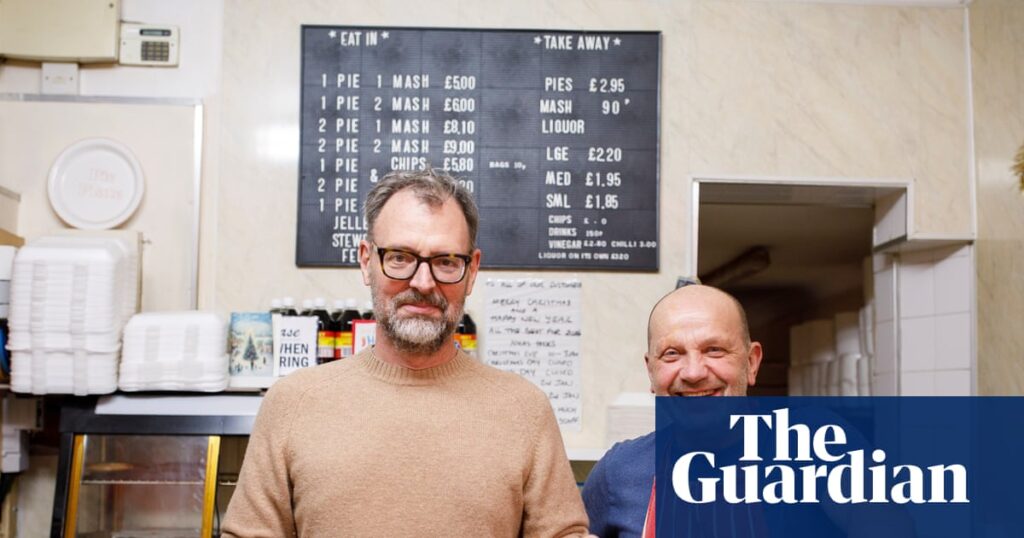
The menu at BJ’s Pie and Mash cafe. Photograph: Alicia Canter/The Guardian
But behind this flurry of enthusiasm is a backstory of unrelenting decline. There are now just more than 30 pie and mash shops in London, where once there were hundreds. On its website the Pie and Mash Club lists five closures in Greater London in 2025 alone, including another Manze’s in Deptford High Street, which shut this time last year after more than a century in business. There was a queue down the street that day, not because it was suddenly cool; it was the end of an era.
But that still isn’t the whole story. Alongside the closures, a few new pie shops have appeared. Barney’s in Walthamstow only opened in 2018. Bush Pie & Mash in Shepherd’s Bush acquired its premises in 2021, filling a gap left by the 2015 closure of A Cooke’s, which had been in nearby Goldhawk Road since the 1930s.
Which picture reflects reality? “It’s a bit of a difficult one to speak about,” says food blogger James Dimitri, who has visited all of London’s pie and mash establishments, bar a few where shops have more than one branch. “A lot of the ones I go to, they’re packed at lunchtimes, from 12 or maybe even earlier.” Others, he says, are doing less well. “There’s one I went to the other day, and it was just a shit atmosphere, kind of dying, and I just know it’s not going to last.”
When it comes to the difficulties facing pie and mash shops, I might consider myself part of the problem: although I’ve lived in London for 35 years, I’ve never set foot in one. It wasn’t the food – beef pies, mash, the classic parsley sauce known as liquor, the eels – that put me off as much as the arcane ritual, the fact that there is definitely a wrong way to order and consume pie and mash. For example: I know that you’re not supposed to use a knife, even if you’re offered one – pie and mash is only ever eaten with a fork and a spoon.
Tim and Don get ready to dig in. Photograph: Alicia Canter/The Guardian
“Those things are slightly intimidating to outsiders, if you don’t know the rules,” says Jonathan Nunn, co-editor of the food and culture magazine Vittles. “There’s an insularity about pie and mash which is one of the reasons why people love it. On the other hand, that insularity is one of the things that makes it difficult – more difficult than British cafes and fish and chip shops – to induct new customers.”
As a precaution I have come to BJ’s with my friend Don, who knows about these things. Don lives just up Barking Road, towards Canning Town. He eats at BJ’s often, and knows enough to have cash on him. He even dropped by the shop earlier in the week to let it be known that he was coming today, and that he would be bringing an idiot with him.
Under Don’s guidance I opt for a single portion each of pie and mash – “one and one” in pie shop parlance. BJ’s is famous, or maybe notorious, for an innovation that amounts in some eyes to heresy: they offer chips as well as mash. “You put this on the internet, that you’ve had pie and chips, the stick you’ll get,” says Jacobi, who runs BJ’s with his wife, Nadine. Worse still, the chips are very good – fried in beef dripping, rather than palm oil. “At least I’m saving orangutans around the world,” he says.
‘A comforting working-class dish.’ Photograph: Alicia Canter/The Guardian
Jacobi sits down with us at one of the long communal tables, to oversee my first pie and mash experience. “I’m supposed to flip the pies over, aren’t I?” I say. “You can, I don’t bother,” says Jacobi, handing me a napkin wrapped around a fork, a spoon and a knife. I think: this is a test.
“It is my understanding,” I say. “That I shouldn’t touch this knife.”
“That’s right,” says Jacobi. “Never use a knife.” But Don, I point out, is using his knife. “That’s cos he’s posh,” says Jacobi. He claims the tradition dates to the second world war, when the pie and mash shops of London donated all their knives to a metal drive. This sounds fanciful, but he says he heard it from a Chelsea pensioner in full regalia.
Pie and mash is a famously under-seasoned dish, which makes the next step crucial: after making Xs in the bottom crust of your flipped pies – with the spoon’s edge, unless you’re Don – you douse the plate liberally with salt, white pepper and chilli vinegar. “You must put the vinegar on, because it changes the meal altogether,” says Jacobi.
As the rain slows, the shop begins to fill up. Jacobi, simultaneously working, holding court and submitting to a fractured interview, clears a table after the departure of a satisfied customer. “There’s another one’s taken the pattern off the plate!” he says. I too am satisfied. The pie and mash was tasty, the chilli vinegar hot. It is simple food, made fresh every day and while some enthusiasts will keep score about which pie and mash shops offer the best fare, that is slightly beside the point.
Two cups of liquor – made with eel stock or potato water. Photograph: Alicia Canter/The Guardian
“What makes one stand out isn’t always going to be the pie itself,” says Dimitri. “Because even when it’s really good, it’s never going to be mind-blowing. It is what it is: a comforting working-class dish.”
I’m thinking: I’ve been here for almost an hour and nobody’s mentioned eels yet. But even as I think it, I see Jacobi coming back to the table with a tub of jellied eels. The pie in pie and mash was originally filled with eels, a cheap source of protein closely associated with London. But as the 19th century came to a close, eel got more expensive, beef got cheaper and the pies were filled with mince to keep costs down. Eels were relegated to a side dish, stewed or jellied – a decidedly acquired taste.
“As a food writer, and as someone who loves London and really wants there to be a great London dish, it’s to my annoyance that I hate jellied eels so much,” says Nunn. “I really cannot stomach them.”
“It’s not a thing that a lot of people have,” says Jacobi, “and it’s mainly older people. My boy will eat it, because he’s been brought up with it.”
Suffice to say that if you don’t like eels, you won’t like them jellied – the jelly, Jacobi tells me, is also made of eel. (Traditionally liquor, too, is made with eel stock, but Jacobi doesn’t keep enough on hand to make it that way every time – alternating batches are made with potato water.)
But an acquired taste should never be too easy to acquire. After working my way through a small plate of eel segments I find myself becoming pleasantly inured. “You did well there,” says Don.
There is an idea that pie and mash isn’t really being eclipsed, it’s just migrating to the suburbs, following on the heels of its former clientele – the white working class of the old East End. But the origin story of BJ’s runs counter to this narrative. “My dad used to be a lagger,” says Jacobi, “but when he pulled out of the company he owned with two partners, he wanted to find something else to do.” In 1979 he started a pie and mash shop in suburban Elm Park – one of the first in Essex – but it was deemed such a threat to the tone of the neighbourhood that the council wouldn’t let him call it a pie and mash shop. “If we’d put that sign out,” Jacobi says, pointing to the sandwich board leaning against the wall, “they’d have closed us down.”
M Manze in Bermondsey, London’s oldest surviving pie and mash shop
Fed up, Jacobi’s father, Benjamin, returned to the East End, bought an old pet shop in Barking Road and opened BJs in 1982. Competition was stiff – there were nine pie and mash shops in Newham then – but crucially Benjamin owned the freehold. “That’s why we’re still here,” says Jacobi. BJ’s is the only surviving pie and mash shop in the borough.
It’s not an easy way to make a living, especially if you’re committed, like Jacobi, to making pie and mash the traditional way. “Tuesdays and Thursdays I mince me own meat,” he says. “Then you’re here at five o’clock every morning, and you’re literally preparing pies for four or five hours. So you’re not earning a penny, you’re just preparing pies. Then you start cooking at 10 o’clock. That’s the worst thing about it, the prep.”
As a highly regarded survivor in the pie and mash world, Jacobi is not unaccustomed to attention. He had an ITV crew in last November, highlighting aspects of the chancellor’s budget. Before that, a TikToker called Ben in the Mix paid a visit. Influencers with cameras drop by regularly. “Best thing,” Jacobi says. “TikTok and YouTube and things like that, helps you out so much. Helps me out anyway.”
But pie and mash bloggers can also be a little bit doctrinaire, and Jacobi resents having points deducted for anything non-canonical, like chips. Another example: he serves his mash in domed scoops, where traditionally it should be scraped on to the edge of the plate to form a little cliff. He even offers gravy as an alternative to liquor, albeit grudgingly. “I always say, I make gravy with water,” he tells me. “I make liquor with love.”
Jellied eels are also an essential item on the menu at pie and mash shops. Photograph: Alicia Canter/The Guardian
Online critics who are new to pie and mash present their own challenges. “One woman gave me three stars because a geezer moaned at her for leaving the door open,” says Jacobi. “It ain’t my fault.” Then there are the Americans who view pie and mash as an exotic curiosity, or a holdover from a previous century, or another example of British cuisine’s manifest shortcomings. When US food critic and social media star Keith Lee came to London last year he ruffled feathers with his blunt assessment of pie and mash, even though he got it about right: “Is it something to rave about? I don’t believe so,” he said. “I just think it’s a comfort food that people are used to going to, and they’ve been going to for years, so they just keep coming back.”
In October 2024 the MP Richard Holden called for pie and mash to be granted traditional speciality guaranteed (TSG) status. In pursuit of that designation, last February, 15 representative producers agreed on a standardised recipe. But would such a designation amount to a lifeline, or a straitjacket?
The pie and mash shop is itself a product of relentless innovation. It sprung up as an alternative to the street pie man, providing four walls and a roof where working people could eat. It switched from eel pie to mince when the economics demanded it. But once pie shops came to be seen as endangered, tradition became the point, and innovation a drawback. Shouldn’t they be able to mutate in order to survive?
‘You must put the vinegar on, because it totally changes the meal altogether.’ Photograph: Alicia Canter/The Guardian
“I like the ones that strictly just do pie and mash and nothing else,” says Dimitri. “The core audience they have, people who visit pie and mash shops, don’t want them to change and get quite angry when they do.”
“I think the presence of liquor is probably the one non-negotiable thing,” says Nunn. “But having the choice of gravy, or vegetarian pies, if those are things that will help pie and mash shops thrive in 2026 London, then I would rather that happen.”
For Jacobi, a simple menu reflects the pie and mash shop’s status as the original fast food. “Some pie and mash shops never used to do tea,” he says, “so they’d have you in and out faster.”
This article was amended on 3 February 2026. A picture caption said the original M Manze shop was in Bloomsbury; however, it is located in Bermondsey.