
Even in the midst of Norway’s biggest royal crisis ever, Members of Parliament have confirmed support for their constitutional monarchy. Public debate is flying, though, over whether Crown Princess Mette-Marit can ever become queen as Norwegians await her explanation of her three-year-long relationship with the late financier and sex offender Jeffrey Epstein.
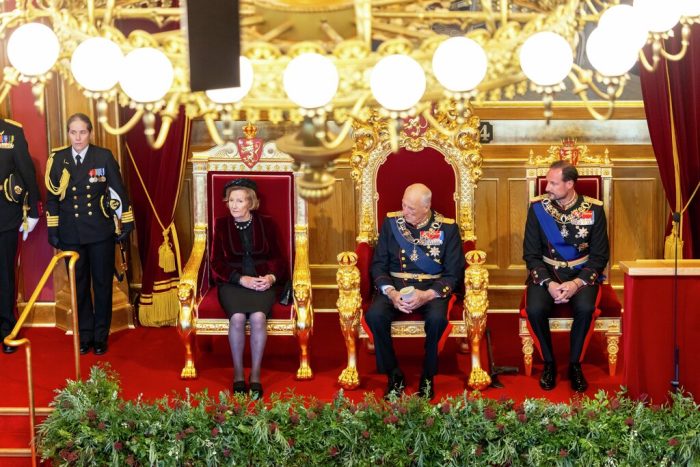 Norway’s Queen Sonja, King Harald V and Crown Prince Haakon Magnus were in place as usual when the Norwegian Parliament formally opened in October for its current session. All three have broad support from most Norwegians, but Haakon’s wife, his sister and stepson have been causing lots of problems. PHOTO: Hans Kristian Thorbjørnsen/Stortinget
It’s been a wild week for the royals, after the US released the so-called Epstein files that reveal his lengthy personal correspondence with, among others, Norway’s Crown Princess Mette-Marit. At the same time, her son Marius Borg Høiby was arrested once again on new charges including assault, just before his court trial on 38 other criminal counts was due to begin in the Oslo County Court.
The Parliament had already scheduled a vote this week on the latest proposal to convert Norway’s form of government from a constitutional monarchy to a republic with a president instead of a king or queen. Such proposals have come up several times before, since a monarchy with power based on inheritance defies Norway’s otherwise democratic principles based on equal opportunity for all.
Despite all the drama within the royal family, only 26 MPs voted in favour of forming a republic when the issue came up, while 141 voted against it. Some MPs stressed in their remarks from the podium that the issue wasn’t a reflection of how good a job the current royal family is doing, rather a matter of principle. Many Norwegians readily admit that a monarchy can seem old-fashioned and out of line with the country’s modern, egalitarian society.
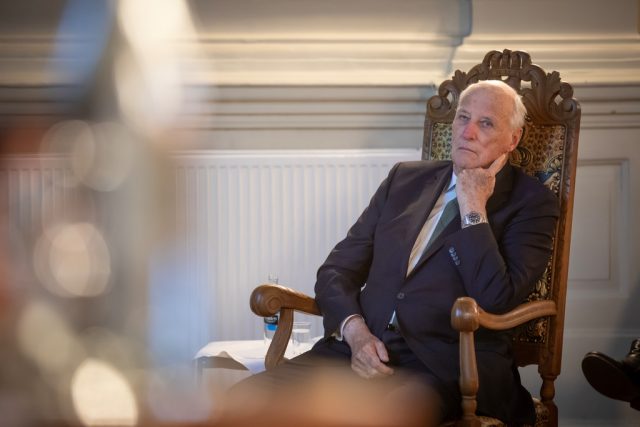 King Harald V, shown here during a military meeting last spring, has had a lot to think about lately but has chosen to stay mum on the drama surrounding his daughter-in-law and her son from an earlier relationship before she met the crown prince. King Harald refused to answer any questions during a public appearance earlier this week. PHOTO: Anette Ask/Forsvaret
A majority still likes the historic and symbolic value, though, of having a monarch as head of state. Many noted how the royal family has long been a unifying factor since Norway became its own sovereign nation in 1905, kept up spirits during World War II and can open doors internationally for a small country with a total population of less than 6 million.
Some MPs ventured to mention their disappointment over Crown Princess Mette-Marit, with the conservative Progress Party’s MP Per-Willy Amundsen even noting that “it can look like the crown princess has kept people in the dark” about her relationship with Epstein from 2011 to 2014, “but that must not overshadow the life-long service the king has carried out for Norway.”
Few MPs think a republic with a president as head of state will be as unifying as the royal family and its future generations. Most not only have great respect King Harald and Queen Sonja (both now age 88) but also for their son Crown Prince Haakon, who’s next in line as monarch. His first-born child, 22-year-old Princess Ingrid Alexandra, is due to succeed him, but she resorted on Thursday to blaming the press for her mother’s embarrassment after her ties to Epstein were revealed.
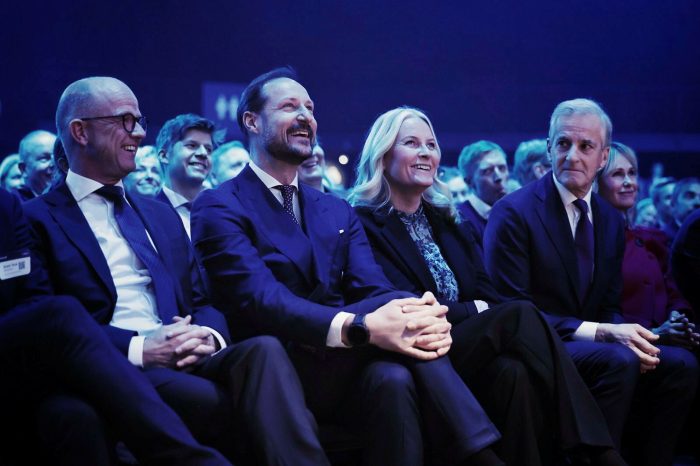 Crown Prince Haakon and Crown Princess Mette-Marit (center) were still smiling when they attended an annual conference hosted by Norway’s large employers’ organization NHO last month. Prime Minister Jonas Gahr Støre is pictured at right. PHOTO: NHO/NTB Kommuniikasjon
It’s Crown Princess Mette-Marit who now faces lots of questions over why she maintained relations with Epstein long after she learned he was a convicted sex offender. Emails released exposed a close, even flirtatious tone between them, she stayed at his home in Palm Beach, Florida, went shopping with him and often wrote that she missed him. He also met her in Oslo.
Newspaper Aftenposten reported this week that photos of Norway’s crown princess taken at his Florida estate in 2013 involved Russian contacts of Epstein. They included a woman who worked as an “assistant” to Epstein and had studied at a Russian university known for educating diplomats and being a recruiting ground for Russian intelligence officers.
There are now nearly as many questions as there are emails in the Epstein files that involve Crown Princess Mette-Marit, some of which raise national security concerns. She has so far refused to answer them. On Monday, Prime Minister Jonas Gahr Støre, who’s been a personal friend of the crown couple, issued a surprisingly strong statement saying he now “expects” Crown Princess Mette-Marit and other prominent Norwegians revealed as having close contact with Epstein to address the questions swirling around them.
“They must answer for themselves and they should shed light on this case,” Støre told reporters. “I expect them to do so.” That includes not just the crown princess, but also former prime minister Thorbjørn Jagland, who also has served as president of the Norwegian Parliament, head of the Norwegian Nobel Committee and secretary general of the Council of Europe. Documents released by the US also reveal lengthy and friendly correspondence between Jagland and Epstein even though Jagland, like Mette-Marit, had tried to downplay or even dismiss it.
Støre stated that both have shown poor judgment in their relations with Epstein, something to which the crown princess had admitted in a brief statement right after her correspondence with Epstein went public: “I think it’s correct to use her own words and say that she has shown poor judgment. I agree with that, and it’s worth saying so when I’m asked about it.”
The prime minister, clearly disturbed by the entire Epstein affair, added that “there is a high ethical standard for those who represent Norway. Given the confidence we place in them, we must expect that they act in an appropriate manner.” The foreign ministry has launched an investigation into one of its most prominent diplomats, Mona Juul, who’s married to Terje Rød-Larsen, both of whom had not only personal but also financial relations with Epstein, according to released documents. Norway’s economic crime unit Økokrim is also “evaluating whether there’s a basis for launching an investigation” as well.
Crown Princess Mette-Marit, meanwhile, has remained mum, as has staff at the Royal Palace. The palace confirmed on Wednesday that she has postponed what was called “a private trip” while her son’s trial was underway, but there’d been no further statements as of Thursday evening.
New public opinion polls have shown that as few as 22 percent of Norwegians questioned think Mette-Marit is fit to become queen. A poll published Thursday that was conducted by Respons Analyse for newspaper Aftenposten showed that fully 57 percent don’t think she should be queen. Carl-Erik Grimstad, a former MP and member of the palace staff who’s written books on the Norwegian monarchy, told Aftenposten that the poll results reflect “a formidable crisis of confidence in the crown princess.” Several humanitarian organizations are also considering dropping her as their royal patron and one already has.
One thing is clear: Only the monarch himself can revoke her royal title. Most don’t think King Harald V will do that, “but he’s the one who decides,” said Ole Jørgen Schulsrud-Hansen, royal commentator at TV2 in Norway. Crown Prince Haakon, meanwhile, has always appeared to be a supportive spouse and most royal commentators think the couple, due to celebrate their 25th wedding anniversary in August, is unlikely to divorce.
That leaves Mette-Marit facing urgent calls to either answer questions swirling around her, make some sort of address to the nation or simply a tearful apology like the one she did when the couple’s engagement was first announced and she needed to atone for her partying past. Grimstad thinks “nothing can be the same after this,” but that the monarchy itself will survive.
NewsinEnglish.no/Nina Berglund