
When King Charles and Queen Camilla were joined by a host of celebrities at Windsor Castle last week, it was billed as the first ever film premiere in a royal residence. Guests mingled on the red (well, green) carpet before making their way to the castle’s Waterloo Chamber for the screening of Finding Harmony: A King’s Vision.
The event was indeed the first full-scale Palace-hosted film premiere. But it was by no means the first time the royal household has promoted film content it has either co-operated with or had a hand in creating. From allowing access for selected documentaries to launching their own video content, the royals have increasingly embraced film to land their message in the internet and streaming age.
“It’s very clear that the royal family are moving with the times and speaking directly to the public via video content through either social media or streamers,” says royal expert Emily Andrews. “They are increasingly trying to take control of the message. It’s not unique to the royal household, it’s happening in all walks of life,” royal journalist Richard Palmer says. “They are trying to get their message out there in many ways.”
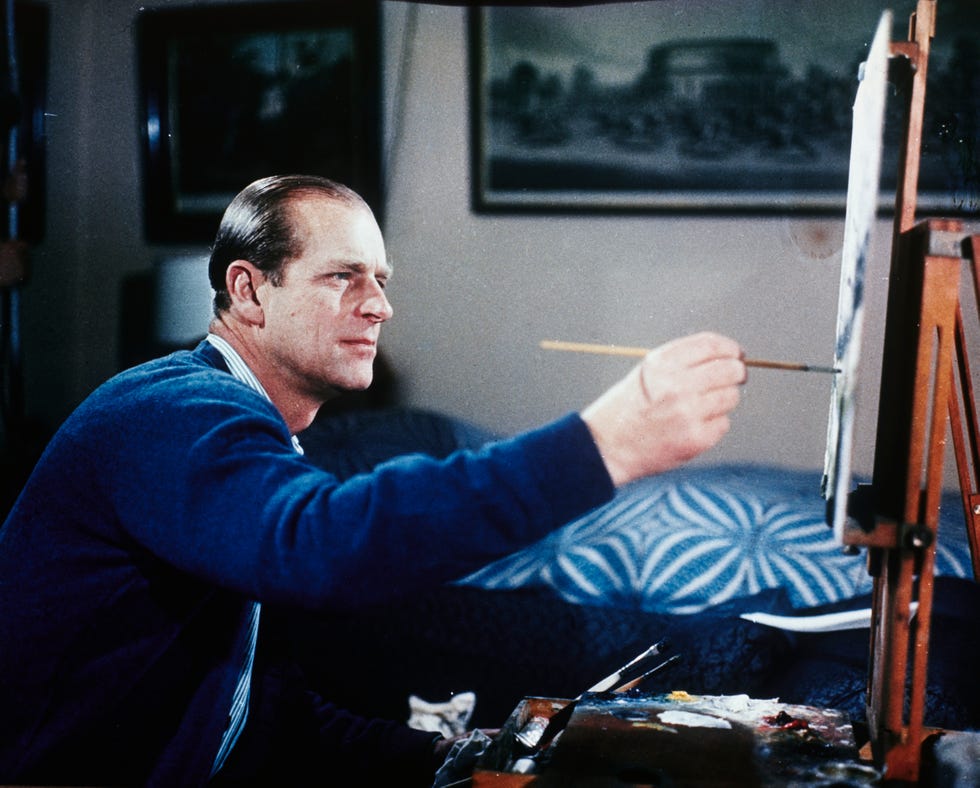
Of course, the concept of documentary film footage with royal co-operation is by no means new—it goes all the way back to the infamous 1969 BBC production Royal Family. Queen Elizabeth is famously believed to have ultimately regretted letting the cameras in. But let’s not forget that from the outset this was very much controlled access—Prince Philip chaired the committee that approved all scenes.
Such prolific behind-the-scenes insight has never been allowed on film again. But in recent years, the royals have co-operated with a spate of select TV documentaries which have showcased aspects of their work or roles.
 Bettmann//Getty Images
A still of Prince Philip painting from the 1969 BBC production Royal Family.
The late Queen famously never gave interviews, but she did engage in on-camera “conversation,” most notably when she spoke with Alastair Bruce for BBC documentary The Coronation in 2018, and with David Attenborough for ITV program The Queen’s Green Planet that same year. The BBC also had access to personal royal footage for 2016 documentary Elizabeth at 90: A Family Tribute, and for 2022 Platinum Jubilee documentary Elizabeth: The Unseen Queen.
“We know that television has the power to change hearts and minds,” Amanda Berry, CEO of William and Kate’s Royal Foundation said in 2024 on the launch of a two-part ITV documentary series about William’s Homewards homelessness initiative, which featured an interview with the Prince. The same year, Queen Camilla was interviewed for an ITV documentary following her work on domestic violence. And in 2025, King Charles spoke to adventurer Steve Backshall for a documentary retracing his steps when he went to the Arctic as a Prince in 1975.
The content of certain documentaries has not gone unnoticed by anti-monarchy campaigners, who criticized the BBC in 2023 for the program they produced when they had “unique” access to the King and Queen in their Coronation year. “I do think that quite a lot of royal documentaries are not balanced. There could be room for more challenge,” says Richard Palmer.
The greatest control of the message comes, however, when royals play a role in producing content themselves. “It cuts out the traditional middle-men of the newspaper and TV news press and it means that the royals have so much more control,” says Emily Andrews. “And commissioning documentaries can allow them to do a deep-dive on causes they want to spotlight.”
Interestingly, the concept of royal family members producing their own content is one often most closely associated with former working royals Harry and Meghan, who stepped back in 2020 and soon after announced their multi-year deal with Netflix. No longer officially representing the institution of monarchy or receiving any public funds, unlike the working royals the couple was paid for the deal. However, it soon became apparent that they were not fully in control of all content, when a source said they had not had editorial control of a trailer for their first program Harry & Meghan that attracted controversy over its use of stock footage. Since then, the couple has gone on to make programs including With Love, Meghan, Heart of Invictus, Polo, and Live to Lead.
However, the working royals have also embraced the idea of having a hand in curating their own content to spotlight a certain cause or message in the way they want it to be understood. Film content launched by working royal family members includes William’s Earthshot documentary, his United for Wildlife docuseries Guardians, Kate’s Mother Nature video series, and her animated film series about early childhood. When the Princess of Wales wanted to let the public know how she was doing following chemotherapy treatment, she did so via an intimate video shot by filmmaker Will Warr. And the royal households routinely now use video in an increasingly-slick way to cover official engagements, employing teams to specifically manage their digital channels.
In many ways, the premiere of Finding Harmony: A King’s Vision is the culmination of the use of film as a medium by the royals to curate their message. Produced by Passion Planet documentary makers in collaboration with Charles’s charity the King’s Foundation for streamer Amazon Prime Video, the feature-length film meticulously sets out the King’s stall. Epic and sweeping footage of the planet is interspersed with intimate scenes of Charles reacting to his own speeches throughout the years. Experts, including the co-authors of Charles’s book Harmony, Tony Juniper and Ian Skelly, give their views on his theories. Their book was published in 2010, but this 2026 film curates the King’s legacy for the next generation.
Recent years have been a reminder that royal family members cannot control the entirety of the narrative around them. But in the internet and streaming age they are making the most of curating their message through film.

Town & Country Contributing Editor Victoria Murphy has reported on the British Royal Family since 2010. She has interviewed Prince Harry and has travelled the world covering several royal tours. She is a frequent contributor to Good Morning America. Victoria authored Town & Country book The Queen: A Life in Pictures, released in 2021.