
12 Black LGBTQ+ Celebs’ Coming Out Stories
I don’t know who needs to hear this again, but representation matters! Full stop. There might be a young, queer kid out there afraid to live their truth until they see their favorite celebrities live their lives out loud and proud. I know that was the case for me.
Here are 12 Black LGBTQ+ celebrities’ coming-out experiences that helped me proudly fly out of the closet with a proverbial rainbow cape:
1.
Grammy-Award winning singer/songwriter Frank Ocean famously penned a heartfelt open letter on Tumblr in 2012, ahead of the release of his first major album, Channel Orange, in which he revealed his first love with a man. “what I’m about to post is for anyone who cares to read. it was intended to fill the thank you’s section in my album credits, but with all the rumors going around.. I figured it’d be good clarify…,” he began.
Frank continued, “Before writing this I’d told some people my story. I’m sure these people kept me alive, kept me safe.. sincerely. These are the folks I wanna thank from the floor of my heart. Everyone of you knows who you are.. great humans. Probably Angels. I don’t know what happens now, and that’s alrite. I don’t have any secrets I need kept anymore.”
In the once-surprising letter, Frank explained that, ultimately, the relationship with the mystery man didn’t work out, but it changed his perspective on life. “I’ll remember who you were and how we’ve both changed and stayed the same,” he said. “I’ve never had more repsect for life and living than I have right now.”
2.
On the last day of Pride Month in 2019, rapper Lil Nas X came out as gay, pointing toward his song “c7osure” from his second EP titled 7. “some of y’all already know, some of y’all don’t care, some of y’all not gone fwm no more,” he wrote in a June 30, 2019 tweet. “but before this month ends i want y’all to listen closely to c7osure.”
The lyrics of “c7osure” began, “True say, I want, and I need to let go, use my time to be free.” The post-chorus of the track stated: “Ain’t no more actin’, man that forecast say I should just let me grow/No more red light for me baby, only green, I gotta go/Pack my past up in the back, oh, let my future take ahold/This is what I gotta do, can’t be regrettin’ when I’m old.”
If people were picking up what Lil Nas X was putting down, he shared another tweet with the artwork from “c7osure” that read, “deadass thought i made it obvious,” seemingly referring to his sexuality.
3.
Emmy-award-winning actor Niecy Nash-Betts revealed her relationship with a photo of her and wife Jessica Betts in a surprise Instagram post in August 2020, alongside the caption “Mrs. Carol Denise Betts 💍 @jessicabettsmusic #LoveWins🌈 📸 @robertector.”
In a profile for Out, Niecy shared how she didn’t initially see the news of her wedding as a “coming out.” But, the When They See Us actor later acknowledged that she understands how the representation of their relationship “matters” at the end of the day.
“It’s very, very powerful, we’ve learned,” Niecy said. “Because any time we go to an event that is especially for queer people, someone always comes up and brings it up,” she said. “I think authenticity is one of the most beautiful attributes you could ever have. To just be 100 percent who you are and allow people to see your happiness, you know what I mean? And see that I’m in a situation that brings me joy, and for that to be celebrated, especially at such a time as this, is a beautiful thing.”
4.
Hunger Games and Star Wars: The Acolyte actor Amandla Stenberg took over Teen Vogue’s Snapchat in 2016 and officially came out as bisexual. “It’s a really really hard thing to be silenced and it’s deeply bruising to fight against your identity and to mold yourself into shapes that you just shouldn’t be in,” she said.
Amandla continued, “As someone who identifies as a black, bisexual woman I’ve been through it, and it hurts, and it’s awkward and it’s uncomfortable…but then I realized because of Solange [Knowles] and Ava DuVernay and Willow [Smith] and all the black girls watching this right now, that there’s absolutely nothing to change.”
“We cannot be suppressed,” she said. “We are meant to express our joy and our love and our tears and be big and bold and definitely not easy to swallow…Here I am being myself and it’s definitely hard and vulnerable and it’s definitely a process but I’m learning and I’m growing.”
In a 2016 Teen Vogue profile, Amandla explained why she publicly identifies as bisexual. “I would also use the word pansexual to describe my sexuality. The thing is I use the word bisexual just because I feel like for people who don’t necessarily know that vocabulary… it’s easier to say I’m bi,” she added. “So, I understand that erasure piece.”
5.
“Make Me Feel” singer Janelle Monáe came out as a pansexual in a 2018 interview with Rolling Stone. “Being a queer black woman in America,” they began, “someone who has been in relationships with both men and women – I consider myself to be a free ass motherfucker.”
Janelle once alluded to being bisexual, but their response evolved as they learned what pansexuality means. “Later I read about pansexuality and was like, ‘Oh, these are things that I identify with too,'” Janelle said. “I’m open to learning more about who I am.”
When speaking of their third studio album Dirty Computer, which includes themes of sexuality and identity, Janelle said, “I want young girls, young boys, non-binary, gay, straight, queer people who are having a hard time dealing with their sexuality, dealing with feeling ostracized or bullied for just being their unique selves, to know that I see you.”
6.
Writer and actor Lena Waithe drew from her real-life coming-out experience as inspiration for the Emmy-winning episode of Netflix’s Master of None, in which she portrayed Denise, who came out to her mother as a teenager on Thanksgiving. In the episode, her mother (played by Angela Bassett) says, “I just don’t want life to be hard for you. It’s hard enough being a Black woman in this world. Now you want to add something else to that?”
Speaking with Out Magazine, Lena explained how the episode’s story resonated with audiences. “People really respond to this character, and I think that’s a triumph. My mom will see this. Her biggest worry was who’s going to know, but now that I’m a public figure, she’s cool about it.”
Lena expressed the belief that writers with underrepresented identities have an obligation to share their stories. “In this world, we’re often silenced,” she said. “Particularly as a black woman, you’re told to shut up and sit down. We’ve been silenced for hundreds of years. No more.”
“We’ve never really seen a black lesbian come out on television, as far as I can remember,” she continued. “That’s important. I’m a minority woman, so I relate very much to that. Coming from being educated in film and TV and being a viewer my whole life, I didn’t get many images of my people’s story. That is one of my goals as a filmmaker: to make that a more normal experience for the world to see.”
7.
Wicked actor Cynthia Erivo opened up on a September 2022 episode of The Kelly Clarkson Show, revealing she wasn’t fully able to embrace her identity as a teenager because she didn’t have the language to understand her sexuality. “I don’t think I had the language to even know what was going on. It’s come much later to me now, and it’s wonderful to just be me, really,” she told Kelly.
“And it made space to just sort of let go of whatever I was hiding,” Cynthia continued. “I guess, you know, you don’t realize you’re doing that, putting so much energy behind it. And once you take the energy away from concealing something that is so a part of you, that you can’t hide it, you can put it elsewhere.”
“I think sometimes we assume that every queer person knows [their sexuality] from the beginning. Most of us do, be we don’t necessarily know the language. Until someone says, ‘Hey these are words that you might want to use. These are expressions that you might want to use,'” she added.
8.
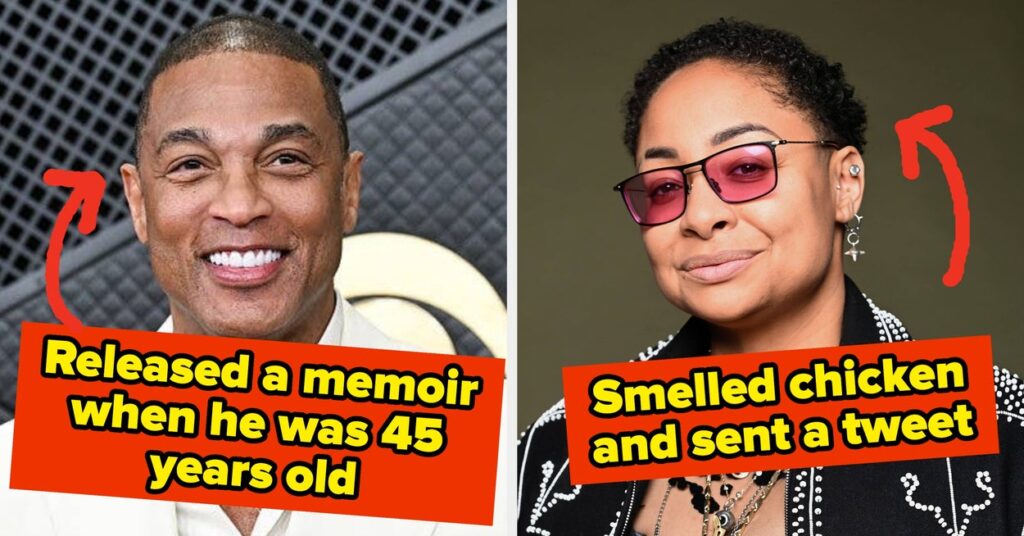
Raven Symoné, who was a famous actor since she was 3 years old, wasn’t always ready to come out. In a 2013 interview with Them, the That’s So Raven star revealed that a conversation with Demond Green, her costar in the Broadway production of Sister Act, set her on the path to sharing her story.
On August 2, 2013, Raven broke the internet when she tweeted, “I finally get married! Yay government! So proud of you,” after Proposition 8 was overturned and California legalized same-sex marriage.
According to Raven, it was Demond’s support that that really led her to come out. “I remember he sat me down once, and he was like, ‘You’re going to have to come out.’ And I was like, ‘No, I’m not,'” she said in the interview. Demond told her she could be a rare LGBTQ+ role model, to which Raven argued that she didn’t get to have one.
“I’m like, ‘Why I gotta be the martyr? That’s not fair,” Raven said. “I didn’t like having that conversation with him.” Then, she joked that the smell of the fried chicken changed everything. “[Demond] sat me down and told me that if I’m going to be in the position I’m in with the name that I have, there’s certain things that I’m going to have to do that I don’t want to do,” Raven said.
9.
Emmy, Grammy, and Tony winner Billy Porter talked to Essence about finally embracing his identity despite the stigma of being openly gay in the ’80s. “I spent years hiding who I was. Now, I live out loud because that’s the only way to be free,” he said.
“For me, coming out wasn’t just about declaring my sexuality—it was about reclaiming my power. Silence equals death,” Billy recalled, coming out as gay in 1985. “The dehumanization of queer people still happens because of silence. Coming out is about no longer being silent. It requires accountability—both from the people hearing the information and from those giving it. We must come out so we know who our allies are and who are not, so we can understand how to validate and save ourselves.”
Billy, a first-generation activist post the civil rights movement, used his platforms as an artist for years to fight stigma against HIV, which he was diagnosed with in 2007. “I only know how to fight for justice,” he said.
Billy explained the struggles of growing up within a very religious community, which first led to abandonment after he came out. “For the first 25 years of my life, I tried to be somebody else. Now, I get to be this thing—unapologetically,” he said. “Come out so you can live freely. So you can know who loves you for who you are. Because that’s where the healing starts.”
10.
In 2011, former CNN anchor Don Lemon was interviewed by the New York Times about his memoir, Transparent, and his choice to share that he was gay publicly in his own narrative. “I abhor hypocrisy. I think if you’re going to be in the business of news, and telling people the truth, of trying to shed light in dark places, then you’ve got to be honest. You’ve got to have the same rules for yourself as you do for everyone else.”
While Don’s sexual orientation wasn’t a secret to his colleagues, the idea of a book revealing the truth was terrifying for several reasons. “It’s quite different for an African-American male,” Don said. “It’s about the worst thing you can be in black culture. You’re taught you have to be a man; you have to be masculine. In the black community they think you can pray the gay away.”
“I think it would be great if everybody could be out. But it’s such a personal choice. People have to do it at their own speed. I respect that. I do have to say that the more people who come out, the better it is for everyone, certainly for the Tyler Clementis of the world.”
11.
Emmy-winning comedian Wanda Sykes came out at 44, well established in her career as an actor and entertainer. In 2008, Wanda gave an impromptu speech at an equality rally in Las Vegas about Proposition 8, a now-overturned amendment that only recognized marriage between a man and a woman.
Speaking with OprahMag.com, Wanda said, “I felt like I had to say something. You’re inspecting my life, the life that I have? You’re saying that my marriage isn’t legal? That’s when I said alright, it’s important to speak out.”
Wanda continued, “Also, I wanted to put a face on who that was affecting, not just white gay men. There are women. There are mothers. There are real people involved in these votes that affect lives and kids. After I gave my speech in Las Vegas, by the time I went back to the hotel, it was on TV and I was like, ‘Oh, okay. I’m out.’ It was like, ‘Oh, cool.’ I already said what was the truth.”
“I know how powerful television can be,” she added, referencing the increase in LGBTQ+ stories in media. “It’s important for us to show how important LGBTQ+ representation is and how it can change minds in society.”
12.
And finally, there’s Emmy Award-winning actor and playwright Colman Domingo’s coming-out story, which was so positive that some people found A Boy and His Soul, the one-person show he created about it, unbelievable. “The critic doubted the validity of my story,” he said in a 2021 interview with Advocate. “She was a white woman, and she claimed that in her ‘research,’ it was very hard for a Black man to come out as gay in an inner-city neighborhood because it meant rejection. So she didn’t believe it.”
Colman was very forthcoming about the supportive dynamic of his family. “It was a nurturing environment, and I was loved by my mom and stepdad, and my sister and brothers,” he told the publication. “The neighborhood was community-centric. We were all there to support each other. I couldn’t have done all the things I’ve done in my life without all that love and support I had when I was growing up.”
The Euphoria actor explained that he first came out to his other brother on his 21st birthday, and eventually his sister after graduating from college and moving to San Francisco. At his sister’s advice, he called his parents so they could find out directly from him. “They told me they loved me and accepted me, and that they wanted to better understand me,” he said. It was the acceptance from his family that empowered Colman to be honest about his sexuality throughout his career.
It’s the 100th anniversary of Black History Month this year! Follow all of our coverage here. Of course, the content doesn’t end after February. Follow BuzzFeed’s Cocoa Butter on Instagram, TikTok, and YouTube to keep up with our latest Black culture content year-round.