
When Crown Prince Haakon, the heir to the Norwegian throne, married the love of his life in Oslo cathedral in August 2001, joy at the royal nuptials mingled with questions about his choice of bride.
It was not just that Mette-Marit Tjessem Hoiby, a waitress whom he met at a musical festival, was the unmarried mother of a four-year-old son. There was concern, too, about the murky world of petty criminals and drug dealers through which she appeared to drift.
Even Haakon’s aunt, Ragnhild, revealed her concerns about Mette-Marit one day becoming queen in a television interview several years later, declaring: “I hope I die before that happens.”
The Norwegians gave their Crown Princess the benefit of the doubt, however. She publicly apologised for her “wild life” and, in the quarter of a century since, has proved herself a popular and hard-working member of the royal family.
Yet the 52-year-old’s judgement is being questioned again as she finds herself at the centre of one of the most serious crises to hit the House of Glücksburg, which has reigned over Norway since 1905 when the country broke away from its nine-decade long enforced “union of the crowns” with Sweden.
It is bad enough that Marius Borg Hoiby, who accompanied his mother down the aisle, is currently on trial in an Oslo courtroom indicted on 38 counts, including four of rape.
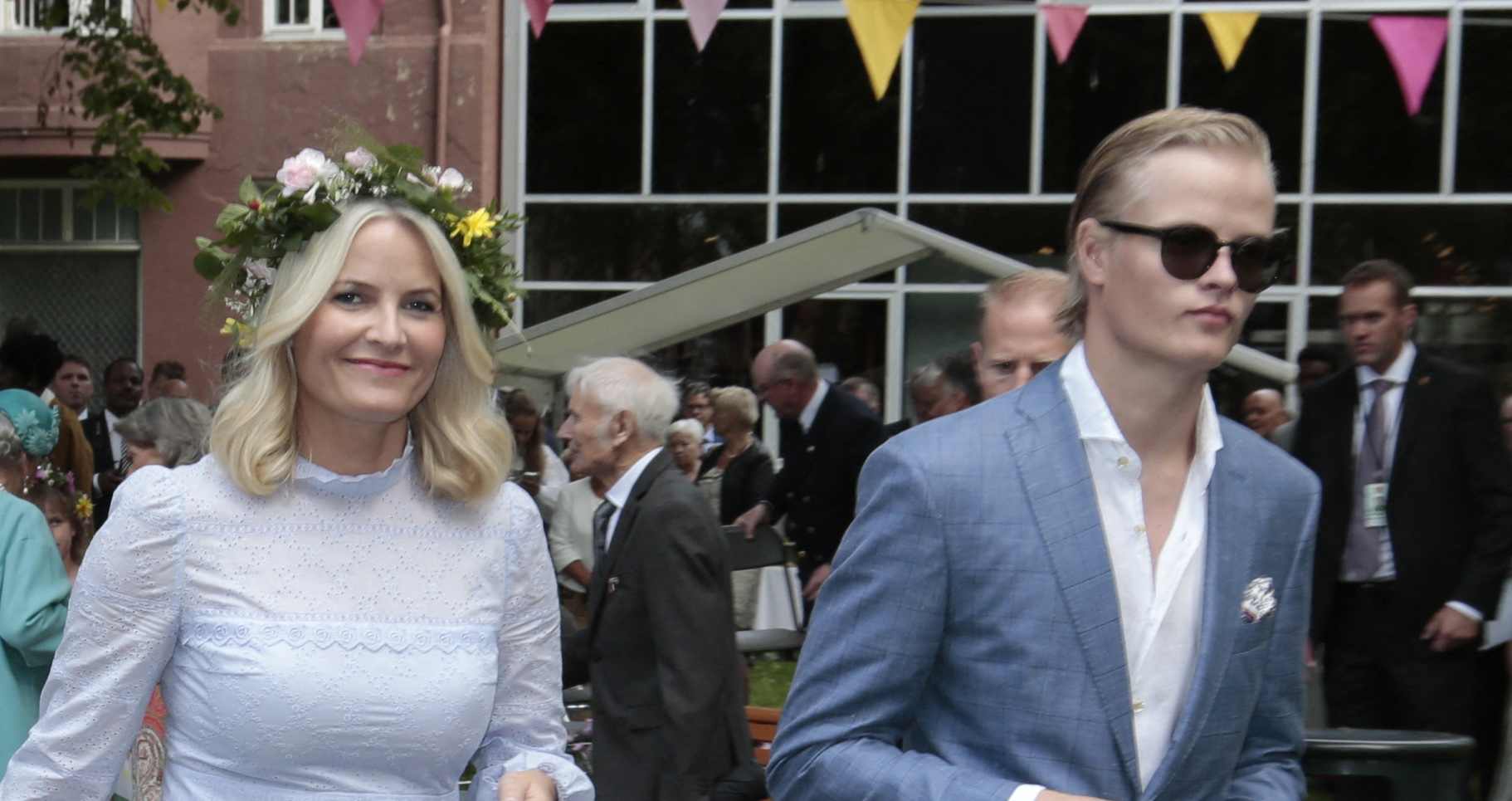
Mette-Marit with Hoiby, who is on trial for four counts of rape
LISE ASERUD/AFP
More damaging still has been the release of hundreds of chatty and often flirtatious emails that Mette-Marit exchanged with Jeffrey Epstein, starting in 2011, by which time the disgraced financier had already served his first stint in jail for sexual crimes.
The Crown Princess’s previous claims that she had been unaware of the extent of Epstein’s wrongdoings appear to have been disproved by an email from her official address in October 2011, in which she wrote: “Googled u after last email, Agree didn’t look too good,” followed by a smiley face.
She went on to meet him several times and stayed for four days at his Palm Beach mansion in 2013 with a female friend while he was not there.
Support for the monarchy in Norway, still as high as 70 per cent or so just a few weeks ago, has plunged to 53 per cent — the lowest level ever recorded. Almost a third of Norwegians would like their country to become a republic, according to a poll conducted by Respons Analyse as the scandal erupted.
Mette-Marit — who called Epstein “charming” and “my sweetheart” in some messages — would be right to take it personally: 47.6 per cent of people questioned in a snap poll for TV 2 said they did not think she should become their next queen. The scandal also comes in the midst of a health crisis: the pulmonary fibrosis from which she has long suffered has become so bad she may soon need a lung transplant.
Mette-Marit and Haakon’s daughter, Ingrid Alexandra, 22, who is next in line to the throne after her father, has also been caught up in the turmoil. In a private Instagram posting to her 800 followers, picked up by the press, she appeared to criticise the relentless media coverage, writing: “I am going crazy. When is enough.”

Haakon, Princess Ingrid Alexandra, Prince Sverre Magnus, Mette-Marit and Hoiby
LISE AASERUD/NTB SCANPIX/ALAMY
It is not just the royal family that is under fire over its links with Epstein; so too are several prominent members of Norway’s political class: Thorbjorn Jagland, a former prime minister and former chair of the Norwegian Nobel Committee; Borge Brende, the chief executive of the World Economic Forum and an ex-foreign minister; and Terje Rod-Larsen and Mona Juul, married senior diplomats, appear in the files.
Home to just 5.5 million people, but hugely rich due to massive resources of oil and gas, Norway has long seen itself as a moral force on the international arena. The country has leveraged its status as the home of the Nobel peace prize to play an outsize role in brokering an end to conflicts in the Middle East, Latin America and Africa. Some of the shine is coming off.
“Everything happening now — with Marius and Mette-Marit, Jagland, Rod-Larsen, Juul, and Brende’s link to Epstein — is affecting Norwegians at a fundamental level,” said Oistein Norum Monsen, who recently authored a book exposing Hoiby’s alleged links with organised crime, adding to the sense of malaise in Norway. “Our values are being put to the test, and perhaps we are naïve, but the belief that we are a moral people is crumbling.”
Hoiby’s trial, which began on February 3 and is expected to last another six weeks, has been dominating Norwegian media. The 29-year-old, who struggled to find a role for himself as a semi-detached member of the royal family, has long been a fixture on the Oslo party scene, often pictured in bow tie and evening dress with a glamorous young influencer or model on his arm.
He cut a very different figure in court. In a jumper and glasses, he appeared nervous and restless as he heard the evidence against him — including from a woman he allegedly raped while she lay unconscious at a party held in the basement of his mother and stepfather’s home outside Oslo in December 2018.

A courtroom sketch of Hoiby
OLE BERG-RUSTEN/REUTERS
Hoiby has denied having non-consensual sex with his alleged victims. Giving evidence on the second day, he claimed to have been surrounded by the press since the age of three and to have “an extreme need for affirmation” that manifested itself in a life of sex, alcohol and drugs. But he may not have helped his case by being arrested two days before the trial for allegedly assaulting a former flatmate, a previous attack on whom precipitated his legal woes.
Some Norwegian commentators have posited that the same need for affirmation might explain his mother’s attraction to Epstein, with whom she was put in touch in spring 2011 by Boris Nikolic, a biotech investor, who worked as an advisor to Bill Gates, the Microsoft founder. “A friend of mine is visiting NYC and I would love for us to meet,” Nikolic wrote to Epstein in February 2011. “She is GREAT! Twisted ;)” he wrote. “Not a typical royalty.”
• Norway’s crown princess apologises to King about Epstein friendship
In messages the crown princess exchanged with Epstein in October 2012, she claimed she was in “shock” to find that he was in Europe “hunting” for a wife, declared that Paris “is good for adultery” and that Scandinavian women were “better wife material”.
A few days later she described an event, which is thought to have been the wedding of Guillaume, the future Grand Duke of Luxembourg, as “boring … like some kind of old movie where you know the characters are not hanging around for too long”.
Perhaps most unfortunate in light of current events was another message the month after in which Mette-Marit appears to ask Epstein if it would be inappropriate to buy wallpaper for Marius, then aged 15, with images of two naked women carrying a surfboard.
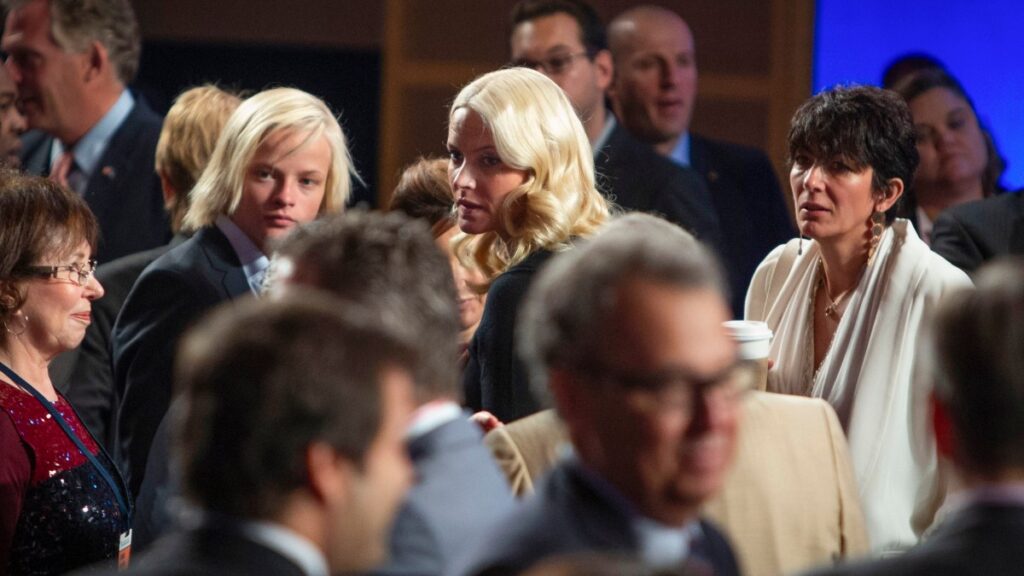
Then on Friday, photographs emerged showing Mette-Marit meeting Epstein’s accomplice, Ghislaine Maxwell, in 2012 at the opening event of the Clinton Global Initiative in New York and greeting her warmly. The palace said the crown princess could not recall the meeting, though she issued a more contrite statement on the same day, the second since the files were released. In it, she apologised to “all whom of you whom I have disappointed … especially the King and Queen”.
Speaking later to reporters during a visit to a kindergarten, Haakon looked under strain. “The Crown Princess understands that there are many who want to hear from her … She would like to tell more about the case, and we hope there is understanding that she needs some time.”
Despite the plunge in popularity, it would be wrong to write off the Norwegian royal family, whose head, King Harald, 88 — a second cousin once removed of King Charles — has spent the past few years weathering a series of controversies involving Haakon’s elder sister, Martha Louise, who in August 2024 married Durek Verrett, an American alternative therapist and self-proclaimed shaman.
In a non-binding vote on February 3, just 26 out of 169 MPs backed a call to turn Norway into a republic, a complex procedure that would in any case require much more than a simple parliamentary majority.
Hans Jacob Orning, an expert on the Nordic Middle Ages at the University of Oslo, says scandals have been part of royal life as long as there have been kings and queens — and have the advantage of ensuring that the institution’s members remain a centre of popular attention.
The difference from medieval times, when kings were colourful characters who repeatedly broke all the rules, is that there is a “division of labour”, he wrote in a recent commentary for the country’s Aftenposten newspaper. “The monarch is a proper and boring bureaucrat who does everything that is expected, younger members of the royal family do all the madness and transgressions.
“This is how modern royal houses manage to fulfill the two functions they must fulfill to be unifying,” he said. “They are bureaucrats and rebels at the same time. A royal house that is not talked about is no longer a royal house.”