
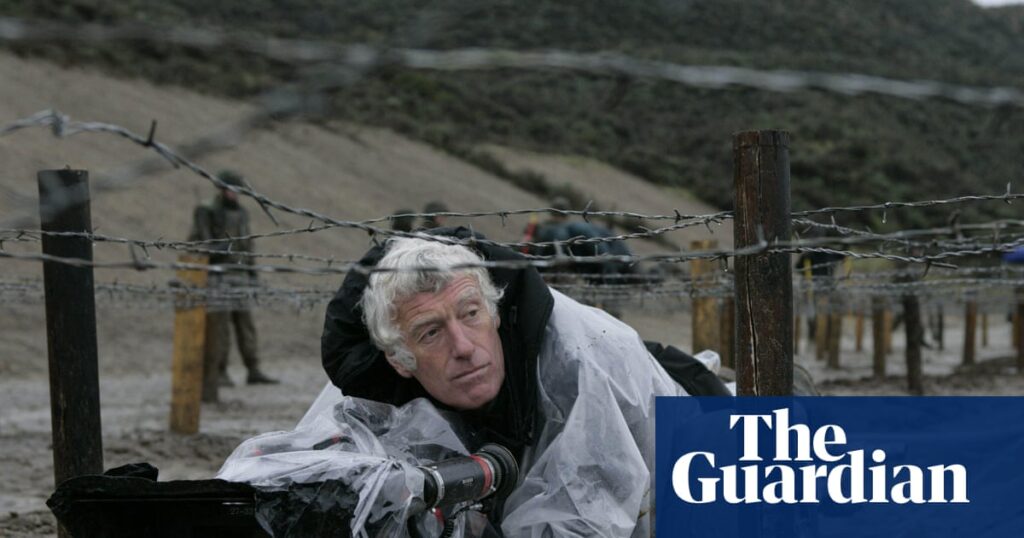
Roger Deakins – cinematographer to the Coen brothers, Martin Scorsese and Sam Mendes, whose work has earned him 14 Oscar nominations and two wins, five Baftas, a knighthood and a reputation for being the greatest practitioner of his craft alive – is struggling to explain just exactly what he does. “Argh!” he exclaims, when confronted by the question: what is cinematography?
“Well, I started off trying to be a still photographer, someone like Don McCullin. And it’s been a whole arc through cinematography. Now what is cinematography? I don’t know. It’s very different from still photography. But the essentials are the same. You’re trying to tell a visual story.” It is “very much a collaboration”, he continues; working with “hundreds of people” on films can be a “wonderful experience … I suppose I’m not answering your question, because actually I’ve got no idea,” he says. “The cliche is visual storytelling, but it’s much more than that.”
The “visual storytelling” he’s done throughout his 50-year career has been spectacular and immense, encompassing the austere desert landscapes of No Country for Old Men to the hallucinatory urban vistas of Blade Runner 2049. He’s captured the rich, dream-like imagery of Martin Scorsese’s Dalai Lama biopic Kundun, the shadowy action of James Bond’s Skyfall, and – to go back to one of his earliest feature films – the tragic romance of Sex Pistols bassist Sid Vicious and girlfriend Nancy Spungen in Sid and Nancy, set against the golden age of punk in London, Paris and New York. That film shoot, in 1985, was his first proper trip to the US; he had no idea then that he’d be back.
Today he is in his Santa Monica home, wearing a baggy black T-shirt and rectangular spectacles secured in place by a glasses cord. His conversational manner is off-the-cuff, straight-talking, devoid of any pretensions while displaying quiet assurance in his own judgments. “I can rattle on for ages,” he jokes, and you can easily imagine him idly shooting the breeze while pursuing his other great love: fishing in Devon, where he grew up. I wonder how that disposition survives in the notoriously egoistic and political world that is Hollywood.
Bowled over … Jeff Bridges in the Deakins-shot Big Lebowski. Photograph: Landmark Media/Alamy
A clearer picture emerges when speaking to his wife, James Ellis Deakins, who joins him today. The two met on set of the 1992 thriller Thunderheart, when she was a script consultant, and have since worked as a team on film sets, with James coordinating communication with the production team and other departments. Where Deakins sprawls and gesticulates and flits from one thought to another, James sits upright, a pink scarf tucked above her (not baggy) black shirt, arms neatly folded, eyes focused in concentration. She will often supply crucial context, pick up on strands Deakins has missed – and subtly rein him in whenever he’s in danger of becoming too indiscreet.
“But isn’t the cinematographer also thinking,” she adds, after Deakins admits to being lost, “how can I tell the story visually in the frame?” To consider how to frame, light and compose a film shot so it will convey the requisite joy or sadness or fear. Say “there’s a shot that makes you feel melancholy or afraid, and you don’t know why”. For James, a cinematographer has succeeded when their camerawork encapsulates the feeling of the story. “Because it’s so visceral, people might not come out of the theatre and go: ‘That was great cinematography.’ They just think: ‘Oh, it’s a great movie; I was so scared.’ But they don’t know the cinematography helped that.”
1984 was the first film where I did a lot of studio work. It felt like a real movie. I thought: How did I get here? I want more
A fuller picture of the craft emerges in Deakins’s new book, Reflections: On Cinematography. Co-written with James, it’s part memoir, part technical guide that takes readers behind the scenes of his projects throughout his career. In it, a cinematographer emerges as not only the director of camerawork, but also a sculptor of light; a watcher of the weather; a fleet-footed problem solver and illusionist; and, in Deakins’s case, a leader of a technical crew who have long become collaborators.
Deakins takes us behind how he mimicked daylight in the blacked-out factory that served as the central cell block in The Shawshank Redemption (skylights in the ceiling with diffusion panels). It was so successful that, months later, he was amused to overhear a fellow cinematographer question the film’s award nominations, because he had erroneously assumed it had been shot in natural light.
Many an hour is spent waiting for the right weather conditions to appear: for snow on the Coen brothers’ Fargo, or for the clouds to roll in on Sam Mendes’s 1917 (as the film appears as one long take, the lighting had to be consistent). Deakins is delighted when his dolly operator finds a lo-fi way to film a tumbling bowling ball in The Big Lebowski – they pushed the camera down the alley with a pole – and for Skyfall, Deakins’s chief electrician lit the back of Liverpool Street station in vivid green, in order to mimic the colour palette of Shanghai, where the scene was supposed to take place, as well as disguise the area to sharp-eyed Londoners.
Writing the book has prompted plenty of reflection. “I think my career path has been unlikely. It certainly seems unlikely if I look back at myself at 16,” Deakins says. It strikes me that his work may soon appear unlikely for a whole new set of reasons. He and James also wrote the book, he says, because “the film industry is in a bit of a decline at the moment”.
Hollywood is now confronting the arrival of artificial intelligence from an already convulsive backdrop of diminished earnings, the rise of streaming and the dominance of franchise reboots and superhero films that rely heavily on green screens and CGI. Deakins’s work – known for its naturalistic, even painterly, scenes, with delicate interplays of light and shadow – may well soon look like a rarity; the stuff of legend from a fast-disappearing past.
Deakins’s childhood in Torquay was not particularly happy: “It led me to be a bit angry.” His parents met during the second world war: his father, William, was an explosives expert with the Royal Engineers and his mother, Josephine, served in the Women’s Auxiliary Air Force. She developed multiple sclerosis in 1949, the year Roger was born, became bedridden, and died nine years later. Meanwhile, Roger spent his teenage years indulging in occasional “excessive drinking” and skipping his studies to go fishing. “I was lost,” he says. He loved watching films in the five local cinemas around Torquay, and was moved in particular by Stanley Kubrick’s Dr Strangelove and Peter Watkins’s The War Game, but never thought of it as something he could do himself.
All he knew then was that he didn’t want to work at a bank: a fate that his school teachers had said would be the “highlight of his life”. Off he went to art school in Bath, where he developed an interest in photography, but still didn’t have a sense of a career. The National Film School was soon accepting its first intake: he was rejected, but was told he’d be allowed in the year after. In the meantime, he took on a job photographing life in north Devon, capturing a community being pushed into modernity through the arrival of mass tourism.
The war game … George MacKay in a scene from 1917 directed by Sam Mendes and shot by Roger Deakins. Photograph: François Duhamel/AP
The first time Deakins had a sense that cinematography was his calling was only when he was in his mid-30s, on the set of Michael Radford’s adaptation of 1984. He had done plenty of camerawork before then: he shot documentaries that took him to Zimbabwe during the war of independence; followed yachtsman John Ridgway’s journey sailing round the world; and also shot music videos for Eric Clapton, Meat Loaf and Marvin Gaye. However, it was on the set of 1984, the “first film where I did a lot of studio work” and “felt like it was a real movie”, where he thought: “Wow. How did I get here? I want more.”
The arc of his career recalls another figure who grew up in a British town far outside the metropole, who found his way into feature film-making relatively late before becoming a Hollywood grandee: Ridley Scott. Scott has credited his early career in advertising with his later success in movies. Did Deakins’s circuitous journey also prove useful?
There’s a certain director who used to operate the camera himself. We agreed that wasn’t going to work. I operate the camera
Documentaries “gave me a lot of confidence”, he says. “That was the thing I was really lacking as a kid: the experience of life and travelling, and seeing there are many things to worry about than what’s happening in your own interior.”
“From a practical viewpoint,” James adds, “when you’re shooting a documentary, you’re shooting something that’s only going to happen once. So you have to determine what angles are the best, you have to do it quickly. You don’t get a second chance.”Deakins believes his adventurous early jobs were important in his development. “Life experience is something that is not talked about a lot,” he says of the industry. “I think some of the directors that are raised in the bubble of the film world, they keep reinventing the same damn movies. They don’t really reach out outside of their movie world.”
Part of the reason why cinematography might be so hard to define is that the job can vary greatly between directors. His longstanding collaboration with the Coen brothers began in 1991 with the comedy Barton Fink, and has extended on to A Serious Man, True Grit and others. Deakins says the pair are “very knowledgable and quite specific about every aspect of a film”, with a “clear idea visually of what they want. Some people might say that might be restricting for a cinematographer, but I find it refreshing because you start at a point and can work further. Another director I’ve worked with, I’m not going to say the name, said: ‘I don’t know anything about the camera, but I want you to do that, and I just want to concentrate on the script and acting.’”
Meeting a director is kind of like “interviewing a potential roommate”, James says: you’re trying to determine whether you’d work well together. “I’ve always loved operating the camera,” Deakins says. “There’s a certain director whose name you mentioned earlier” – which makes James laughs and wave her hand about in mock exasperation – “who I’ve been to interviews with, who always used to operate the camera himself. We agreed at the end of the interview it wasn’t going to work. Because I operate the camera, and he operated the camera. So how’s that going to work?” The director in question is, judging from his past comments, Ridley Scott.
“And yet you guys got along so well,” James adds, “and always do every time we run into him.”
Deakins’s insistence on operating the camera himself, it seems, reflects a broader principle he values in his work: specificity and intentionality. “I don’t like shooting films with dozens of cameras,” he says. “I like the precision, that’s why I’ve loved working with Joel and Ethan [Coen], and with Denis [Villeneuve.] … I love that process of finding the scene rather than shooting a lot of stuff and finding it in the cutting room. That’s just sloppy and lazy.” He prefers “stripping things down to the basics”; his still photography tends to capture desolate, mournful scenes in black and white. Good cinematography, for Deakins, shouldn’t announce itself; in fact, it shouldn’t be noticed at all. He and James recently rewatched the 1963 Paul Newman film Hud, directed by Martin Ritt with cinematography by the pioneer James Wong Howe. “It’s magnificent. Everything about it is so simple, and so precise and deliberate. But you’re totally immersed in the characters and the world it creates.”
By contrast, “so often, especially on modern movies, you see the camera swooping all over the place, flashy coloured lighting. It’s just a distraction, because it makes you aware that you’re watching the movie.” Other pet peeves: lens flare (also distracting); excessive cuts (can drain the tension out of a scene); overenthusiastic and unthinking adoption of new technology (“How often do you watch a TV series, and when they cut to a wide shot it’s actually done by a drone? And you go: ‘Oh no, another one.’”)
The world changes; people get their entertainment from different sources now. It’s just a natural evolution
Film sets can be famously stressful places. In his book, Deakins recounts being publicly insulted by directors; once, a night shoot was held up while its lead actors sparred over whose trailer would park closest to the set. He doesn’t seem like someone who is happy to indulge egos, as seen by his marked lack of interest when I ask about his two – and to many, wildly overdue – Oscars (“It’s the work that matters, not all that stuff”).
“Where I lose my patience is when I don’t feel people have the passion, or make the most of opportunities,” he says. “I find it really hard to put up with. I’m not the easiest person to get on with on set, frankly.”
“That’s not true, actually,” counters James.
“Well I don’t know, people say that.”
“Well, people who are actually there and working love working with you, because you’re so focused and ready to do it. It’s the politics you’re not good at.”
The Hollywood that Deakins grew up admiring – he references multiple Paul Newman films – is very different from the Hollywood of today. He’s not a fan of big action films: when Sam Mendes called him about shooting Skyfall, the first thing the director said was: “Don’t put the phone down when I tell you what I’m doing next.” I ask Deakins about something he’s previously said: “I’m nostalgic for the kind of films that used to be made that aren’t being made any more.”
“Don’t be too bitter,” cautions James.
“The world changes,” Deakins says even-handedly, “people get their entertainment from different sources now, it’s just a natural evolution. Would they make Hud today? Probably not.”
“There are less character-based movies,” adds James. “‘Event’ movies are great to see and fun, but it’s also nice to have ‘character movies’ to learn about how a different human being is. That’s what we’re missing.”
Meanwhile, there has also been a backlash against the state of cinematography. A viral essay on the archetypical Netflix film criticised its “terrible lighting”, and how scenes look “both oversaturated and flat, with the blacks brightened and the highlights dulled”.
“I think part of the reason is that [digital camera] technologies have advanced to such a state that you don’t have to light a shot,” Deakins says. Beforehand, when you had to think about how to reproduce the effect of, say, car headlights coming on to a road at night, you “had to make decisions about light and shade”. Now, James says, “producers don’t want to spend the time on lighting, because if you can see the image, then you must have it. So the whole concept of making the [camera] frame tell the story, alongside the dialogue, has been disappearing.” It is increasingly popular, Deakins says, to “shoot something fairly flat and manipulate it” in post-production. As for AI? “All I’ve experienced is the real world, and shooting a film on location, and that collaborative process,” he says. “I don’t want to experience 24 weeks on a volume [a wall made of LED screens] with a virtual reality background.”
All this may suggest the pair have begun to turn their backs on the film world, but they are busy running their Team Deakins podcast and website, which they hope demystifies the industry for newcomers. They do considerable outreach: the website hosts a forum where they chat with all manner of posters – even students seeking help with their school projects. Deakins is also working on his second book of photography. Although they have dedicated much of their lives to the film world, they’re keen to maintain a sense of perspective. “Oftentimes, in the business, people tend to think this is the most important thing in the world,” says James.
“I met a farmer once, and he was doing a stone wall up in Dartmouth,” Deakins says. “They just lay these stones together without any mortar or anything. It’s just brilliant what they do. And he was just loving the work.
“Isn’t that just life?” he continues. “You’ve got to love what you do, whatever it is. It doesn’t have to be film-making; it can be anything.”
Reflections: On Cinematography by Roger Deakins is published by Octopus on Thursday.