
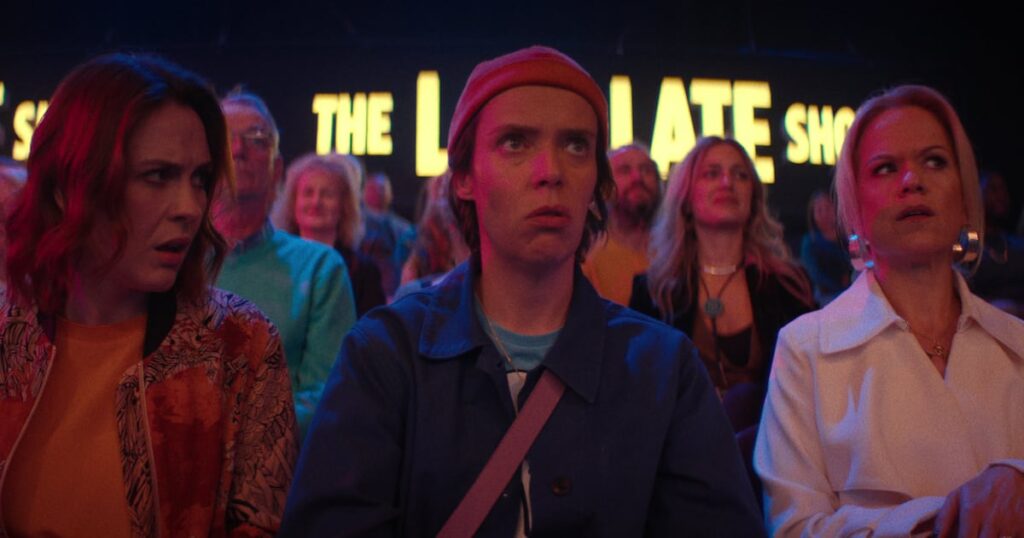
A charmer on social media called me an unrepeatable name after I expressed misgivings over the finale of Lisa McGee’s Derry Girls, which, at the very last moment, lost its footing and was swept away in a deluge of saccharine. I suspect I shall have to don a hard hat all over again with the release of McGee’s first major series since Derry Girls, the underwhelming and tonally disorienting How to Get to Heaven from Belfast (Netflix, Thursday).
McGee has described the series as a marriage of her two big loves, comedy and mystery, and names Scooby-Doo and Columbo as among her inspirations. (It’s also clearly indebted to Rian Johnson’s Knives Out movies.) But it’s a patchy soldering together of two essentially incompatible genres and is neither funny enough to hold its own alongside Derry Girls nor serious enough to be enjoyable as a mystery romp.
An additional problem for Irish viewers is that McGee, from Derry and living in Belfast, has based much of the action in the Republic while seeming to have gleaned her knowledge of the 26 counties from old D’Unbelievables box sets. The moment the action crosses the Border it’s headlong into a Jumbo Breakfast Roll song neverland, brimming with the sort of performative Irish eccentricity that is sure to go down well in Britain (as with Derry Girls, How to Get to Heaven is produced by the London-based Hat Trick Productions) but may have viewers here choking on their Lucky Charms.
The vibe is Father Ted trying to be Inspector Morse – and while McGee’s talent for hilarious dialogue remains unparalleled, it sits uneasily alongside a storyline about intergenerational abuse and the writing out of history of Irish female suffering.
It’s a shame that the series lacks the sureness of touch of Derry Girls, a show that knew exactly what it wanted to be, as it has the bones of a solid whodunit. The story begins with three former Belfast convent schoolfriends, played by Róisín Gallagher, Sinéad Keenan and Caoilfhionn Dunne, reuniting when the fourth member of their teenage friendship group (Natasha O’Keeffe) dies in mysterious circumstances in Donegal. She was a troubled new student who had come to Belfast from Galway, and whose dark past followed her north.
The catalysing moment in their friendship was a terrible incident that forever bound the four together – and has haunted them ever since. Or at least that’s what we’re supposed to believe. But the emphasis on Derry Girls-style bantering comedy hobbles the more serious elements of the script, which draws on Ireland’s shameful record of silencing and incarcerating women and which dips into Celtic folklore, without ever quite working out what it wants to do with these elements.
It’s great fun as long as you don’t pay too much attention to the plot – or how the characters flit from cartoonish to serious. For instance, Keenan’s Robyn is depicted as the most grounded and no-nonsense of the trio yet is reduced to a two-dimensional comic-book character when she leaps to the baseless conclusion that her husband is having an affair.
The show is all over the place – and never in a way that convinces. Characters played by Emmett J Scanlan, Bronagh Gallagher and the Derry Girls star Saoirse-Monica Jackson are treated as comic relief one moment and serious protagonists the next. Then there is Darragh Hand as a Dublin garda in Donegal who routinely takes time out from his policing duties to help with his family’s car-repair business – this is presented as the sort of thing that might genuinely happen in Donegal – and who seems to think he’s in a David Fincher film.
It is when How to Get to Heaven from Belfast crosses the Border that things go south with a vengeance. An episode set in Dublin would put the most misty-eyed Irish American to shame – though McGee sells a sequence in which her heroes gatecrash The Late Late Show (which in this universe is filmed at the Bord Gáis Energy Theatre).
[ Lisa McGee on How to Get to Heaven from Belfast: ‘A messed-up cousin of Derry Girls’Opens in new window ]
McGee is one of the best writers of the zinging one-liner on television, and her portrait of adult friendship – with its understated rivals and resonances – is well drawn. But the denouement is a mess, and the blend of tones never comes together, particularly when the show decides late that it wants to be a Gaeltacht-set version of Stranger Things.
The paradox is that McGee has already demonstrated her mastery of the mystery genre. In 2020, between the second and third seasons of Derry Girls, she wrote The Deceived, a fun riff on Daphne du Maurier’s Rebecca, featuring a pre-megastardom Paul Mescal. It played it straight and worked a charm. Alas, her Netflix debut is a jumble by comparison. Despite the best efforts of all involved, How to Get to Heaven from Belfast is a one-way trip to binge-watch purgatory.