
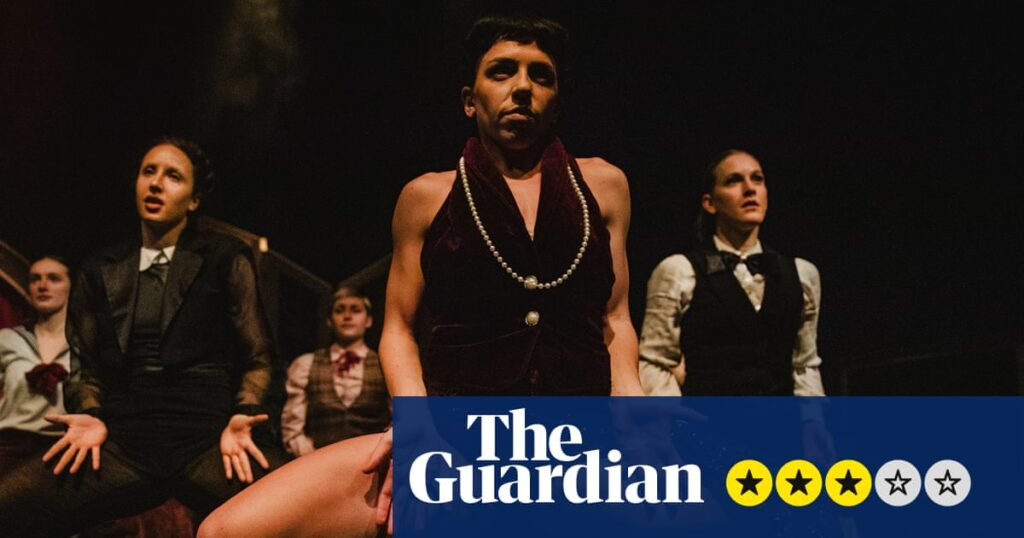
Le Monocle was a famed lesbian club, opened by Lulu de Montparnasse in 1920s Paris. Marlene Dietrich visited and Edith Piaf’s mum sang in the cabaret. It was a rare haven where lesbians could live and love freely. It’s also the setting for Rendez-Vous Dance’s latest show, telling this secret Sapphic story.
We see the clientele arrive, in sequins or suits, to the rich honey voice of jazz singer Imogen Banks, whose understated charisma is at the heart of the show. Banks and BSL interpreter Caroline Ryan seamlessly infiltrate the cast, and with the help of James Keane’s atmospheric score, choreographer Mathieu Geffré builds up a world.
It begins a bit Kit Kat club, then moves to low-lit wooziness, bodies melting together. One woman dressed in a sailor suit gets a quirky-limbed, characterful dance in the spotlight. Another binds her breasts to the song Mon Homme (My Man).They don moustaches and mimic chivalrous gestures, both mocking masculinity and delighting in the cosplay of it.
Rich honey voice … Imogen Banks. Photograph: Cave and Sky
The fluidity of identity is at play, and it’s the same in the dance, which can be louche, matching the drunken lurch of the music, or meticulous, playful or sultry. But their revelry is ruptured by a sudden thunderous intrusion, terror clad in a black trenchcoat – presumably the spectre of the Nazis whose occupation forced the club to close in 1941. Threat rumbles, never far away.
Geffré’s previous show What Songs May Do… was a hit at the 2024 Edinburgh fringe. That was a realistic-feeling portrait of queer love set to Nina Simone. The Monocle doesn’t succeed in being quite as convincing. The characters aren’t so deeply drawn, their arcs waver, the momentum occasionally stalls. The dancers could squeeze more juice out of their movement and their connections with each other, like the couple whose romantic duet closes the first half: I just didn’t believe their love.
But the idea is great, the originality, the uncovering of a lesser-known story and exploration of female partnering; the history, the songs, the tangible, celebratory sense of community. It’s a moment in time well worth bringing back to life.
On tour until 6 March