
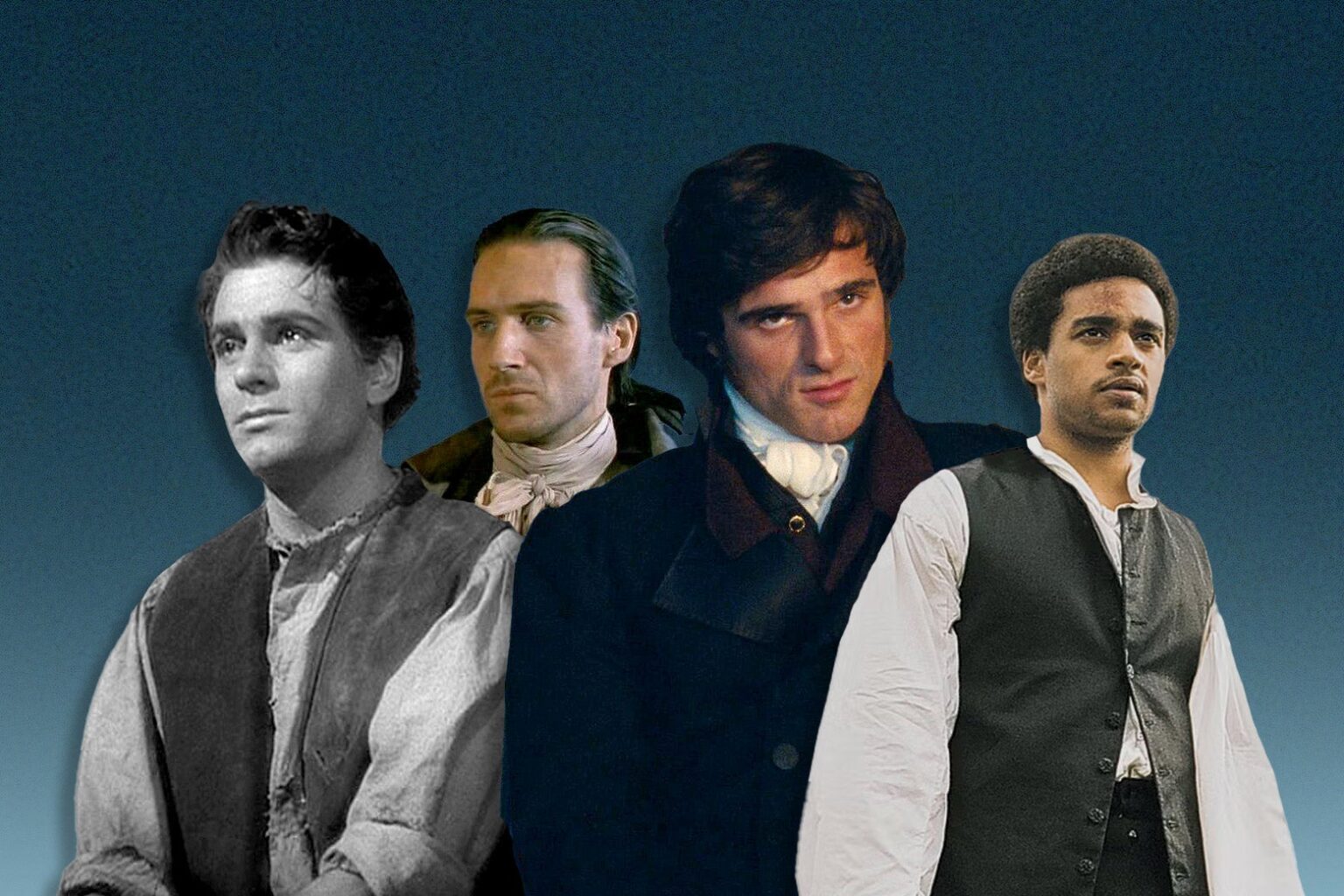
Since the 2024 announcement of the casting of Margot Robbie and Jacob Elordi in Emerald Fennell’s buzzy adaptation of Emily Brontë’s Wuthering Heights, invested parties online have condemned the filmmaker’s choice of Elordi, a white (and very tall) Australian actor, for the role of Heathcliff, the adopted brother of the Earnshaw family who, through their mistreatment and his separation from his beloved adopted sister Cathy, becomes implacably vengeful and cruel. “Why are we, in the year of our lord 2024, casting Heathcliff with a white actor????” reads a representative line in a LitHub piece that sums up the tenor of much of the controversy. X users have spent the better part of a year calling each other idiots for declaring that, based on their enlightened readings of the 1847 novel, Heathcliff is obviously supposed to be white—or not. Things descended to a point where I saw people arguing over whether Elordi’s father’s Basque origins could qualify the actor for the role, if you squint. Fans have suggested other actors as candidates for a Heathcliff who’d be a little less pale, from Dev Patel to Shazad Latif (who plays Edgar Linton, the other side of the love triangle, in Fennell’s version). As the movie releases just in time for Valentine’s Day, that contentious question will be top of mind for at least some book-minded readers: Is Heathcliff supposed to be a man of color?
This new round of discourse is especially fiery given that Emerald Fennell is a director who attracts dissent. She inflamed people even more in this case when she explained her casting choice by saying that she had made the movie she imagined while she was reading the book, because she was “focusing on the pseudo-masochistic elements of it.” But the debate over Heathcliff’s race has been ongoing since at least the 1990s. Scholars, novelists, filmmakers, documentarians, and artists have parsed the scraps of information Brontë offers in the book—Heathcliff could be Romani, Spanish, Indian, Asian—and made new arguments for those and other possibilities. Who is Heathcliff? It’s a question that has a lot more answers than “Jacob Elordi.”
It’s also a question that cannot quite be answered just by turning to the source text, though that’s where everyone starts—and so shall I. The little boy Mr. Earnshaw brings to Wuthering Heights from Liverpool in 1771 is, in Earnshaw’s introductory description, “as dark almost as if it came from the devil.” Many times, another character refers to Heathcliff as a “gypsy.” “He’s exactly like the son of the fortune-teller that stole my tame pheasant,” declares Isabella Linton, the daughter of the local gentry, when she first meets him in his teens. “He is a dark-skinned gypsy in aspect, in dress and manners a gentleman,” says the traveler Lockwood, who encounters Heathcliff in his middle age. This is the reference many previous filmed adaptations of the story—the ones that star white British actors armed with a smolder and some dark hair dye—tend to play up, maybe because, for 20th-century viewers, the idea that he’s Romani in origin could give the character of Heathcliff a big-R Romantic flavor, a savor of the lonely moors, without getting too far into contemporary politics.
At other times in the novel, characters suggest that Heathcliff could be Asian, Indian, or Spanish. Mr. Linton, when he first meets Heathcliff in his teens, calls him “that strange acquisition my late neighbour made, in his journey to Liverpool—a little Lascar, or an American or Spanish castaway.” (A lascar was a name for a sailor from the Indian subcontinent or from Asia, employed by British shipping companies and sometimes stranded in Britain for months between voyages, therefore known to British citizens.) In a more tender moment, the servant Ellen “Nelly” Dean, who narrates most of the novel, recalls an exchange in which Heathcliff laments to her that Cathy is developing feelings for Edgar Linton, wishing that he, too, had “light hair and a fair skin.” Nelly tries to console him with the thought that “a good heart will help you to a bonny face … if you were a regular black”—a reference you could read to mean that Heathcliff is not a “regular black” but some other thing. Nelly posits that Heathcliff may be a “prince in disguise,” trying to talk him into a better mood: “Who knows but your father was Emperor of China, and your mother an Indian queen, each of them able to buy up, with one week’s income, Wuthering Heights and Thrushcross Grange together?” she wonders. “And you were kidnapped by wicked sailors and brought to England. Were I in your place I would frame high notions of my birth,” she adds, attempting to cheer him up.
In the 1990s, literary scholars suggested that perhaps Heathcliff’s origins in Liverpool could be interpreted as a reference to an origin in Africa. Writing in 1995, academic Maja-Lisa von Sneidern saw it as a near certainty that the little boy Earnshaw brought back from Liverpool, in what would have been 1771, at a time when the city still played host to many vessels engaged in the triangular trade, would have been a racial other, and might very well have been Black. Literary theorist Terry Eagleton, on the other hand, wondered if the Liverpool connection could mean that Heathcliff is Irish. Eagleton suggested, in his 1996 book Heathcliff and the Great Hunger, that the Brontë family may have read about starving Irish people landing in the port of Liverpool around the time Emily was writing the novel—including in the magazine Illustrated London News, which might have portrayed the children of these arrivals as having dirt-blackened faces and big black eyes, like Heathcliff upon his arrival at Wuthering Heights. (In a hilariously confident footnote, Eagleton wrote: “I have indicated already that Heathcliff may not of course be Irish, and that even if he is, the chronology is awry as far as the Famine goes. But in this essay Heathcliff is Irish, and the chronology is not awry.”)
Heathcliff is a creation of his environment, a person thrust into a social context that rejects him violently, who then refracts that violence back, becoming violent beyond belief.
Any definite interpretations are complicated by the fact that Brontë uses color in intertwining literal and metaphorical ways—not just to detail Heathcliff’s hair, face, and eyes, but to describe the dirt he always has on his face and body, and to capture the dark, unforgiving nature of his soul, his turn toward violence and domination. Nelly sees his darkness increase throughout the time he’s at the Heights, as when Cathy’s first absence at the Grange leads him to forgo washing, and “the surface of his face and hands [is] dismally beclouded,” so that he looks like “a forbidding young blackguard.” Heathcliff’s otherness increases as time goes on and he’s exiled, first from the hearth at Wuthering Heights, then from Cathy’s side. He becomes something of a mythical creature, acquiring almost supernatural powers of cruelty and endurance, living on even as Cathy, Isabella, Hindley, and Edgar all die young. As Emily’s sister Charlotte Brontë wrote in an 1850 forward to a new edition of the novel, if it were not for Heathcliff’s occasional grudging regard for the characters of Hareton and Nelly, “we should say he was child neither of lascar nor gipsy, but a man’s shape animated by demon life—a Ghoul—an Afreet.” Like Victor Frankenstein’s monster, played by Elordi just last year in an unprecedentedly romantic mode, Heathcliff is a creation of his environment, a person thrust into a social context that rejects him violently, who then refracts that violence back, becoming violent beyond belief.
“It’s important that Heathcliff not fit any of the categories that govern the ordinary world—because that’s how gothics and romances work,” said Dan Stout, a professor of English at the University of Mississippi, to whom I posed the question of this Byronic hero’s heritage. “But I think it’s not important that we know exactly what Heathcliff ‘really’ is—racially or otherwise—his history is a cuckoo’s, as the novel says. In fact, if we were to know what he ‘really’ is, it would mean (obviously) that we have categories to understand the otherness. But the novel doesn’t want that—or if it wants that, it does a really bad job of getting what it wants.” Even with all the oddness of Wuthering Heights, it feels safe to say that isn’t quite a crime we can accuse Emily Brontë of committing.
There are other ways to see Wuthering Heights as being “about” race-based discrimination and systems of bondage, even if Brontë resists giving Heathcliff a definite origin. Every person in the story fights one another, tooth and claw, to establish a place inside the tiny local hierarchy, made up entirely of Wuthering Heights and Thrushcross Grange. As poet and novelist Patricia Lockwood said on a London Review of Books podcast episode about the book, it’s almost as if Wuthering Heights is set in the world of dogs, not only because of the many references to dog bites and dogfights, but also because of the perpetual conflict between people in this little world. (In classic Lockwood fashion, she describes Heathcliff as a “mastiff,” “a dog standing on hind legs.”) Readers of Wuthering Heights can come to feel oppressed by the great number of similar names—the mononymous Heathcliff, Catherine Earnshaw, and Edgar Linton; then, in the next generation, Hareton Earnshaw, Linton Heathcliff, and Catherine Linton—but this repetitiveness serves to emphasize how small and incestuous this little world is, how isolated and miserable.
It’s a social ecosystem that changes everyone in it for the worse. Heathcliff becomes a “goblin,” a “devil,” with “cannibal teeth,” fueled by endless animosity. Most adaptations, including Fennell’s, would prefer to present the bad deeds Heathcliff commits as part of his excessive love for Cathy, but in the novel, after his return to the Heights as a rich man and Cathy’s marriage and death, he’s a fire hose of punishment and manipulation, his animus touching almost every character. He deceives, marries, and abuses Isabella, hangs Isabella’s pet dog (dogs again!), deprives his nephew Hareton of education, maybe-probably kills his adopted brother Hindley, holds multiple characters against their will, and relentlessly squeezes his tenants for money.
But he’s not alone—the other characters also commit bad deeds out of their desire for control and dominance. After his father’s death, Hindley oppresses Heathcliff out of pure spite, angry at his father’s affection for this orphan who may or may not be an illegitimate brother, but also in order to restore hierarchy in the house by putting Heathcliff in his “place.” As Hindley’s plan unfolds, Cathy (who is not some admirable heroine—don’t get too entranced by Margot Robbie’s face) taunts Heathcliff for his uninteresting conversation and for not being able to read. She develops a taste for luxury, ultimately setting Heathcliff aside long enough to marry Edgar. Edgar and Isabella, for their part, are kind to Cathy, but they are deluded at best and cruel at worst when it comes to Heathcliff.

Laura Miller
The Unlikely Hit That’s Popularizing a Whole New Type of Novel
Read More
At the time of its publication, readers received these degenerate deeds with shock, believing the book to be totally amoral. In a roundup of critical responses to the novel over the years, writer and critic Henry Oliver finds an anonymous 1848 review that sums up the story as having “a rough, shaggy, uncouth power that turns up the dark side of human nature, and deals with unbridled passions and hideous inhumanities”; an 1850 review called it “one of the most repellent books we ever read.” But later scholars, like von Sneidern, suggest that we could read in Wuthering Heights a quiet analogy with another type of agricultural location shaped by cruelty, imposed in the name of hierarchy: the plantation. The Heights, she wrote, might be considered a little plantation colony “in the heart of Yorkshire.”
By the time Brontë was writing in the 1840s, British abolitionists had been arguing for decades that the institution of slavery corrupts both enslaver and enslaved—just as Hindley’s oppression of Heathcliff, which goes largely uncontested by anyone inside or outside the Heights, ruins everything for two generations. In this world, Heathcliff’s presence, as Nelly puts it, “brings bad feeling.” And Heathcliff’s eventual triumph over Earnshaws and Lintons alike shows that a bent for domination is not the sole province of the white and wealthy. In this reading, Wuthering Heights could be a reminder that, as von Sneidern wrote, “all are capable of infinite brutality and falling victim to the addictive pleasure of possessing another human being.”
Later adaptations have played with these interpretations, explicitly naming Heathcliff as Black. Peter Forster’s wood engravings of Wuthering Heights, published in a Folio Society edition of the novel in 1991, represent Heathcliff as exaggeratedly Black, trying, the artist said, to “vex the Tory gentry,” and to present a modern equivalent of the “gypsy,” in order to illustrate how Heathcliff was “a social outcast in a conservative country district.” Windward Heights, a 1995 novel by Maryse Condé, transplants the entire story to the Caribbean. The Lost Child, a guttingly bleak 2015 novel by Caryl Phillips, imagines Heathcliff’s mother as a formerly enslaved woman kept—then discarded—by Mr. Earnshaw in Liverpool (making Heathcliff Cathy’s half brother). An interpretation of the story of Heathcliff’s mother can also be found in Ill Will, Michael Stewart’s astonishingly bloody 2018 novel. In Wuthering Heights, Edgar Linton semimockingly asks whether Heathcliff has come into an “inheritance” when he returns to the Grange after his absence, dressed as a gentleman. But, in classic Brontë fashion, we never get to know for sure how Heathcliff got his money. Stewart answers this question with gouts of gore. His Heathcliff discovers that his mother was an enslaved woman whom Earnshaw had repeatedly raped in Liverpool. At the end of his investigation into his origins, Heathcliff brutally murders the two men most responsible, then takes their money back to the Heights to continue his revenge.
Andrea Arnold’s 2011 film adaptation of Wuthering Heights cast James Howson as a Black Heathcliff and is shot in a strikingly different way from other on-screen versions of the novel. This is an extremely lonely movie, framed mostly from Heathcliff’s point of view. Rather than calling Heathcliff a “gypsy,” Hindley uses the N-word on him with brutal liberality. After the death of Mr. Earnshaw and his exile from the house, Heathcliff haunts the moors, the stable, the courtyard, listening and watching for glimpses of Cathy around the corners of doors and windows. Arnold chooses to emphasize the bareness of the house, the wildness of the landscape, and the misery of Heathcliff’s situation. Those dissatisfied with Emerald Fennell’s treatment of Heathcliff’s story should try this one.
The Big Upset in Ice Dancing Shows Why the Sport Is So Enticing
Why a Floppy-Haired 27-Year-Old Olympic Skier Is Making Conservatives So Very, Very Angry
None of this is going to resolve any online drama; there’s no way to scour history or past adaptations and “find out” what Heathcliff’s actual race or ethnicity might have been. Fennell wrote in an introduction to a new edition of Wuthering Heights, published as a companion to the movie: “Part of its pleasure-pain is that it is a maddeningly strange book—more easily intuited than understood—and frustrates all attempts to pin it down. No matter how many times I return to it I find whole passages I swear I have never read before. … It is not so much a book as a Rorschach test.” In this, at least, she is correct. Two weeks ago, I set out to simply reread the novel, to answer this question of Heathcliff’s origins, and ended up down a hole of adaptations and interpretations, mind utterly dominated by Wuthering Heights, like so many before me. Brontë has set up a story that’s prime territory for rethinking. Emerald Fennell isn’t the first to try re-creating its slippery depths in her own vision, and she won’t be the last.
Get the best of movies, TV, books, music, and more.