
The first time anyone goes to the Antarctic is truly special. Just getting there is an adventure: it takes several planes, and about three to five days. Travelling there was a childhood dream of mine. I saw it as a way to test myself against something so much bigger. I nearly applied for a role at the British Antarctic Survey (BAS) 30 years ago, but then my wife and I were expecting our first child. Instead, I’ve worked as a chef in Michelin-star restaurants in Paris and London, hotels in Kuala Lumpur and St Moritz, and even at a school in Oxfordshire.
In 2016, I took a sabbatical and finally joined BAS as a chef for a summer. Five years later, I went back for the winter, and last year, I became the organisation’s full-time catering manager. I felt ready for an adventure. Now I oversee the catering across BAS’s five Antarctic stations: bases for the organisation’s research and also where the staff live. Each year, I spend three months there; for the rest of the time I work at BAS’s HQ in Cambridge.
There are four chefs at our main hub, Rothera, in the summer. We start the day by baking bread. We get through around 12kg of bread mix a day at high season. We serve breakfast, lunch and dinner, as well as “smoko” at 10am. It’s a traditional meal in the Antarctic: a fry-up with bacon rolls, beans, sausages, tomatoes and soups. The food intake is 5,000 calories a day. That’s about twice as much as a grown man would usually need, because the staff are often outside in the cold during the day, being extremely active.
Olivier Hubert on a winter trip on Orca, a mountain on Adelaide Island, off the Antarctic peninsula. Photograph: courtesy of Olivier Hubert
We are running a canteen, not a Michelin-star restaurant. The people here have no other option – it’s the only canteen for thousands of miles. But we take pride in our meals. As the staff are mostly British, we cook home comforts: toad in the hole, shepherd’s pie, fish and chips, curries, a roast every Sunday.
On Saturdays, we push the boat out. We do restaurant food with tablecloths and candles. There’ll often be a theme. When we hosted a 1970s dinner party, we made something ghastly out of frankfurters and mash, plus slices of pineapple and glace cherries.
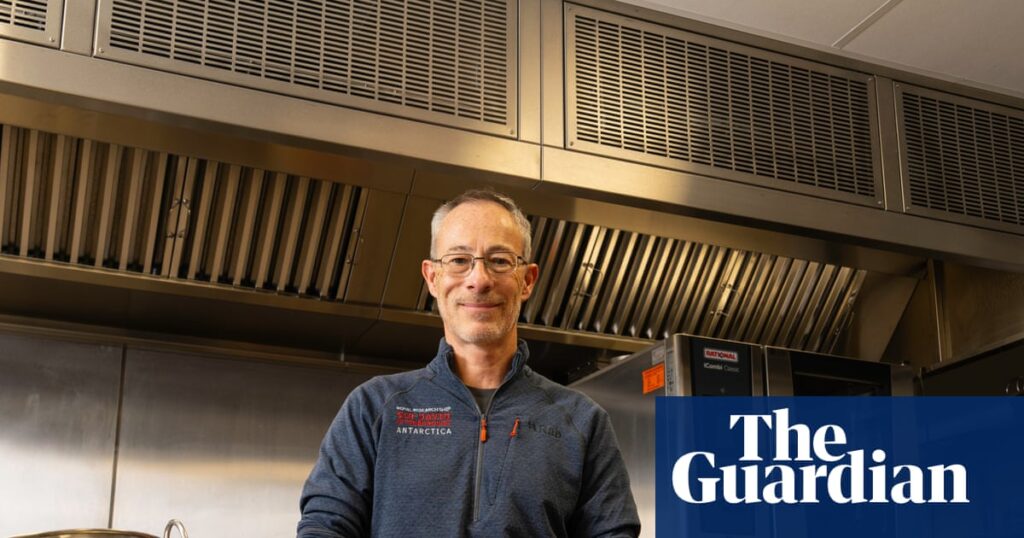
‘Being there, your priorities shift’: in a BAS kitchen in Antarctica. Photograph: Olivier Hubert
You might not think it, but we have a good range of products at our disposal. The food is frozen when it reaches us, so you need to thaw everything. Inevitably, this does affect the taste. With meat, fish or dairy, the quality remains high, but fruit and vegetables can lose their texture and crunch.
You also have to be much more careful about managing what you’ve got. At Rothera station, there’s only one food delivery a year. I order bacon and sausages by the tonne. We’ve got walls of chopped tomatoes and tins of potatoes and all the basics. The dry food fills up to four 20ft-long shipping containers. Our frozen goods fill another one or two similar-sized freezers.
Ours is a good, professional kitchen – you wouldn’t know you’re in the Antarctic unless you look through the window. We’ve got the most amazing view of the icebergs, sea and mountains.
The continent is completely barren – the only thing you’ll see are emperor penguins. But on the peninsula, there’s lots of wildlife: all kinds of penguins, seals and whales. And then there’s the birds: skuas, albatrosses, petrels.
The temperatures are a shock at first: on the ice shelf, it can reach -40C in the winter. When you join BAS, you get a massive kit bag with everything you need, and you’re trained how to look after yourself in the cold. The key is to wear the right kit, avoid getting wet, eat food rich in fat and sugar, and keep active.
Being there, your priorities shift. You realise, in the words of French philosopher Jean Bodin, that “there is no wealth but in men”. A lot of the material things we covet don’t have that much value. Having to recycle, package and ship all our waste back home makes you aware of how wasteful our rich western societies have become.
Coming back to the real world can be difficult. I struggle, thinking: do I fit in to this world any more? When you’re out there, you’ve got to remember how fortunate you are. It’s a privilege, and I remind myself to enjoy it to the fullest.
As told to Emma Magnus
Do you have an experience to share? Email experience@theguardian.com