
Win, lose or draw at the box office, when it comes to making certain movies from a time-tested tentpole filmmaker like Gore Verbinski, ya gotta back the director if you’re a film financier, and ya gotta make it loud by going theatrical if you’re a distributor.
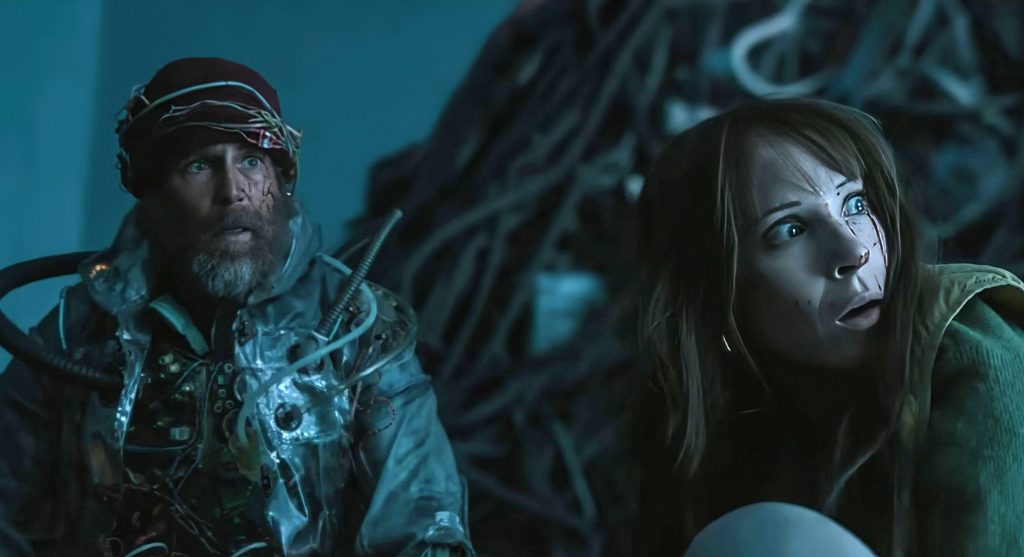
Such is the case for Rango Oscar winner Gore Verbinski’s return to the big screen after 10 years with this weekend’s Briarcliff Entertainment release, Good Luck, Have Fun, Don’t Die. At first blink, who knew the blockbuster Pirates of the Caribbean franchise director had taken a break (note not nearly as long as Terrence Malick’s 20 years’ rest between 1978’s Days of Heaven and 1998’s The Thin Red Line). That said, the filmmaker had been developing other projects since his last movie, the 2016 Swiss-spa psychological horror title A Cure for Wellness, i.e. an X-Men spinoff in Gambit and the once-set-at-Netflix animated project Cattywumpus, (which we first told you about). However, what prompted the $3.76 billion–grossing filmmaker to helm his latest was the chance to work off the rails, with a truly gonzo original screenplay about a guy from the dystopian future who lands at an L.A. diner (specifically Norms), where he recruits disgruntled patrons to save the world from the terminal threat of AI.
RELATED: The Movies That Have Made More Than $1 Billion At The Global Box Office
The journey of Good Luck, Have Fun, Don’t Die was eight years from conception to ultimate big-screen transformation, first hatched by The Invention of Lying co-director and scribe Matthew Robinson as a 26-page TV pilot called Don’t Trust Anyone Under 30.
That concept was a scene in a classroom where a literary major was desperately trying to connect with students over books. There wasn’t enough meat to make a sustainable TV show, so Robinson took another crack and created a Man of the Future plotline with more vignettes.
“We knew there was something really cool,” producer and 3 Arts Entertainment Partner and Robinson’s rep Oly Obst told Deadline. A series of read-throughs of an evolving script occurred at 3 Arts offices with a group of writers and performers to further develop the project. The takeaway of that exercise was that Robinson’s opus would morph into a feature.
“As time went on, the subject matter of AI only became more relevant and timely, and hotter and hotter,” said 3 Arts Entertainment Partner and the pic’s producer Erwin Stoff (whose producing credits include Unbroken, the Tom Cruise movie Edge of Tomorrow and serving as EP on The Matrix and I Am Legend).
“It really reached a point where Matt said, ‘Unless we make this now, the time is actually going to pass us by,’” adds Stoff.
While some filmmakers tried to make a go at Good Luck, Have Fun, Don’t Die, it wasn’t until Stoff thought of Verbinski. He pitched Verbinski, and within two days, it was a no-brainer for the filmmaker, who “responded with the enthusiasm of a gladiator. There was nothing that was going to stand in his way of making this movie,” said Stoff.
Verbinski had a longstanding working relationship with producer Denise Chamian, who came aboard to produce Good Luck, Have Fun, Don’t Die, and it was then that Oscar winner Sam Rockwell’s name came up to star. Once he was attached, the castings flowed with Juno Temple, Haley Lu Richardson, Michael Peña and Zazie Beetz boarding. From there, Constantin bankrolled the movie for around $20M net, with the pic shot in South Africa due to lower below-the-line costs. South Africa has starred as Los Angeles before in the 2006 Colin Farrell Depression-set Ask the Dust, and in the case of Good Luck, Have Fun, Don’t Die, the Norms diner was re-created in Cape Town. Once Verbinski boarded the project, it was close to a three-year journey to the screen.

CAA Media Finance and Gersh held screenings for buyers, and the most passionate to step up was Tom Ortenberg’s Briarcliff Entertainment, known for propelling the Donald Trump origins title The Apprentice to two Oscar noms. Briarcliff got the pic’s Terry Gilliam-esque sensibility, Ortenberg having worked at Columbia during the David Puttnam era, when they had the Valley-turned-London filmmaker’s The Adventures of Baron Munchausen.
Hence the marketing leaned into the hipster Gilliam stylings of yore, the one-sheet of Good Luck, Have Fun, Don’t Die a complete homage to the Monty Python alum’s animation as well as the one-sheet for his 1986 Brazil. The multi-Clio-winning AV Squad was a big partner on creating the campaign under Briarcliff marketing boss David Edwards. Key art designers Kiera Maloney, Ben Garriga and Brain Lauzon at AV Print worked on three posters, respectively. The chief among them was the wired headdress of Rockwell (above), the teaser being the title treatment of a finger on a bomb trigger, and the third being an ensemble (on the right). Other artistic influences in the one-sheets included Mad magazine and the artist Robert Williams.
The pic under Ortenberg’s watch promptly made its way to Fantastic Fest in Austin, where it made its world premiere as a surprise screening. Good Luck, Have Fun, Don’t Die also played LA’s BeyondFest and Palm Springs.
The pic’s campaign leaned into the avant-garde with myriad creative pranks and stunts, i.e. a plane and banner flew over Silicon Valley recently reading “Hire Human Beings #GoodLuckHaveFunDon’tDie”.
Another entailed a 2,000-ticket giveaway to those who lost their jobs recently to AI.
For the Monday night L.A. premiere, Norms was re-created with a banger party complete with klieg lights and a guest DJ set by The Crystal Method, who Verbinski once shot a music video for.
There was also a TikTok fan-edit contest for the pic, whereby participants could take gigabytes of hi-res footage and clips from the movie and create videos with their own artistry.
Some of the social media influencers who got in on the fun included absurdist @TrueWagner (Alan Wagner), who had an AI Son viral video and website stunt that clocked 3M organic views and appeared in NYC Times Square in front of a real (not digital) billboard for the film.
In the end, the movie, which arguably is Briarcliff’s most all-in promo-wise since The Apprentice, could rep an opening record for the indie distributor over four days (their best ever was 2020’s Honest Thief which grossed $4.3M in its Friday-Monday stretch).
RELATED: There’s Something Funny About Indie Releases This Weekend – Specialty Preview
Said Stoff, “Thank God financiers like Constantin exist, because that’s what makes it possible to make these types of films, and it takes this kind of determination to make movies like this and show theatrically.”
Added Obst: “One of the worst types of censorship is self-censorship. If people aren’t willing to take risks on scary, crazy, adventurous stories, then we’ll start to self-censor ourselves and stop trying to tell them.”