
Just 24 hours after Sean Baker arrived in Penang, Malaysia, to shoot “Sandiwara” — the Oscar-winning director’s new short film starring Michelle Yeoh — he threw his initial script out the window.
“It was ridiculous,” Baker tells Variety in a quiet corner of the Ritz Carlton in Berlin, where the short premiered on Friday. “It was like exactly what someone from the outside would be writing from their couch in West Hollywood.”
Baker’s original idea for the short, which is in collaboration with fashion house Self-Portrait’s Residency program — an initiative aimed at bringing together artists from all disciplines to create without boundaries — was a “caper” that saw Yeoh “running from some gangsters,” he says. But once he spent some time in Penang, the director found new inspiration. “It was immediately apparent that this is one of the major foodie destinations in the world,” he says, adding that the city is also “very physically different than what I imagined.”
Self-Portrait founder Han Chong, who grew up in Penang, wanted to make a film celebrating his roots. “It’s much deeper than just fashion,” he says. “Especially when we have Michelle and Sean, I didn’t want to restrict them with a fashion film. The whole idea is tell a story of my hometown — the culture, the emotion.”
Shot on an iPhone, “Sandiwara” follows Yeoh as she embodies five different characters — an influencer, food critic, chef, restaurant server and singer (all wearing Self-Portrait clothes) — as their stories intertwine at a Penang food court. For Chong, it was a dream come true to get Yeoh on board, who he sees as “Miss Malaysia.”

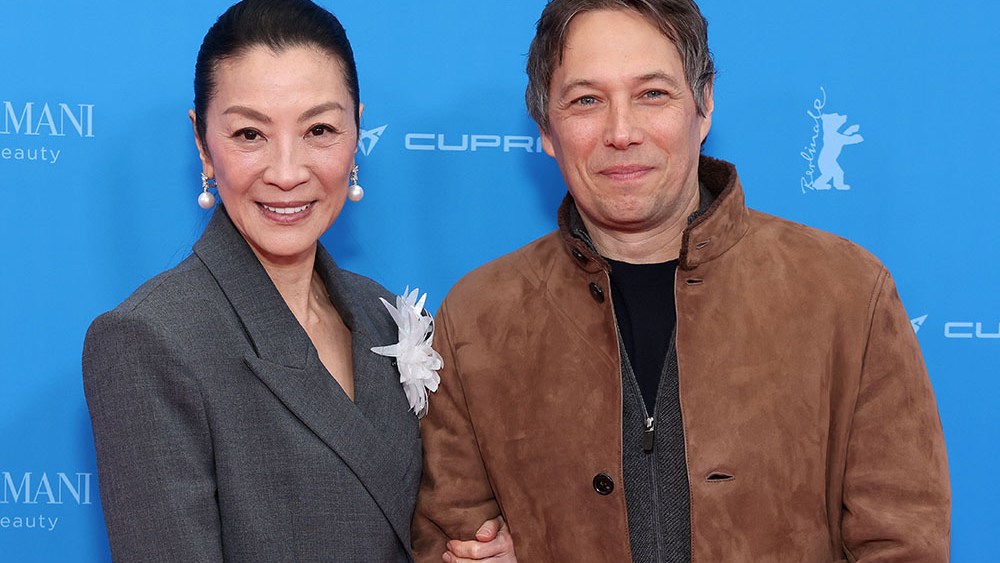
Han Chong, Michelle Yeoh and Sean Baker at Berlin Film Festival.
Getty Images
“In Asia, she represents possibility, so everyone looks up to her,” he says. “And I didn’t just want to do a campaign. I wanted her to represent something for our Asian culture on a global stage and also her talents.”
Enticed by the lack of creative constraints and the chance to get to work with Yeoh, Baker signed on to the project not long after. “Their energy together was so incredible,” Chong adds. “Both of them just wanted to make this work really well. The amount of time they put in, how generous they were, I was like, ‘No way.’”
Below, Baker tells Variety more about “Sandiwara,” working with Yeoh, life post-Oscars glory — and reveals the premise of his next film.
How did the idea for “Sandiwara” come to be and what drew you to the project?
It was just before I started getting very busy with “Left-Handed Girl,” which takes place in night markets in Taiwan and it was shot on the iPhone as well. So I was like, I can do that, I just came from that. But I quickly learned that I was being a little naive — [Chong] was mentioning night markets and food courts, so I just naturally assumed, ‘Oh, it will be very similar.’ But it’s not, it’s its own thing. And so that discovery was wonderful too, because I was able to spend nine days over there prepping for two days of shooting.
You met Michelle Yeoh for the first time on set. What was it like working with her? Obviously, you two got along since you presented her with an honorary Golden Bear this week at the festival.
You know, it was an instantaneous connection. I did not feel intimidated — I normally do with big stars, so it has to be her personality. She’s just very open. Ever since the shoot, which was late September, we’re text buddies. It quickly became a friendship and I think it’s just because she’s really down to earth. There’s no diva quality whatsoever. So much so that we went two hours over on both nights, and she didn’t even blink. She’s like, “I don’t care, let’s just make this happen. We only have this time, let’s do it.” She was very dedicated to it — she wasn’t phoning it in in any way, shape or form.
This film sees you return to your roots of shooting on an iPhone, and part of it has you shooting on a bike through the streets of Penang. What was that like?
We knew she was on a bike, so I was on a bike too. That’s how we shot a lot of “Tangerine,” going up and down Santa Monica. And we crashed on the first take, and I was like, “Oh, this is not going to go well.” But then we got it.
We did some of this in “Anora,” but this was almost fully not controlled. We of course had permission to shoot in that big food court, but 95% of the people in the background are real people, those are not hired extras. So to throw Michelle Yeoh, who is an A-lister, in the middle of that was really exciting for me. Because in the past, yeah my actors were known, but they were blending in to a certain degree. Now, the challenge was to be able to get stuff in the same conditions with an A-lister. And I think it’s a testament to just how much she took on these characters, that of course there would be some double takes — like, “Wait a minute, is that Michelle Yeoh there?” — but it wasn’t like, “That’s Michelle Yeoh!” It was questionable.
What interests you about the intersection of film and fashion?
[Fashion] always inspires me because in all of my films, my characters’ wardrobe choices are very intentional and important. But also, I like to be experimenting with style and so this is my way of doing it. Television is such a machine and commercial spots are obviously not yours whatsoever as the director — this fashion world is the only place where it feels like I’m making one of my films. And Han gave me full creative control. The only thing I was questioning the entire time was, “Is this the most G-rated thing I’ve ever done? Are people going to expect her to suddenly strip?” That was the only thing that I was kind of asking myself, like where is the edge? But I feel that because we’re shooting with the iPhone under florescent lights and stuff like that, there’s still a grunge and a grit.
Michelle Yeoh in “Sandiwara.”
Do you feel like things have finally calmed down for you since the craziness of “Anora’s” awards run?
I went right from “Anora” into “Left-Handed Girl” into this, and so there really hasn’t been a lot of breathing room. But it did take a while to process, I have to tell you. And it didn’t help that I was having to suddenly campaign with “Left-Handed Girl.” I was very happy and proud of that movie, but I also don’t know if I could have gone through all of that again. It’s a lot. So to answer your question, Samantha [Quan, his producer and wife] and I can finally take a deep breath and we don’t have the pressure anymore. A lot of the weight of expectations and stuff has been kind of lifted because winning the Palme d’Or was like my dream come true. And that’s not embellishment — that was my one goal in life. So it happened, and then everything else, including the Oscars and the BAFTAs, it was all gravy. And then it was just like, OK cool, so now there’s no reason to fret anymore. We have to stay grounded and we are — I’m not jumping into an $150 million movie, I’m just simply not doing that.
Have there been offers from studios?
I was offered development deals, but I very much want to make my films independently. I mean, it would be amazing if Neon in the States would distribute my film again. I’d love to work with them again so much. But we are making our film independently so that I can retain full control in terms of everything from casting to content, and not even have to take one note. Because that drives me up the wall. It’s like, why?
So what is your next film? I’ve heard rumors of it being set in Italy and starring Vera Gemma…
Oh, yeah. It’s my love letter to the Italian sex comedies of the ’60s and ’70s, so I’m leaning into that. We want to shoot this year.
This interview has been edited and condensed for clarity.