
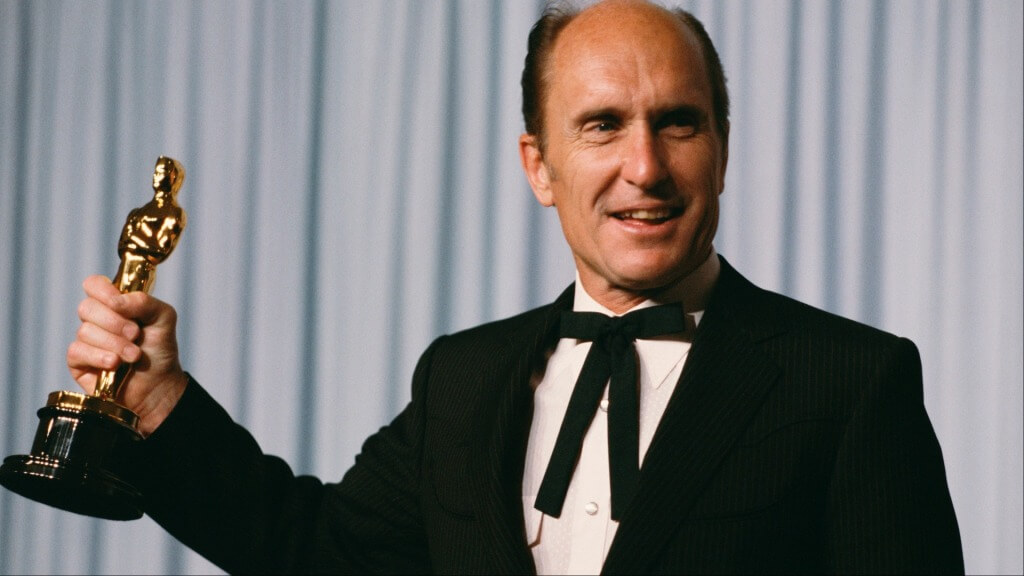
Robert Duvall, the firm screen presence that brought authority and soul to some of the greatest movies ever made, has died. The Oscar-, Emmy-, and Golden Globe-winning actor created more than 145 films, each benefitting from Duvall’s stern looks and serene presence. His wife Luciana shared the news on Facebook. “Yesterday we said goodbye to my beloved husband, cherished friend, and one of the greatest actors of our time. Bob passed away peacefully at home, surrounded by love and comfort,” reads her statement. “To the world, he was an Academy Award-winning actor, a director, a storyteller. To me, he was simply everything. His passion for his craft was matched only by his deep love for characters, a great meal, and holding court. For each of his many roles, Bob gave everything to his characters and to the truth of the human spirit they represented. In doing so, he leaves something lasting and unforgettable to us all. Thank you for the years of support you showed Bob and for giving us this time and privacy to celebrate the memories he leaves behind.” Duvall was 95 years old.
Often considered one of the greatest actors of his or any generation, Duvall came up at a time when Hollywood overflowed with subtle and explosive leading men. However, while the paranoia of Al Pacino and Robert De Niro added an unknowability to their performances, Duvall always anchored himself to a heartland believability. Shrinking in the corner, his heavy brow weighing his hangdog head down, Duvall often held the foundation, providing degrees of irritability and warmth to gangster films, westerns, comedies, and dramas with commitment and experience. Few screen actors are as believable as Duvall. Now, there’s one fewer.
Unlike many of his Godfather counterparts, Duvall was not a method actor. “I just follow the script,” he told Stephen Colbert in 2021. “One scene to the next scene […] You talk, I listen, that’s the beginning and end of it right now.” Duvall always preferred playing characters rather than leading men, which probably explains how he became the standout of so many classics, particularly for Francis Ford Coppola. Duvall was the director’s secret weapon across Coppola’s most successful run of films. The pair first worked together on The Rain People, a role, as fate would have it, Duvall picked up after Rip Torn dropped out.
As the outcast consigliere Tom Hagen, Duvall made one of his signature roles—one that seemingly resembled his actual personality. Always a step removed from the center of the action, Hagen, the Jewish surrogate son of Vito Corleone, was the best pick to run the organization. The mirror reflection of first-born Sonny (James Caan), Hagen is haunted and frustrated by the limits of his role within the family. Duvall brought a bit of that buried pain to the fringes of the screen, always listening and observing. But Hagan’s quiet calculations and level-headed strategies defined the brooding Duvall; another role for Coppola brought out the bluster.
Duvall continued to work with Coppola throughout the ‘70s, nabbing an uncredited role in The Conversation before making his other signature role in Apocalypse Now. Showing he could yell with the best of them, Duvall fired off memorable lines at a machine gun clip as the Lt. Col. Bill Kilgore, a surf-obsessed war hawk who loves the smell of Napalm in the morning. Duvall received his first Academy Award nomination for his performance and helped change the way people heard Wagner’s “Ride Of The Valkyries.”
In between jobs for Coppola, Duvall starred as television executive Frank Hackett in Network. Peter Finch’s “I’m mad as hell monologue” may be the most oft-quoted from the film, but Duvall’s firing of Max Schumacher (William Holden) remains just as explosive and precise. Known for being the quiet man out, Duvall drips with personal satisfaction as he unloads on Holden.
“I think I did okay,” Robert Duvall told Colbert of his performance in the scene. “You gotta keep it within your temperament. Your sense of whatever. Your anger. Your vulnerability […] It’s still you doing it within your set of emotions.”
Born on January 5, 1931, in San Diego, Duvall was the son of an actress and a U.S. Navy Rear Admiral, a middle child of three sons. He was a Navy brat from a family with a robust military lineage. His mother was related to Robert E. Lee, and like other children of Navy admirals, he spent much of his childhood moving around the country, eventually settling in Maryland.
Much to his father’s dismay, Duvall served in the Army during the Korean War, and it was in the Army that he started acting. When he returned from service, Duvall attended the Neighborhood Playhouse in New York City alongside Gene Hackman, Dustin Hoffman, and James Caan. Throughout the late ‘50s, Duvall acted on stage in numerous productions, including The Little Prince, The Crucible, and Agatha Christie’s Witness For The Prosecution. Toward the end of the decade, he jumped to television, starring in an episode of Armstrong Circle Theater. He’d later star in episodes of Alfred Hitchcock Presents, The Twilight Zone, The Outer Limits, and The Mod Squad.
At the Neighborhood Theater, Duvall starred in a play called The Midnight Caller by Horton Foote, who wrote the screenplay for To Kill A Mockingbird. The writer personally requested Duvall for the film, asking him to play the silent but crucial role of Boo Radley, the misunderstood outcast at the center. It was Duvall’s first screen role.
Foote would make another impact on Duvall. In 1984, Duvall won his first Oscar for playing over-the-hill country singer Mac Sledge in Tender Mercies, written by Foote. Having already been nominated four times, Duvall didn’t see winning as a big deal. “It didn’t really affect [my career] one way or the other. It was nice to win,” Duvall told The A.V. Club in 2003. “That was it. It’s okay, but it didn’t do anything special. I went in right after that and tried to get money for The Apostle, but couldn’t get it. Couldn’t get a cent. But it’s better that I did it years later because it seasoned and got richer.”
The Apostle, which netted Duvall another Best Actor nomination, was one of five eclectic films Duvall directed in his career. His first, 1974’s We’re Not The Jet Set, was a documentary about a rodeo family in Nebraska that Duvall met while filming The Rain People. 2002’s Assassination Tango indulged Duvall’s longtime love for the Argentine dance, with the actor playing a long-in-the-tooth hitman who gets wrapped up in tango culture while on assignment in Argentina. His last film, Wild Horses, came out in 2015.
Every time one looks at Duvall’s body of work, another classic performance leaps out, whether from Academy Award-nominated performances in The Godfather, The Great Santini, A Civil Action, or 2015’s The Judge, or the ones he deserved nominations for, like Network, Open Range, or M*A*S*H. However, his favorite performances were on television. His favorite, Gus McCrae in Lonesome Dove, benefitted from being a miniseries, Duvall said, because he could develop his knight of the old West over four episodes.
However, Stalin in Stalin, a role that won him his fourth Emmy, was the toughest. The ever-modest Duvall told HuffPost in 2015 that “the best review he ever got” was from Russian filmmaker Nikita Mikhalkov’s father, Sergey, who worked as Stalin’s personal poet. “He said I did it okay, so that was a good review,” Duvall said. In that same interview, his wife, Luciana, corrected him, saying that the actual quote was that Duvall “captured the soul of Stalin.”
In his personal life, Duvall married four times, but his marriages to Barbara Marcus, Gail Youngs, and Sharon Brophy ended in divorce. In 2005, he married Argentine actor and director Luciana Pedraza, whom he met in Buenos Aires a decade earlier. Born the same day as Duvall 41 years later, Luciana starred in Duvall’s Assassination Tango. The couple founded the Robert Duvall Children’s Fund in 2001 to help impoverished children around the world.