
With Women Of Action, Caroline Siede digs into the history of women-driven action movies to explore what these stories say about gender and how depictions of female action heroes have evolved over time.
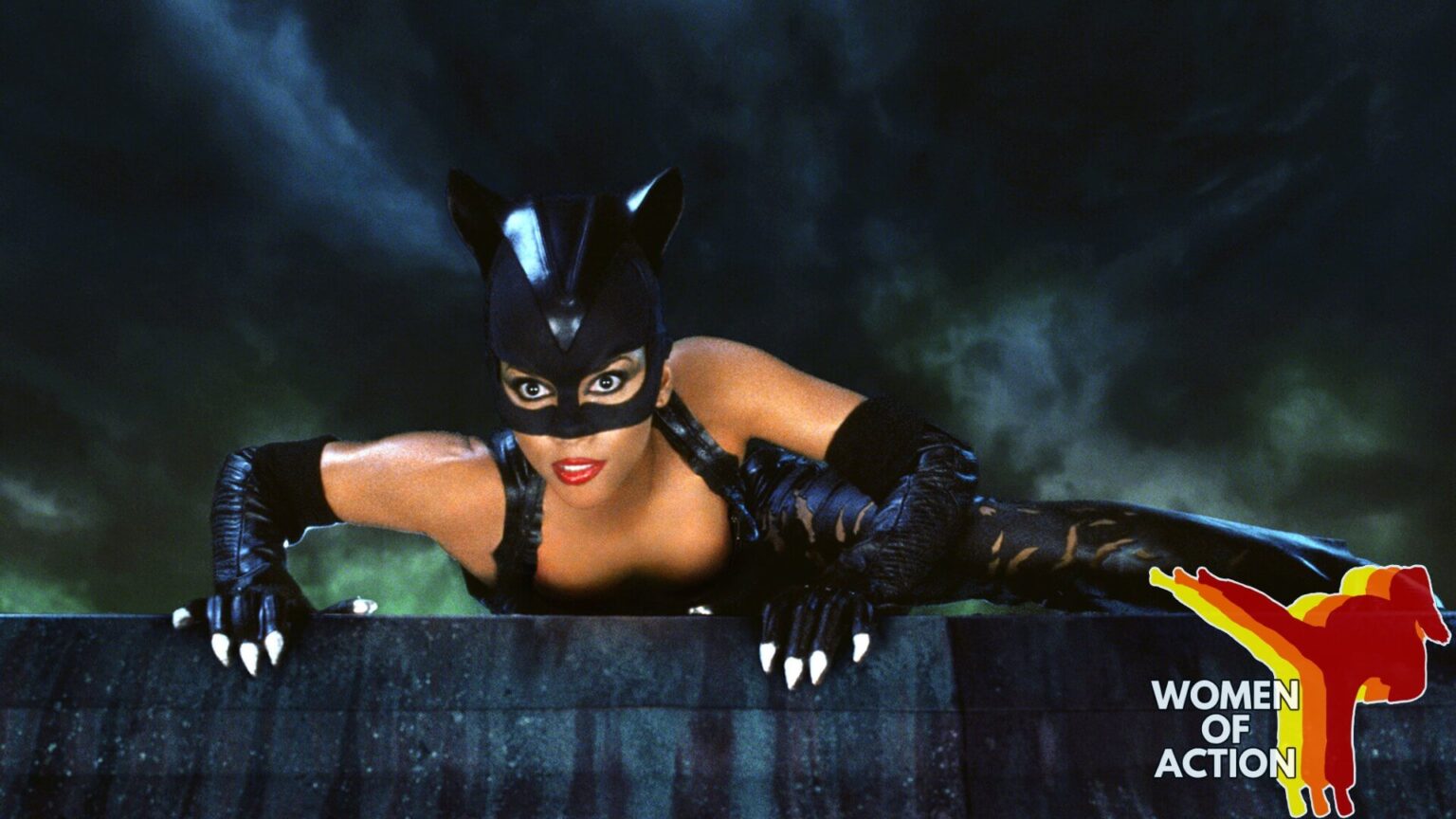
One of my all-time favorite Saturday Night Live sketches comes from Scarlett Johansson’s 2015 hosting gig, when the Marvel Cinematic Universe was at its peak but had yet to produce a female-led film. “Does Marvel not know how to make a girl superhero movie?” a movie-trailer voiceover intones before cutting to an imaginary Black Widow movie in the vein of a mid-2000s rom-com—complete with Black Widow getting an internship at a fashion magazine and Thor serving as her gay best friend. It’s a hilarious send-up of Hollywood’s complete panic around the idea of women-led superhero movies. But it’s also an almost verbatim recreation of a superhero movie that actually did come out in the mid-aughts: Halle Berry’s Catwoman.
It’s a cosmetics company, rather than a fashion magazine, where “fun-deficient” artist Patience Phillips (Berry) works. But beyond that, many of the details are the same as the sketch. The sassy besties endlessly invested in her romantic life? Check. The improbably giant big-city apartment? Check. The quirky klutziness? Check. The meet-cute with a hot guy who winds up on the opposite side of the law? Check and check. All the fake Black Widow trailer was missing was a sexy one-on-one basketball game and a slashed-up leather dominatrix outfit—two of the most-mocked details in an incredibly mocked movie.
But is there any possibility the creators behind Catwoman made a movie this ridiculous without realizing what they were doing? Is this a case of a female-led superhero movie truly not realizing how bad (and borderline offensive) it is? Or is this a case of a movie aiming for camp and missing the mark by a cat’s whisker?
It’s a question that presumably haunts Berry, who—to her credit—showed up to accept her Razzie Award for Worst Actress holding the Academy Award for Best Actress she’d won three years earlier. Catwoman was supposed to be the movie that catapulted Berry into a new stratosphere as a blockbuster actress. Instead, it largely derailed her career into the world of mid-budget thrillers. As she put it in her genuinely hilarious Razzie speech, “First of all, I want to thank Warner Bros. Thank you for putting me in a piece of shit, godawful movie. You know, it was just what my career needed. I was at the top and then Catwoman just plummeted me to the bottom. Love it! It’s hard being on top, it’s much better being on the bottom.”
Indeed, when Berry commits to a bit she really commits to it. Throughout Catwoman she deliriously rubs catnip on her face and scarfs down a can of tuna with her fingers. As Berry explained in Entertainment Weekly‘s oral history of the film, “They gave me a cat early on because I didn’t have one. His name was Playdough. I watched, studied, and learned how cats think. I didn’t have the responsibility of children and family; I was just a woman alone with a lot of idle time to focus on this. I was full-on cat, all the time. I’d crawl around my house, trying to jump on my counters, thinking, If I were a cat, how would I get up there? I was in it 24/7.”
And while it’s hard to say her performance is good, exactly, that level of commitment is probably better than the alternative where she just sleepwalked her way through the film. A lot of movies are bad, but few are as memorably bad as Catwoman, which also gives us Sharon Stone vamping it up as a villainous ex-model trying to sell dangerous face cream, and a scene where Patience searches “cats. women” to try to figure out what’s going on with her new feline abilities. (She eventually stumbles onto a helpful history site with a tab for “diabolical cats.”) It’s impossible to put this on with a group of friends and not have fun laughing at it. That alone is its own kind of cinematic achievement.
Unfortunately, it doesn’t seem to have been an intentional one. Catwoman is a story that unsurprisingly starts in development hell. The original idea, back in 1993, was for Tim Burton to direct Michelle Pfeiffer in a spin-off inspired by her phenomenal work in Batman Returns. When that fell apart, Warner Bros. tried to court Ashley Judd and Nicole Kidman for the role, but then shifted focus towards a lower-budget, Blade-inspired origin story that would be gritty and feminist.
As the superhero genre started to explode in the early 2000s, however, Warner Bros. shifted back to the idea of a big studio movie—one that would have no explicit ties to Batman. French effects supervisor Pitof was brought onboard to direct, Berry was hired for the lead role while filming Die Another Day, and one more set of writers was brought on to rework the script. Scribes John Brancato and Michael Ferris intentionally leaned into a more comedic take on the duality between mild-mannered Patience and her feral alter ego, but studio execs soon began ordering changes and cuts, resulting in what Brancato calls “an oddly cobbled-together version of the script.”
In fact, Brancato and Ferris were hired and fired twice, after a darker rewrite from Men In Black‘s Ed Solomon was trashed just weeks before production began. Pitof had to scrap all his pre-production prep and fire his production designer to appease the studio. “My leverage was little,” Pitof told EW. “I was part of every discussion, but there were 20 people in the room. They’d listen, but I didn’t have what I did in France: final cut.” The film was rewritten constantly during production and reshoots were still taking place up until a month before it hit theaters, all adding up to what Brancato calls “a strange, out-of-control machine.”
Still, as with so many big Hollywood projects, it’s hard to say how much everyone involved is idealizing a project that was maybe never going to work, even without studio interference. While Brancato claims their original script delivered a more satirical takedown of the beauty industry, as Berry put it, “I always thought the idea of Catwoman saving women from a face cream felt a bit soft. All the other superheroes save the world; they don’t just save women from cracked faces.”
Indeed, as silly as it sounds, it’s impossible to overstate how unprecedented Catwoman was as a project. While Berry had already played Storm in the first two X-Men movies and while female-led action blockbusters like Angelina Jolie’s Tomb Raider and Milla Jovovich’s Resident Evil were having a moment in the early 2000s, the list of mainstream American superhero movies starring women basically boiled down to one: 1984’s Supergirl, the poorly received spin-off of the Christopher Reeve Superman universe. And though Eartha Kitt had famously played Catwoman in the 1960s, Catwoman would remain the first and only superhero movie led by a Black woman until Black Panther: Wakanda Forever in 2022.
Rather than grapple with or even acknowledge that glass-ceiling-shattering reality, however, Warner Bros. took the “soft” path. Make Catwoman hot to appeal to the guys. Put her in a rom-com to appeal to the girls. Set the whole thing in the beauty industry because that’s where female protagonists belong. Build the movie around the twist that it’s actually an evil woman running the corrupt cosmetics company rather than a man, which is somehow both progressive and regressive at the same time. End the whole thing with a vampy “cat fight.”
The 2000s were a frictionless, smooth-brained time for feminism and Catwoman very much fits that ethos. In some ways, that’s the best thing about it—there’s a madness to Catwoman that you just don’t get from superhero movies today, which tend to be bad in boring, formulaic ways rather than exhilaratingly off-putting ones.
At its best, Catwoman has a sense of intense comic-book styling that recalls the Sam Raimi Spider-Man movies or the better moments of Joel Schumacher’s Batman films. (There’s an incredible scene where Berry saunters up to a bar to order a “White Russian. No ice. Hold the vodka. Hold the Kahlúa.”) But, at some point, the whole thing just collapses under the weight of its terrible CGI and hackneyed plotting. A movie that’s truly in on the joke would have been able to sustain its ridiculousness to the end, as Batman & Robin does. But Catwoman makes the fatal flaw of trying to become at least a little bit serious about what it means to “die and be reborn” and “experience a freedom other women will never know” as a catwoman. This is its ultimate undoing.
While Catwoman has found its following as a cult classic over the past 22 years, its status as an infamous flop still outweighs any ironic reclamation, particularly for Berry. “I hated that it got all put on me, and I hate that, to this day, it’s my failure,” she told EW in 2024. “I felt like it was Halle Berry’s failure, but I didn’t make it alone.” Thankfully, in the years since Catwoman‘s release, she’s proven to be an effective action heroine elsewhere—both in smaller thrillers like Kidnap and in bigger projects like John Wick: Chapter 3—Parabellum.
Catwoman herself has recovered too, first in the hands of Anne Hathaway in The Dark Knight Rises and then Zoë Kravitz in The Batman. However, no one has yet been bold enough to return to the idea of a solo Catwoman flick. Maybe that’s the most telling lesson Catwoman has to teach us: When Batman or Superman or The Fantastic Four star in a movie that stinks, Hollywood just recasts the roles and makes another one. But when women superheroes fail, they don’t usually get a second chance. Once Jennifer Garner’s Elektra bombed the year after Catwoman, Hollywood put a kibosh on female-led superhero movies for over a decade, until Wonder Woman took a swing 12 years later.
So far, at least, James Gunn’s rebooted DC Universe doesn’t seem to have any plans to change that fate for its feline heroine. Catwoman may be one of the most iconic female characters in the entire comic book canon—and her story feels ripe for a lower-budget, thematically rich retelling—but unlike her male counterparts, she doesn’t get nine onscreen lives.
Next time: Zack Snyder’s Sucker Punch turns 15.