
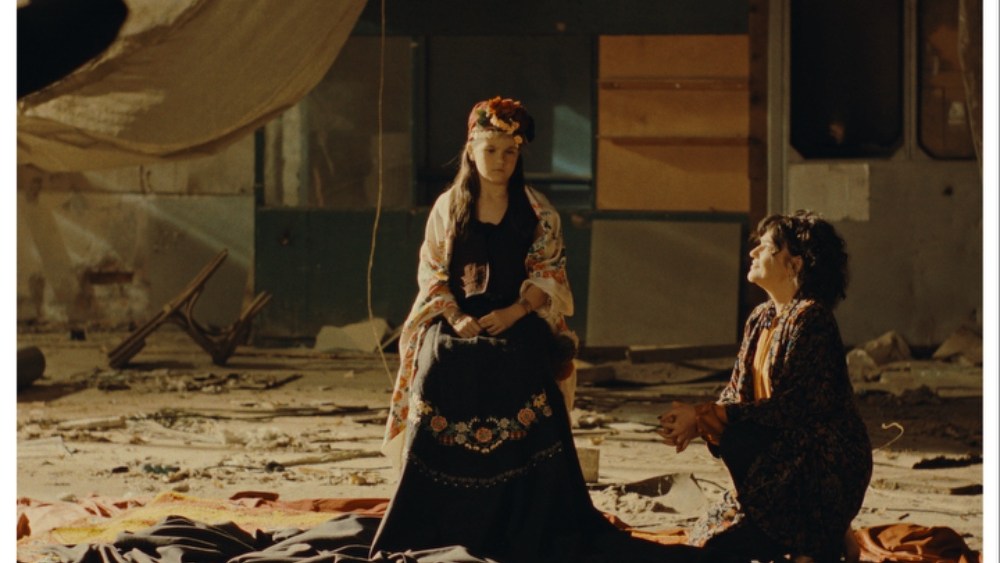
The immigrant experience is most often discussed, and most easily understood, as one of an entire person’s movement and relocation: a journey from A to B and perhaps further letters, with concomitant processes of discovery and nostalgia, alienation and adaptation. It’s less simple, however, to articulate the disembodying nature of immigration: the sense of a phantom self left behind, living the life that might have been, and uncannily confronting you when you return. A film of many subtle, tricky marvels, Geneviève Dulude-De Celles‘s slowly bewitching “Nina Roza” comes closer than many to conveying that strange, imprecise separation of the soul — through both lucidly expressed feeling, and artfully built narrative structure.
One of the quiet surprises of this year’s Berlin Film Festival competition, the Québécois filmmaker’s notably assured second feature arrives seven years after her debut “A Colony” won the Crystal Bear in the same fest’s youth-oriented Generation Kplus sidebar. That film, a simple but piercing portrait of a shy teen caught between opposing peer influences, was familiar in some ways but auspicious in the calm depth of its gaze — and that humane poise is present again in “Nina Roza,” this time in service of more complex characters and more finely calibrated conflicts. The pensive sophistication and opalescent style with which the film unparcels its ideas might not please arthouse crowds wanting broader emotional gestures, but Dulude-De Celles may be a festival-circuit major in the making.
It’s nearly 30 years since Mihail (a marvelous Galin Stoev) left Bulgaria following the death of his wife, taking their young daughter Roza to begin a new life in Montreal. Over time, he has established himself as a leading contemporary art consultant, often called on by collectors and curators to research and validate new talents — though he’s somewhat thrown when regular client Christophe (Christian Bégin) requests his expertise regarding Nina (played by identical twins Sofia and Ekaterina Stanina), an eight-year-old painter in rural Bulgaria whose naïvely abstract but vibrantly composed canvases have gone viral after being discovered by Italian talent scout Giulia (Chiara Caselli). Agents and gallery owners are abuzz; Christophe wants Mihail to determine if the hype is real.
Wary not just of alleged child prodigies, but also of returning to a homeland he hasn’t set foot in since his initial departure, Mihail is reluctant to take the job. He’s spurred to do so, however, by Roza (Michelle Tzontchev), a single parent who now tellingly goes by the anglicized Rose, but is troubled by her growing distance (and more so, her young son’s) from her cultural roots — and her fading memories of a mother who didn’t travel and change with them.
On his arrival in Bulgaria, ambiguities abound, both regarding his professional reason for being there (as Nina, beguiling but hard to read, claims she no longer wishes to paint) and his unwanted reconnection with home. On the one hand, he’s haunted by what’s familiar and constant from his past there. On the other, he’s treated as a visitor by the locals, who mock his accent and distrust his watchful presence; only he can sense in himself any trace of national belonging.
A Bulgarian-Canadian theater director making his film acting debut, Stoev is a compelling thinker on screen: There’s a wounded gravity to his silences that can tilt the direction of a sparsely written scene, while his remarkable face, storied in its lines and hollows and textures, rewards the camera’s sustained scrutiny. But the film makes dialogue count when it wants to: An acrid reunion scene with Mihail’s estranged sister Svetlana (a superb, seething Svetlana Yancheva) is propelled by the vituperative, frankly expressed resentment of those left behind. “Who told you I wanted to see you?” she spits, making clear where her brother truly isn’t at home.
Nina, meanwhile, may or may not be a great artist, but she’s wily and evidently special, with a perspective rooted in her humble, rugged surroundings. (We’re even told the paints she uses, with their unusually earthy colors, are made from natural pigments of the region.) She’s also the exact age Roza was when Mihail uprooted her from Bulgaria, and the longer he spends with Nina, the more she becomes a proxy for Roza’s parallel, non-immigrant self — especially as she faces a similar crossroads, with Giulia and Nina’s opportunistic family eager to move her to Italy, where she’s to attend a prestigious art academy. Nina would rather remain loyal to her soil.
It’s a doubling that Dulude-De Celles never makes overly literal or contrived, but underlines with deft editorial sleight of hand, and the inspired twin casting of Nina, whose temperament and outlook do shift imperceptibly from scene to scene. Alexandre Nour Desjardins’s elegant, glimmering cinematography also plays with the concealing properties of bronzed magic-hour light and minty morning mist, the romantic beauty of the images encroaching on Mihail’s resolve to see things for what they are.