
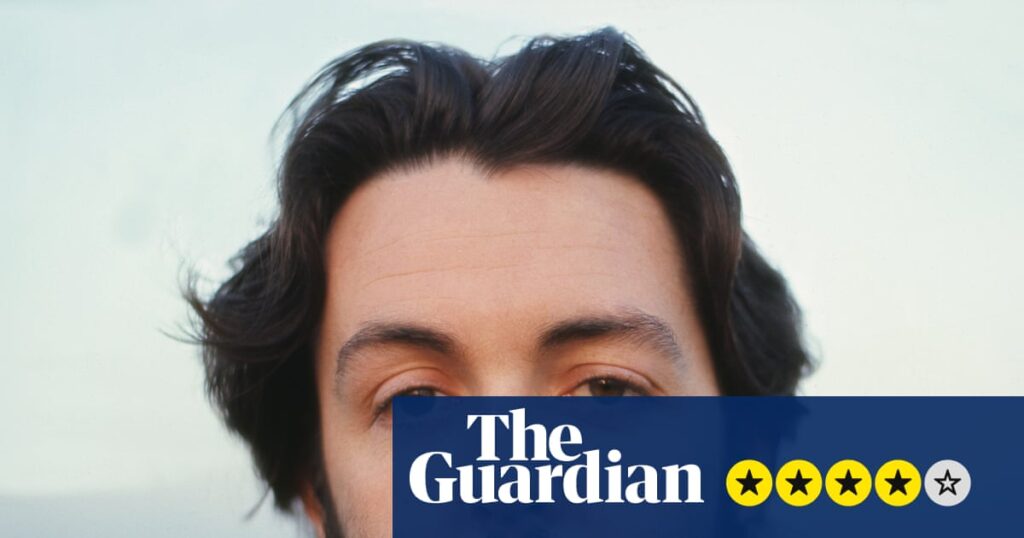
Another hefty legacy project for Paul McCartney, who acts as off-camera interviewee and executive producer in this documentary by Morgan Neville. Man on the Run is comprised of archive film, photos and audio recordings of McCartney and his late wife, Linda, his children and others. Some of McCartney’s overlaid commentary seems to be new, and some pre-existing.
The film tracks his tense, complicated, fruitful career from the endgame of the Beatles in 1969 to the definitive demise of his next band Wings in 1981, a few months after John Lennon’s death – although what exact psychological role Lennon’s life and death played in Wings’ beginning and end is not explicitly discussed. (The film does, once again, show us that startlingly strange and casual-seeming interview McCartney gave after Lennon’s shooting, his shock resulting in an apparently cold attitude – but what he may really have been thinking is something else not explored here in detail.)
When the Beatles broke up, McCartney appeared to be in retreat from the world, winding up in rural Scotland with his wife and children – working on music in a desultory way, but also amassing new songs on his four-track tape recorder. He made solo albums, including the poorly received Ram, whose perceived “diss track” slights towards Lennon resulted in yet more acrimony. While Lennon was spearheading the counterculture in New York, McCartney experimented with a new pop aesthetic of uncool, including a bizarre TV special of outrageously naff vaudeville song’n’dance. Later, alongside Christopher Lee and James Coburn, he would put Clement Freud and Michael Parkinson on the front cover of Band on the Run; strange, considering the calibre of celebrity he surely could have secured. The film’s title, incidentally, is a giveaway hint at how Paul, not the band, is really the star of this show.
The musicians he recruited for Wings included – to press derision – his wife, Linda, who rose above the mockery with good humour: “I’m not here ’cause I’m the greatest keyboard player; I’m here because we love each other.” Fans understood the “family” ethos of Wings; the band played sellout tours, answered the post-Beatle naysayers with the colossally bestselling Mull of Kintyre and appeared to have settled very comfortably into a mainstream identity. However, the film doesn’t mention Wings’ highly political debut single Give Ireland Back to the Irish, released in 1972 and conceived in response to Bloody Sunday.
The lineup of Wings changed a good deal (cue rueful Spın̈al Tap gags), and it now seems as if Denny Laine was really the third and only other Wing; the others were hardly more than session musicians, and perhaps the turnover suggests some unspoken resentment. You may find yourself wondering why we are going over this ground again, but it’s an engaging film, and there is always something mesmeric in McCartney’s face: cherubic, and yet sharp and watchful.
Man on the Run is in cinemas from 19 February, and on Prime Video from 27 February.