
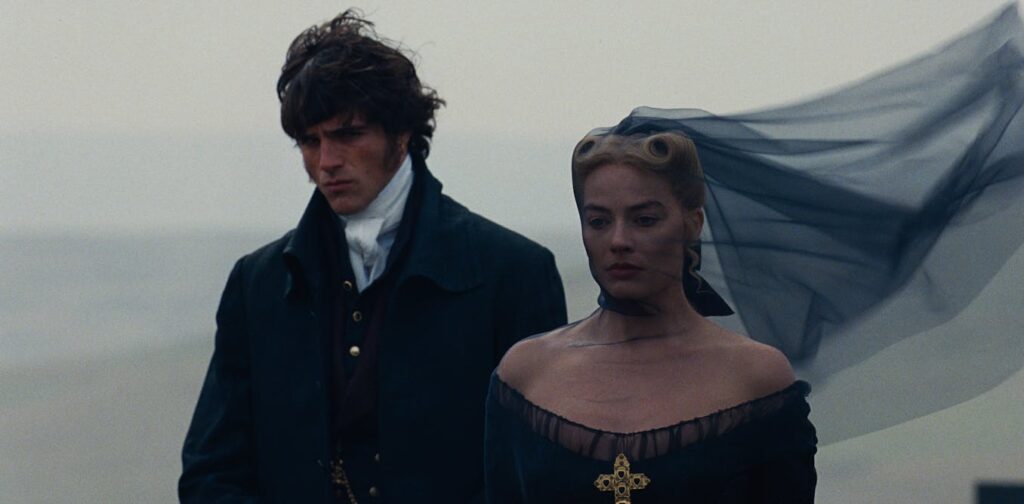
Emily Brontë died of tuberculosis 177 years ago, yet this adaptation is still the worst thing that has ever happened to her.
This is how one Letterbox’d user described writer-director Emerald Fennell’s film adaptation of Brontë’s classic tale.
Reviews for the film are mixed at best. While some critics have praised the visuals, detractors return to the same argument: it is not a good adaptation.
Good adaptations take advantage of the affordances the cinematic medium provides, so some changes are permissible. Fennell goes well beyond this, altering essential characters, relationships and themes to the point that the film feels like erotic fan-fiction with a Hollywood budget.
To synopsise, Brontë’s story is a tragedy of intergenerational trauma. It follows Heathcliff, an abused serial abuser, and Catherine, an intergenerational manipulator. The pair’s toxic relationship – and mutual revenge on everyone they knew (beyond the grave in Catherine’s case) – wreaks havoc.
Visually loud, emotionally mute
Given its tagline “the greatest love story ever told”, Fennell’s film was destined to make some changes.
The frame narrative of the novel is missing. The novel is told through housekeeper Nelly Dean, who is recounting it to Heathcliff’s tenant, Lockwood. The film, meanwhile, starts in Catherine’s childhood and ends at her death.
This also means Fennell stops short of the final act of the novel. In doing so, she omits an entire generation of important characters on whom the original Catherine and Heathcliff – two traumatised, irredeemable wrecking balls – foist their damage.
The interpersonal dynamics that underpin Brontë’s story are warped into a vacuous caricature, missing the point with virtuosic flair. And make no mistake: there is flair. The visual design is bombastic, pointedly anachronistic, and utterly at odds with the novel’s gloomy Gothic countenance.
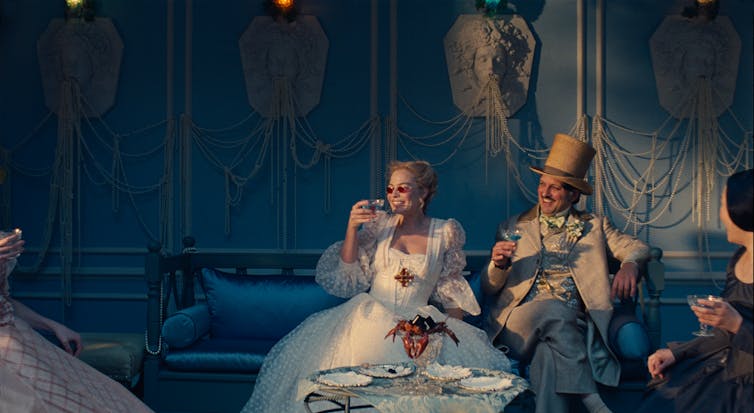
The opulent, richly saturated sets veer sharply from Brontë’s bleak, wind-swept moors.
Photo Courtesy Warner Bros. Pictures
Brontë’s perpetually grey and haunted moors are swapped for technicolour highlights, elaborate outfits and, at times, saturated tangerine sunsets. It watches like Sofia Coppola attempting Edgar Allan Poe – or a Charli XCX clip (guess who wrote the original soundtrack). This is an odd liberty for a film named after the story’s original setting – the stormy Wuthering Heights estate.
As pioneering Gothic theorists Sanda Gilbert and Susan Gubar write, the Heights in the novel are blanketed by “a general air of sour hatred” that manifests as “continual, aimless violence”.
In the Gothic, setting functions as a haunted presence that reflects the characters’ aberrant psychological states. The past haunts, even when there are no ghosts.
Fennell’s version retains the melodrama, but not the foreboding, hate and malice. And despite the explicit sexuality (none of which appears in the novel beyond euphemism), her take on the story feels oddly toothless. Neutered, even. It trades Gothic for vaudeville.
The erasure of Hindley and Heathcliff
To say the film lacks the novel’s social commentary is an understatement.
From the opening scene, the changes to the source material are clear. We see a young Catherine witnessing a hanged man with an erection – and this tone remains for the entire runtime.
Hindley – Catherine’s brother who forces Heathcliff into servitude, and is arguably the lynchpin of Heathcliff’s revenge – is also entirely absent from the film.
Literary critic Terry Eagleton notes how it is Hindley’s inherited status that enables his abuse of Heathcliff. It is Heathcliff’s lack of wealth, status and property that sees Catherine wed the wealthy Edgar Linton; and, as theorist Arnold Kettle argues, it is Heathcliff’s weaponisation of wealth and inheritance that finally serves as his vehicle for revenge.
To remove these factors is to remove the novel’s entire moral framework.
In the film, Heathcliff’s grievances shrink to Catherine choosing to marry Edgar Linton. This is as close as the film comes to the novel’s treatment of classism, racism and intergenerational trauma.
Likewise, ending on Catherine’s death erases the consequences of the deuteragonists’ manipulations – namely the suffering of their respective children and servants.
The casting of Jacob Elordi as Heathcliff has its own controversy. In the novel, Heathcliff’s ambiguous racial identity, within the context of Georgian England, shapes almost every interaction he has.
Even though it’s not clear what his racial identity is (some scholars point to hints that suggest he may have escaped from slavery), his character is defined by “othering”. This is something Elordi’s Heathcliff is at no risk of believably experiencing.
The film flattens the novel’s broader account of how trauma replicates across generations, and how systemic marginalisation can both attract and beget abuse.
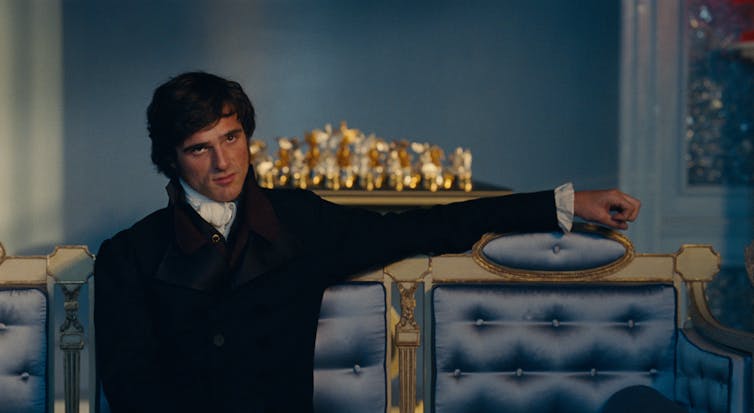
Jacob Elordi’s casting sidesteps the racialised marginalisation central to Heathcliff’s character.
Photo Courtesy Warner Bros. Pictures
On abuse – perhaps Fennell’s strangest departure from the source material is reframing Heathcliff’s treatment of Isabella (Edgar Linton’s sister and later Heathcliff’s wife) as a consensual BDSM dynamic.
Brontë’s Heathcliff terrorises Isabella physically and emotionally, and implicitly sexually, until she flees with their son.
The switch from repressed, complex desire in the novel to explicit sex scenes (absent from the book), and the rewriting of abuse as kink, seems to cater to audiences raised on post-50 Shades Of Grey erotica rather than Victorian Gothic.
Literary classics for a Tiktok generation
Like 2020’s colourful Austen adaptation, Emma (well received as a film, but criticised as an adaptation), Fennell’s Wuthering Heights signals a trend towards the “tiktokification” of literary adaptations.
Hollywood has long taken liberties with books, but this recent wave feels engineered for clips, reels and virality, rather than the necessary sacrifices of adaptation.
We know it’s possible to have adaptations with both flair and substance. Consider Baz Luhrmann. The Oscar-nominated Romeo + Juliet (1996) is just as visually bombastic, yet the extent of verbatim Shakespeare retains a dedication to the source that Fennell’s film lacks.
So what does it have to offer? Virality. Even this article contributes to the internet firestorm that will ensure Wuthering Heights’ commercial success. It will ragebait critics far longer than such a limp effort deserves – and we are all its victims.