
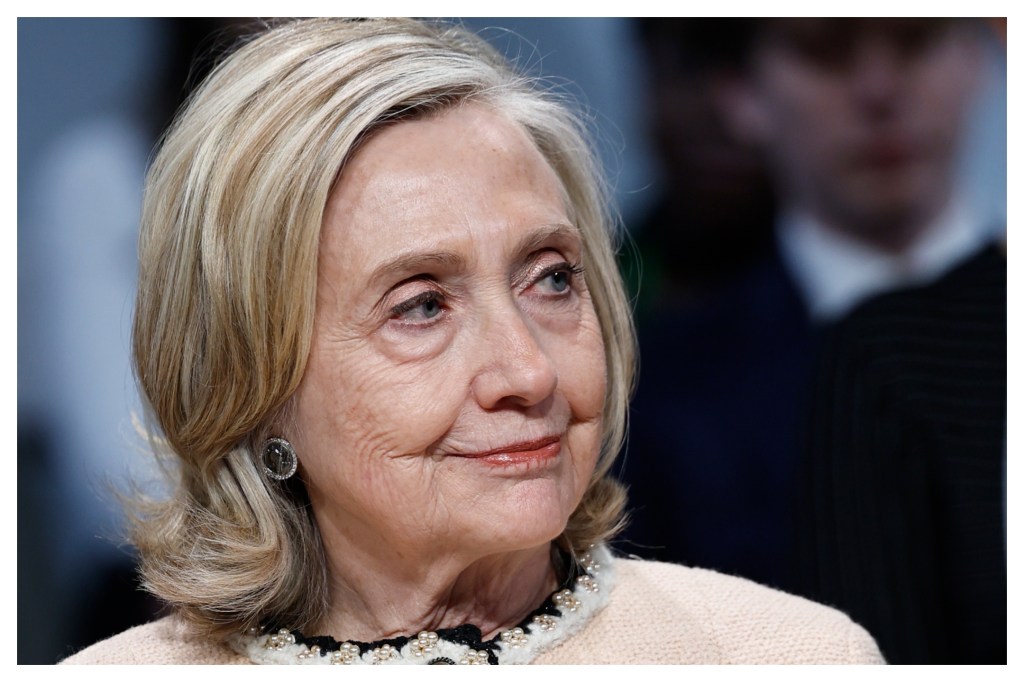
Hot on the heels of the Munich Security Conference, Hillary Clinton touched down on the fringes of the Berlin Film Festival this past week for a screening of Havana Marking’s 2024 Undercover: Exposing the Far Right, organized by NGO Cinema for Peace as part of its annual World Forum.
The documentary follows a 2023 undercover investigation undertaken by UK anti-fascist organization Hope not Hate, in which its journalists Patrik Hermansson and Harry Shukman infiltrated far-right groups.
HiddenLight, the London-based production company created by former U.S. Secretary of State Clinton with daughter Chelsea Clinton and Sam Branson in 2020, is an executive producer on the film, lead produced by Natasha Dack and Amelia Watkins at Tigerlily Productions, with Marking Films Inc.
“We thought it was such an important story, and one that doesn’t get enough attention, about what’s going in a certainly transatlantic, if not international, network of far-right groups … and an effort to turn the clock back on democracy, freedom, on human rights,” Clinton said during an onstage discussion after the screening alongside Hermansson and Marking.
“When a group like Hope not Hate is willing to really put itself at risk to try to uncover what is happening behind the scenes … we wanted to help bring that to a broader audience,” she continued. “I’m very proud of the film. I think it tells a story that’s even more important now than it was when it was filmed, because people didn’t understand what was at stake and what was happening at that time.”
Shukman went undercover at far-right meetings in the UK, Tallinn and Warsaw. Along the way, he rubbed shoulders with the likes of Paul Golding, leader of the far-right Britain First party and its 2024 London mayoral candidate Nick Scanlon as well as neo-Nazi podcaster Ryan Williams, aka Nativist Concern, and Matt Frost, the creator of a site called Aporia, with a scheme for reviving ideas around eugenics with the support of a big tech financier.
Originally due to world premiere at the London Film Festival in October 2024, the film was pulled at the eleventh hour over security fears, a move that bewildered Marking and her producers. It went on to premiere instead on the UK’s Channel 4. It toured festivals after an international premiere at IDFA, but has yet to be showcased or acquired for release in the U.S.
Some 18 months after it first aired on Channel 4, Clinton suggested the work has gained fresh resonance in Donald Trump’s second U.S. presidency and had been ahead of it time.
“It exposed some of what we’re seeing now, not behind the scenes or having to be filmed in secret … it’s just right out there in the open. We are in a great struggle to define the future, to protect the values of our joint humanity. This film should be a wake-up call. I hope more filmmakers, more journalists, more activists expose what’s going on. Not only in the UK, but also across Europe, and certainly in the United States, there are a lot of tentacles that need to be understood,” she said.
“I was at the Munich Security Conference over the last few days, and did an event with representatives from the EU, from individual European Parliaments, and everybody is waking up to a well-funded, very focused effort to create internal dissension within Europe, within the United States, to bring to power or keep in power very right-wing political officials who are promoting a different future for the rest of us.”
Marking, whose previous credits include Afghan Star, Smash and Grab, The Story of the Pink Panthers and The Kleptocrats, said the idea for Undercover: Exposing the Far Right had come through the realization that after years of making films going behind the headlines of the fight for democracy across the world, the story had come to her front door.
“Five years ago, I realized that the frontline is actually in England, or rather the West, that’s where the story is right now. The fight for democracy, it’s here, now,” she said.
Hermansson admitted he was initially reluctant to let Marking into the investigation.
“My responsibility, my in the role in the project was Harry’s safety, Harry’s safety and Harry’s safety and getting the story. It just didn’t seem worth it,” he said.
“We’ve always tried to do these things super tight. Undercover work is built on trust and care for the person doing it. We have to keep it so tight that we can be absolutely sure that nothing can get out. There are lots of other dangers we cannot control, but we can’t be causing the danger by leaking.”
Ultimately, however, Hermansson felt that the documentary’s account of Hope not Hate’s work could be beneficial to its cause.
Touching on the film’s exploration of the Overton Window theory on how exposure to extreme ideas can shift what is acceptable in mainstream discourse over time, Clinton said the window had made a quantum shift in the interim.
“When this film was made, the people that Patrick was getting to know, filming, exposing, they were very focused on the tightness of their networks, on who they could trust and who they couldn’t trust. They had an awareness of how what they were doing and saying might be perceived outside of the circles that they ran in,” said the former Secretary of State.
“If you look at the so-called Overton Window now, people are saying out loud and advocating and doing the kinds of things in public that they used to whisper about or talk about behind closed doors. It’s a very dangerous development … they seem to be much more blatant … just talking about the United States, some of the things that are being said and done in our country right now are so outrageous, so shocking that you could not even imagine them occurring three years ago, five years ago, because they were so beyond the pale of politics.”
She pointed to the shooting dead of Renée Good and Alex Pretti in Minneapolis by ICE immigration agents in January as a “terrible example” of how the window had shifted.
“The immediate reaction was to blame her, to try to tell a story about this woman who was confronting the ICE agents because of the way that they were treating people, no empathy, no acceptance of responsibility,” Clinton said of Good’s death.
“And then, when it happened again and they killed Alex Pretti, they immediately lied about what he’d done and who he was,” she said.
“You can see all these right wing tropes that have been developed by this philosophy that these people have about their commitment to turning the clock back on the world that’s been created in the last 80 years and dominating it … they’re not whispering about it, they’re not talking about it amongst themselves, they’re making these arguments about the replacement theory and white supremacy, and clearly adopting positions that you never would have heard publicly advocated by people in positions of responsibility before.”
The screening took place as part of Cinema for Peace’s annual World Forum conference gathering pro-democracy figures and progressive thinkers and also featuring its annual awards ceremony fundraising gala, which this year feted Kaouther Ben Hania’s The Voice of Hind Rajab and also honored Good with a posthumous award.
In a filmed video-call with the Cinema for Peace founder and chairman Jaka Bizilj, Good’s wife Becca recalled her late partner as someone who “believed in kindness full and fiercely” and “that every person deserved the same compassion, care and dignity regardless of who they were, where they came from or what they looked like.”
She also revealed her wife had been a cinema buff and a fan of the Criterion Collection as well as Wes Anderson.
Asked what her response would have been to the award, Good replied: “She would say this is bonkers, absolutely bonkers.”
Watch the full conversation below.