
In today’s fast-moving media world, brands are frequently required to respond to scandals that may tarnish perceptions of their products or services. Quick responses to quieten rumours or accept responsibility for missteps are crucial.
This becomes challenging when people themselves are the brand. Their behaviour is much harder to control than a press release. They present feelings and emotions that may disrupt any strategic response to scandal.
Britain’s royal family is a case in point – and with the arrest of Andrew Mountbatten-Windsor, their brand is facing one of its biggest tests of the modern age.
Consumers are known to form deeper, more emotional bonds with human brands than nonhuman ones – such as the passionate fans of Taylor Swift, who identify with her on a personal level. The flipside is that any perceived lapses or failures in judgment may also generate stronger emotions, reflecting more negatively on perceptions of that brand.
For years, the royal family has had to navigate publicity around the former Duke of York. Much of this is related to his long-term relationship with the late financier and convicted child sex offender, Jeffrey Epstein. Mountbatten-Windsor’s arrest under suspicion of misconduct in public office places the rest of the family in a position of protecting the brand from damage by distancing themselves from him.
The arrest follows the US government publication of documents that appear to show Mountbatten-Windsor sharing official information with Epstein during his time as a trade envoy. That period, from 2001-11, was not without scrutiny for the then-prince. But the palace generally kept a low profile in response – following the mantra “never complain, never explain” that was often attributed to the late Queen Elizabeth.
Mountbatten-Windsor stepped down from the trade envoy role in 2011, with the palace issuing a simple statement that, in future, he would “undertake trade engagements if requested”.
In the following years, public pressure mounted on the royal family to be more transparent in many respects, especially concerning Mountbatten-Windsor’s embroilment with Epstein.
The turning point from a low-profile brand management strategy to more overt actions appears to have been Mountbatten-Windsor’s Newsnight interview in November 2019, in which he claimed to have broken off his friendship with Epstein in 2010. He also denied allegations of sexual abuse that had been brought by Epstein victim Virginia Giuffre.
This moment provided a focal point that attracted public outrage. In response, the royal family began to take more decisive action to avoid the brand being contaminated or “infected” by the negativity surrounding the former prince.
Social contagion
The concept of social contagion helps us understand how this works.
According to social contagion theory, people are influenced by those around them. This helps explain how behaviour, attitudes or emotions can spread through a group or society, much like a virus. What you may call “cancel culture” occurs when disapproval and moral condemnation of an individual or group snowballs across social media as people feel compelled to join in.
The reaction to the Newsnight interview – memes, mocking headlines and charities and sponsors distancing themselves from Mountbatten-Windsor – would have made clear to the royal family that their brand was at risk from this social contagion.
Despite the late queen’s reported support for her son, the monarchy began taking formal measures to protect the institution. In November 2019, Mountbatten-Windsor stepped back from public duties “for the foreseeable future”. In January 2022, he was stripped of royal patronages and military titles, as well as the right to use His Royal Highness in any official capacity.
The following month, Mountbatten-Windsor settled out of court with Giuffre for a reported £12 million, with no admission of wrongdoing.
Read more:
Spare: how the soap opera around Prince Harry’s memoir will affect the royal brand
In May 2023, although he attended King Charles III’s coronation, he played no official role and was not included in the procession or royal balcony appearance. Since that time, King Charles and Prince William have made it known they do not want him back in public life.
The full removal of Mountbatten-Windsor’s title of prince in October 2025, following the publication of more Epstein-related documents, solidified his permanent exclusion from public life. Most recently, he has been forced to leave his royal residence and move to a more isolated home on the Sandringham Estate in Norfolk.
Both the king and William issued written statements to distance themselves in light of the newest Epstein files, expressing their “deep concern” for Epstein’s victims. The formality of making written statements signalled the seriousness with which they viewed the events, and also acted as a public record of their distancing from Mountbatten-Windsor. In showing their sympathy for the victims, they were aligning morally with them rather than defending him.
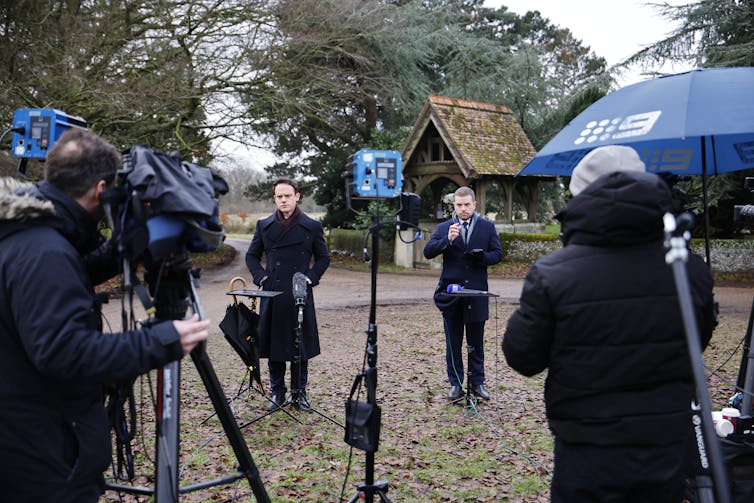
Reporting on the arrest of Andrew Mountbatten-Windsor.
Tolga Akmen/EPA-EFE
Once a brand is accused of criminal wrongdoing, this potentially escalates a crisis from a minor reputational issue into one that risks a complete breakdown of trust in the brand.
In a statement, the king said “let me state clearly: the law must take its course” and “my family and I will continue in our duty and service to you all”. His reference to “Andrew Mountbatten-Windsor”, as opposed to acknowledging him as his brother, makes clear Mountbatten-Windsor’s ostracisation from the rest of the family.
The royal family appear to have navigated their responses to the potential tarnishing of the monarchy in both official and unofficial ways. They have stripped Mountbatten-Windsor of all official roles and titles, excluded him from public royal events, shown public support for Epstein’s victims, and employed a media management strategy that shifts the focus to other royals.
But polling conducted before the arrest suggests the royal brand is still at risk.
Brands can weather scandals by making fast responses and accepting responsibility. But they may also need to build trust again by proving in the longer term that they have changed. Perhaps the royal family is due for a rebrand.