
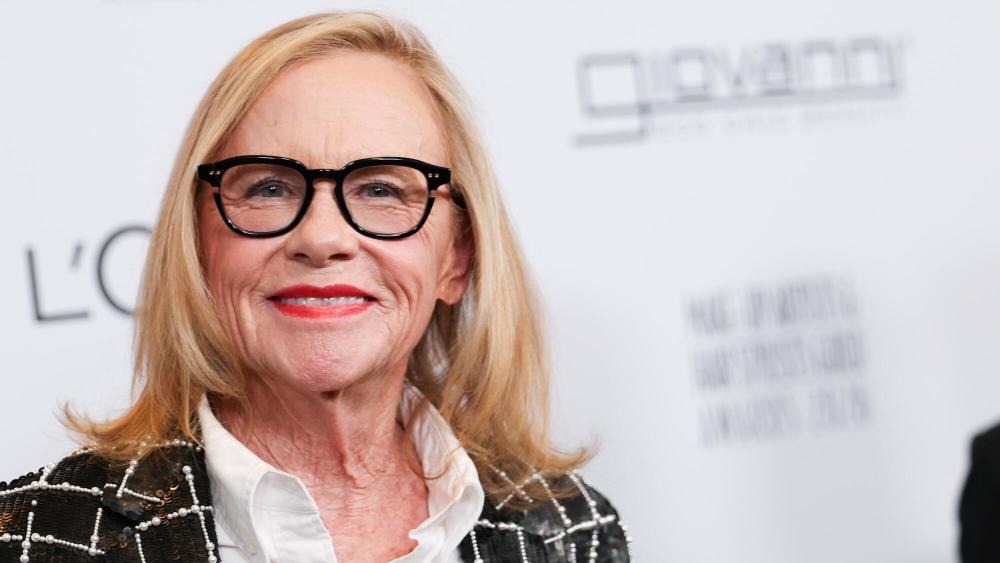
Amy Madigan didn’t expect to be here.
Not in the thick of awards season, not making history with a 40-year gap between Oscar nominations, and certainly not doing it as the ferociously unforgettable Aunt Gladys in Zach Cregger’s horror-thriller “Weapons.”
The veteran actress returns to the Oscar spotlight four decades after her inaugural nomination for “Twice in a Lifetime” (1985), now recognized in the best supporting actress category for playing Gladys, an elderly relative whose late-film arrival in “Weapons” detonates the movie’s final act — and has left audiences shaken ever since.
“I always defer to the writers,” Madigan says. “It’s got to be on the page. It’s got to be the script.” From the moment she read Cregger’s screenplay, she recognized Gladys instantly: “I just fell in love with Aunt Gladys. From the first time she spoke, I just knew who she was.”
That instinct drove everything, including the film’s demanding physical sequences. “This is Gladys. She’s running for her life,” she says. “I can do it. I can do it.” The transformation became a talking point for viewers who didn’t recognize her at first glance — a reaction she calls “the supreme compliment.”
If this campaign has reframed Madigan for younger audiences, she’s clear-eyed about what it means and what it doesn’t. “I’m an ultra-realist, because I’ve been doing this a long time,” she says, adding, “I am on people’s radar. People are paying a lot more attention.”
But she’s blunt about where she is right now: “Right now I’m unemployed. So that’s what happens.”
In a season crowded with comeback narratives and overdue recognition, Madigan’s story lands differently. She never stopped, but finally, the industry caught back up.
Read excerpts from her interview below, edited and condensed for clarity.

Amy Madigan in “Weapons”
Warner Bros.
You are here receiving your second Academy Award nomination 40 years after your first. You now hold the longest gap between two nominations for an actress. Your first was in 1985 for “Twice in a Lifetime.” Did you ever think you’d be back?
No. I can be honest with you. The first time around, it was a complete surprise. The whole world of how you navigate all of this was completely different. I worked with a cast — Gene Hackman, Ellen Burstyn, Ann-Margaret and Brian Dennehy — so I was just like, wow, I know these people through their work. I was very surprised. But this time around … I mean, did you think Aunt Gladys would end up here at the Oscars? No [laughs]. Not because of quality, but because of genre bias. But I’ve loved being wrong about this.
And with a Critics Choice Award under your belt, too. How did that feel?
Once again, I was in a stellar group of people. I was not expecting it. When they called my name I was like, “What?” And if anybody’s watching, I ran up there, which was kind of hilarious. But it was a delight. Critics’ work is personal, it’s very emotional, and we need it to help get the word out — to show people, no, this is a great piece of cinema. The love that’s come for Aunt Gladys was not expected.
This may be an overused term, but you are truly “unrecognizable” in the role. A number of people have said they didn’t know it was you.
A number of people have said that, and I say that is the supreme compliment. As an actor, you hope you can just go inside of yourself and the character. The look had so much to do with Aunt Gladys. It took us a while to figure it out. We did a lot of tests, put things on, took them off — but we had it at just under three hours. Compared to others like Jacob Elordi (“Frankenstein”), who I understand was in the chair nine to 11 hours. But when you have a part like that, you do it. And you need to trust the people around you.
To get the part, was this a traditional audition or something else entirely?
The people I work with said Zach Cregger was doing a new movie. I had seen “Barbarian,” which I thought was unbelievable — don’t pull that rope in the basement. So I knew Zach could really make a movie. I was told he’d like to meet for lunch. And Zach has been very open about this: On the way to lunch, he was telling himself, “Do not offer her the part. Do not offer her the part. Let’s just see what happens.” We just started talking — he was very open, volunteering personal information about his life. And after lunch, he says, “The part’s yours if you want it.” He’d seen my work over the years and knew I had the right combination of cutting someone down and being playful about it.
I have to admit something a little embarrassing. I’ve loved the Oscars my entire life, but I learned only in the past few months that you were married to Ed Harris.
That’s good, though. That’s how it should be. I stand by this notion — he should have won for “The Hours” (2002). What’s your favorite Ed performance? Well, I’m partial — I can’t be impartial. But I think “Pollock” is a great movie. Sony just remastered and recolored the whole thing. It’s so hard to make a story about an artist’s work. It’s a beautiful film. And to play Peggy Guggenheim — I was kind of like, “Ed, I’m not a Jewish woman, I don’t know.” And he goes, “No, no, you can do this.” So I worked with another prosthetic, wigs, all of that. He’s a great actor. We met doing a stage play here in Los Angeles, right on the stage. And you learn a lot about a person when you’re standing on the boards with them. There’s no equipment around you.
How has he been through this whole awards run?
When Ed got his nominations, it was such a different time. There was no real awards circuit like this. Not a ton of press. Now it’s such a different thing, and this whole enveloping process. But to answer your question: Ed is thrilled for me. He knows what it’s all about, and he knows the business side often doesn’t coincide with the artistic side. I’m very lucky that I’ve got someone watching my back.
Knowing how much you love classic cinema — if you could go back to the ’40s or ’50s and work with any of those great actors, who would you choose?
For the women, I’d love to work with Bette Davis. When you think about a young woman starting her career, doing “Of Human Bondage” — I mean, she was just such a great actress. And of course, look at the material she had. For the men, I always wanted to work with Richard Widmark or Robert Mitchum. Widmark was often the ancillary guy, except when he had that one — “Panic in the Streets” (1950) — where he was running around the city with the bubonic plague. That was a very scary movie. There was something about those films, and the cinematography knocked me out.
Being back on the circuit looks a lot different. Who’s been one of your favorite people you’ve met along the way?
Wagner Moura (“The Secret Agent”). We became cigarette buddies, and we’d go out on the platform and have a real conversation. That movie, first of all, is so necessary right now politically, given what’s going on in our country. And his performance is very understated in this dramatic way. I was very emotional watching it. The art has to be out there. I’ve never been one of those people that’s like, “Shut up and play basketball.” No, you have a platform, and now more than ever, that platform must be opened and exposed and blast out there.
Did you watch Bad Bunny and the Super Bowl halftime show?
I got to see the halftime show, which I cranked at 11, as they say. And I was just floored. It was so emotional. It was so beautiful. It just enraptured everybody. And it really did make me giggle that the people on the other side of the aisle were just so offended and flipping out about it. What’s happening with ICE, what’s happening in Minnesota, across the country, in the Middle East — things are not mutually exclusive. But I think people are paying attention here in the United States.
Looking over your career, what’s the one thing that’s part of your legacy — something that reminds people why you became an actor?
When I mentor young people, I say: If you can do something else, do it. You have to grind. You have to want this more than anything, even if that means three jobs on the side. But what always gets my heart — it’s my love for it. It’s about the work. And “the work” is a wonderful word. It’s not artsy. It’s not precious. You do the work. And that is the most exciting thing to me. And it still is.
Variety’s “Awards Circuit” podcast, hosted by Clayton Davis, Jazz Tangcay, Emily Longeretta and Michael Schneider, who also produces, is your one-stop source for lively conversations about the best in film and television. Each episode, “Awards Circuit” features interviews with top film and TV talent and creatives, discussions and debates about awards races and industry headlines, and much more. Subscribe via Apple Podcasts, Stitcher, Spotify or anywhere you download podcasts.