
Steven Spielberg wrote a check for $25,000. Zoe Saldaña pledged $2,500 a month. Jon M. Chu gave $10,000, Norman Lear’s widow, Lyn, chipped in $5,000, while a slew of others — TV writer Julie Plec, talk show host Ricki Lake, model Lydia Hearst — signed up for thousands more.
In total, the GoFundMe launched to help James Van Der Beek‘s widow and six children so far has collected more than $2.6 million — tangible, dollar-and-cents proof of how much the Dawson’s Creek star was valued in Hollywood and how genuinely shaken the town was when, on Feb. 11, at just 48, he lost his three-year battle with colorectal cancer.
But, of course, no good deed goes unscrutinized, and those donations have been raising some prickly questions, especially online, where not everyone has been feeling so generous about Van Der Beek’s GoFundMe campaign. Scores of posters have been wondering out loud why the family of such a famous actor — the star not only of a seminal millennial teen drama that ran on The WB for six seasons but of a string of later TV projects and films— would require an online fund-raiser.
“This doesn’t sit right with me. Not at all,” one skeptic wrote on Threads, piling in on the backlash. “Sure, I get it. But thousands of people around the world face this exact situation every day and deal with the struggle. They don’t get $2.5 million. It’s just weird. He had to have had life insurance … and residual checks.”
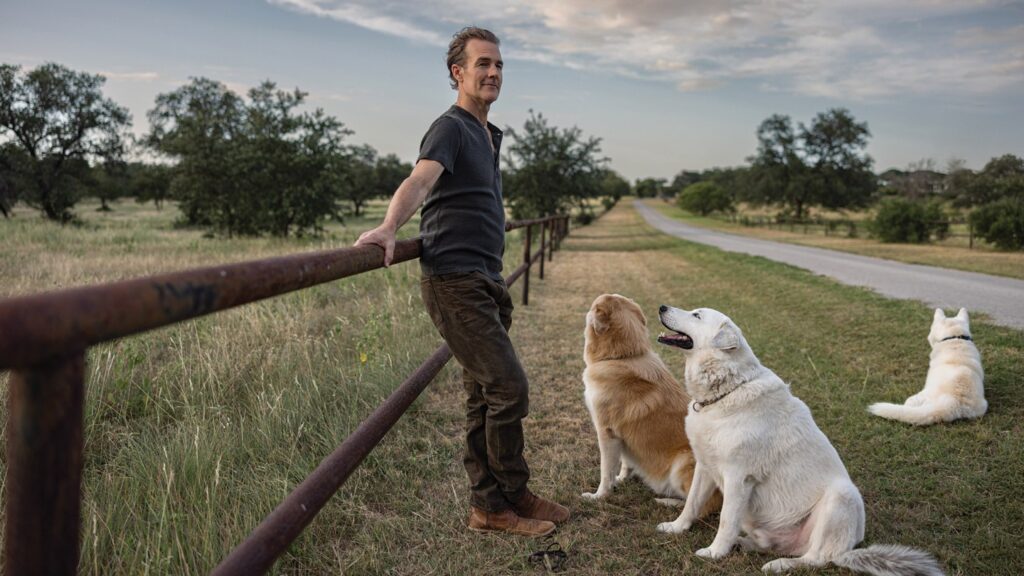
Maybe. But Van Der Beek, for all his widespread name recognition, was not a super-high-net-worth celebrity — or at least he didn’t spend super conspicuously. He didn’t travel by private jet, bankroll an entourage, collect museum-grade art or own multiple extravagant homes — or even one, for that matter. Until shortly before his death, he was renting the 36-acre ranch outside Austin, where he moved in 2020 and where he spent his final days among his family and friends, along with a small menagerie of horses, dogs and chickens. Whatever money he made through his decades onscreen — and from what can be pieced together from interviews and industry realities, it probably wasn’t a huge amount — got sucked up by the costly business of battling cancer, especially the alternative therapies Van Der Beek was said to have leaned into. By the end, he was reduced to auctioning off Dawson’s Creek memorabilia online, like that E.T. toy his character kept in his bedroom (it sold for $6,000).
“It was a lot of ups and downs these past few years,” a family friend tells THR. “The last year, he really tried to do everything. After attempting the holistic route, he traveled and tried to get other options. He really wanted to live and had a lot to live for. He fought really, really hard.”

The actor with his wife, Kimberly, and their kids (clockwise from top left), Jeremiah, Olivia, Joshua, Emilia, Gwendolyn and Annabel.
Courtesy of GoFundMe
***
The role that made Van Der Beek famous — Dawson Leery, the earnest, Spielberg-worshipping aspiring filmmaker whose romantic idealism and habit of narrating his own life helped drive Dawson’s Creek to hit status when it arrived on the airwaves in 1998 — did not make him rich. Like most young actors landing their first big TV gig, he was paid peanuts, at least at first.
“This was a Kevin Williamson script, and every actor we cast was essentially unknown,” recalls a Warner Bros. source. “Katie Holmes was cast from a home video on her kitchen counter. I can’t imagine James had any points.” Another knowledgeable source believes that Van Der Beek likely started the series at scale, got bumped up to something like $35,000 an episode and in later seasons pocketed closer to $200,000. But residual deals back then were notoriously stingy, particularly for new talent, so when the series ended its run in 2003, there wasn’t a whole lot of ongoing revenue.
“There was no residual money,” Van Der Beek bluntly told an interviewer in 2014. “I was 20. It was a bad contract.”
Van Der Beek with Katie Holmes on Dawson’s Creek.
Courtesy Everett Collection
After Dawson’s Creek, Van Der Beek worked steadily, but not in the sort of long-running, hit vehicles that tend to mint fortunes. He had some memorable turns — 26 episodes of Don’t Trust the B—- in Apartment 23; 31 of CSI: Cyber; eight of Pose — along with film roles in such movies as Varsity Blues and Rules of Attraction that kept him visible without necessarily delivering Marvel-level paydays. His 2019 turn on Dancing With the Stars might have been a bigger jackpot if he’d made it past the semifinals (reported figures suggest he likely earned about $250,000).
Van Der Beek with Amy Smart in Varsity Blues.
Deana Newcomb/Paramount Pictures/Courtesy Everett Collection
None of this is to suggest that Van Der Beek was anything like destitute. Yes, there were some IRS issues in the early 2020s (he reportedly owed, and eventually paid, an overdue balance of $269,000 in taxes). But he was a working, in-demand actor who, just five years ago, was pulling in good money on the Disney Junior animated preschool series Vampirina. Based on industry norms, his paycheck for playing Boris the Vampire on 73 episodes could have been upward of $500,000. Last year, he’d appeared in two episodes of Overcompensating and the teen sports romance Sidelined 2: Intercepted and was cast in a recurring role on Amazon’s upcoming Legally Blonde sequel, Elle.
But raising six kids, even in Austin, is expensive, and the rent on that 36-acre ranch — which before Van Der Beek’s arrival was sometimes leased out as a wedding venue — wasn’t cheap either (comparable properties in the area can go from $10,000 to $30,000 a month). Reports that Van Der Beek had purchased the place just before his death for $4.8 million turned out to be only half true. Reps for the actor told People that “James secured [a] down payment for the Texas ranch for the family with the help of friends through a trust so they could shift from rent to mortgage.” But the rumors that he had that kind of money fired up the online criticism of his GoFundMe page, to the point where Van Der Beek’s friend and fellow actor Mehcad Brooks felt compelled to respond.
“You have no idea wtf you’re talking about,” he posted. “You have no idea the pain they went through. It’s ok to stfu when you can’t know what the fuck you’re talking about.”
One thing it’s safe to say about Van Der Beek’s finances is that even in his leanest year, he was almost certainly earning at least $28,090 — the minimum acting income required to qualify for SAG’s insurance plan. Those famously generous benefits would’ve covered a large portion of his cancer treatments. But, of course, not even the best insurance plans cover alternative medicine — and a source close to the Van Der Beek family confirms that along with standard medical treatments, he turned to nonstandard ones.
It’s not surprising, given that Van Der Beek’s wife, Kimberly, has long been a champion of alternative medicine. Indeed, her Instagram feed — which, between adorable photos of her towhead kids cavorting on their ranch offers a hodgepodge of whole-body remedies and interviews with natural-health gurus, along with a smattering of vaccine misinformation and debunked conspiracy theories, like the one about 5G phone signals causing brain cancer — has turned her into a star in her own right, a wellness influencer with some 280,000 followers.
The couple married in 2010 — shortly after Van Der Beek’s divorce from his first wife, Party of Five actress Heather McComb — and settled into a 3,100-square-foot Spanish colonial in Beverly Hills (James designed the poolside daybed himself, according to an Architectural Digest piece). But about six months into COVID, they picked up their kids and decamped from L.A. to the Texas town of Spicewood, population 8,000.
Turns out they weren’t the only Angelenos with that idea. Podcaster Joe Rogan, Shazam star Zachary Levi, actress Haylie Duff, comedians Theo Von and Tim Dillon and even for a time Elon Musk — in the early months of the pandemic, they were all part of a self-styled libertarian expat cluster that turned the Austin outskirts into a “conspirituality” hotbed, a fringe hub where wellness culture and COVID conspiracy rhetoric coexisted in perfect harmony.
Van Der Beek’s own attitudes about traditional medicine are difficult to pin down. In 2014, he was comfortable enough with it to partner with AstraZeneca on a flu shot-awareness campaign. And in 2021, after Kimberly suffered a pregnancy loss, he worked with the Red Cross to promote blood donation. Still, at the same time, he was also at ease socializing with outspoken anti-vaxxers and anti-maskers. A 2022 Rolling Stone exposé on Kimberly’s online wellness brand found Insta posts from a March 2021 gathering in Austin showing her husband alongside anti-mandate champions like Dr. Micah Pittman, the Texas chiropractor who became famous for his outrageous COVID conspiracy memes. It’s perhaps notable that the one and only time Van Der Beek spoke publicly about politics — at least that can be found online today — it was during the 2020 presidential campaign when he posted a video calling the Democratic Party’s primaries “undemocratic” and complained that Joe Biden was too old to be president (something George Clooney was also saying at the time, but still).
A GoFundMe page has been set up with the family “facing an uncertain future.”
Courtesy of GoFundMe
Whatever Van Der Beek’s ideological bent, it’s understandable he’d want to throw every possible treatment at his cancer, no matter what the cost. Not much is publicly known about which wellness therapies he attempted, but as a rule, these regimes can be pricey. Some intensive holistic specialized clinics — often overseas — reportedly charge between $15,000 and $65,000 per stay. Some of the non-FDA-approved “cancer-fighting” dietary supplements, like Poly-MVA, require a small fortune to take, up to $20,000 a year. And all of it is strictly out-of-pocket, no matter how great your guild insurance might be.
Somehow, though — miraculously — throughout his treatments Van Der Beek remained almost supernaturally upbeat, turning his battle with cancer into what may well have been the most inspiring performance of his career. “When I heard the news,” he said during a Today interview, “I was like, ‘This is going to be the best thing that’s ever happened to me.’ I had this little voice in my head that said, ‘You’re going to make changes in your life that you would never, ever make if you didn’t have this extreme of a diagnosis, and it’s going to add healthy, happy years to your life.’ “
Ultimately, tragically, that didn’t turn out to be true. For Van Der Beek, traditional treatment proved no more effective at staving off the inevitable than the alternatives. And while nobody outside his family may ever know exactly how much money he made over the years or how it got spent, the true final accounting isn’t the one in his bank account. It’s not even the tally on that much-debated-about GoFundMe page. It’s the number of friends, colleagues and strangers who decided that his life — and the people he loved and left behind — were worth investing in.
Chris Gardner, Katie Kilkenny and Tony Maglio contributed to this report.
This story appeared in the Feb. 23 issue of The Hollywood Reporter magazine. Click here to subscribe.