
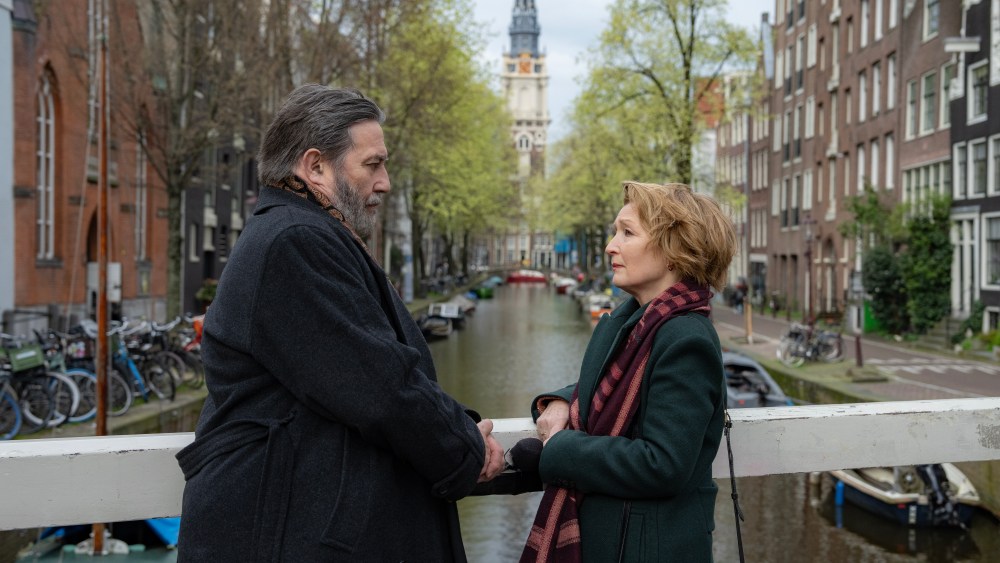
Lesley Manville and Ciarán Hinds are such terrific actors that a lot of us would follow them anywhere. But in the wee drama “Midwinter Break,” these two pour their skills into playing a couple of fuddy-duddies — a homepsun Northern Irish married couple, Stella and Gerry, who have reached their early seventies and are so set in their dainty, placid ways that they’ve become like two old pieces of cozy matching furniture. They sit, they read, they have a drink, they have a meal, they exchange comforting pleasantries…and then another day is behind them. And another, much the same, lies ahead.
The whole design of the movie is to take these two out of their comfort zone, to dip beneath the stodgy surface contentment of their well-worn habits and touch the explosive emotions that the couple — or, at least, one of them — has been covering up.
At Christmastime, they’re at home, Gerry seated in the living room nursing an evening cocktail, when Stella asks if she can still tempt him; we wonder if she means something erotic, and when he turns her down, we really wonder. (Is the threadbare dimension of their marriage that the fire has gone out in the bedroom?) But no, she’s just talking about going to church. Stella and Gerry exist in a state that looks halfway between retirement heaven and a coma. The two have a son, who is grown, who they don’t see very much. They are also exiles: residents of Glasgow, Scotland, even though the film presents them as Irish to the core. There’s a reason they left their homeland behind.
In the middle of the night, Stella gets up and goes over to the computer, acting on a sudden inspiration. A bit later, after exchanging Christmas presents, she hands Gerry an envelope with a surprise gift inside: two plane tickets to Amsterdam, where she has arranged for them to have a four-day getaway. She wants to shake up their routine. But as soon as they arrive in that elegant Dutch city of bridges and hidden corners, it’s clear that it’s going to take more than a change of locale to do it.
The movie opens with a jarring flashback. We see the young Stella (Julie Lamberton), very pregnant, being rushed to a hospital after some kind of accident (she has blood on her arm). A cataclysm took place, but we’re not sure what, and our first thought is: Did she lose the baby? Is their son not their actual son?
As Stella and Gerry settle into their Amsterdam vacation, having breakfast at the hotel, visiting a fabled art museum, always lubricating the day with a pint, a glass of wine, a tumbler of Scotch (Gerry brings a bottle along with him in case he needs a quick refill), we register the depth of their connection. (In the bedroom, it turns out, the fire is still alive.) These two fit into each other’s lives as snugly as nesting dolls, to the point that they may have no surprises left, nothing new to discover.
Except that they do. Stella wants to visit a women’s housing facility that’s also a stately convent: a Catholic retreat nestled right in the middle of Amsterdam. A devout Catholic herself, she’s intensely interested in the women who live there. She tells Gerry, who has always been a secular man, that she wants to find a way to be more devout in her own life. And the reason for that is that she wants…more. More than what the two of them already have. This leaves Gerry flabbergasted. What’s the “more” that she could be talking about? He has no concept of it. He thinks their lives are perfect.
It all connects, of course, to that opening flashback. But what happened there is not, perhaps, what we suspect. Was it a miracle? Stella thinks it was. But the real point may not be about what did or didn’t happen. It’s about how two people in a marriage this close could be so cut from the same cloth and, at the same time, so different. Not because there’s some deep dark secret, but because people are…different. Gerry, we can see, drinks too much (he’s the definition of a happy “functional” alcoholic), and Stella has a problem with that, but the real problem isn’t the drinking. It’s the void Gerry is covering up. And Stella now wants to fill her own void with faith.
The director, Polly Findlay, presents all of this in a fluid and fastidious prestige-teleplay-of-the-week way. Adapting a 2017 novel by Bernard MacLaverty (the script is by MacLaverty and Nick Payne), she creates a generous space for her actors, who turn what might have been a rather staid movie — and still, at times, is — into a meticulous duet.
Manville has often played characters of magnetic will (just think of her domineering snob of a sister in “Phantom Thread,” her lusciously obnoxious tippling receptionist in “Another Year”), but in “Midwinter Break” she throws us for a while because her Stella, at first, seems the picture of dowdy devotion. But it turns out that she’s devoted to something deeper, a mystery she can no longer repress. Manville, in a nifty feat of acting, lets that unruly spirit poke through, even as she persists in trying to keep a polite lid on it. She shows us the spirituality of an ordinary woman. And Hinds, dolefully bearded, makes Gerry as comfy and trusting as an old sheepdog: a genuinely benevolent man, yet one who is starting to drown in his quiet complacency. “Midwinter Break” does nothing earth-shattering (it remains wee), but the movie touchingly colors in how it might be possible for two people to know each other too well and also not well enough.