
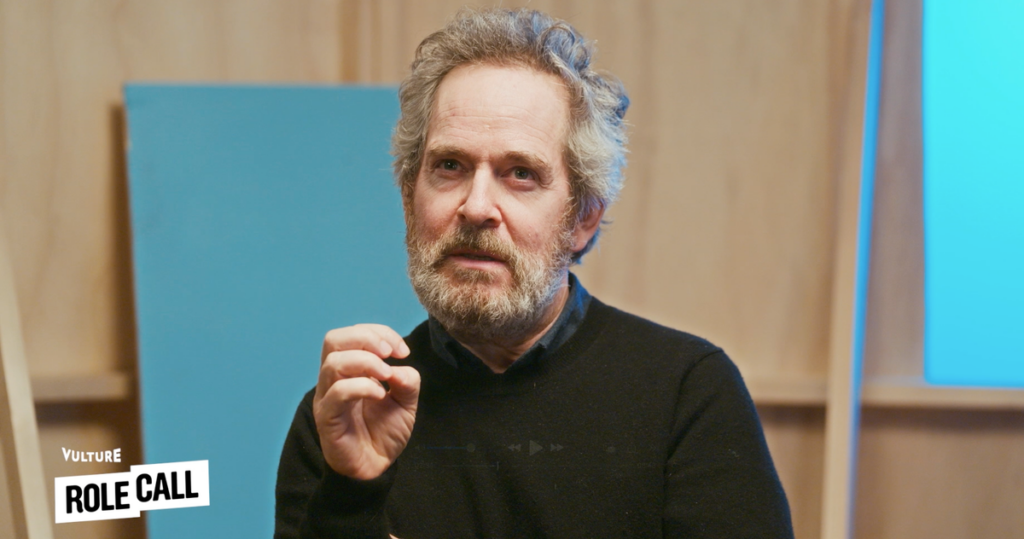
Among the many men who pursue Jane Austen’s heroines, none are as spectacularly wrong for the job as Mr. Collins. The pompous clergyman enters the life of the Bennet family, his distant cousins, with the assumption that, given his respectable position and benefactor, Lady Catherine De Bourgh, one of those daughters would be happy to marry him. He tries for Jane, is redirected toward Lizzie, then settles on the poorer Charlotte Lucas. In any adaptation of the many adaptations of Pride & Prejudice, Collins is played as some variation of a comical, exhausting twerp, though it’s Tom Hollander who, in Joe Wright’s 2005 adaptation, found one of the more enduringly hilarious takes on the character. Hollander’s Collins does everything just a tad wrong — arrives at the Bennets with an overlarge hat, rambles at the dinner table, struggles through a country dance. And yet, in Hollander’s performance, you feel something for the man who has no idea how to navigate the expectations of dating and, as the actor puts it, suffers as much as anyone else because he doesn’t own his own house.
Wright’s 2005 film, which starred Keira Knightley and a pre-Succession Matthew Macfadyen, has had remarkable staying power, a surprise even to Hollander. A stage veteran who has built a long career in television and film — including recent stints on The White Lotus and as Truman Capote — Hollander had fond memories of the lovely summer in the countryside he spent filming Pride & Prejudice. He had little expectation that people would come up to him 20 years later to quote back his character’s lines about the quality of boiled potatoes.
You’ve made, at this point, three films with Joe Wright, but this was his first feature film. Did you know him before filming Pride & Prejudice?
No, I didn’t. For Joe, it was much more personal, a much more instinctive process for him. This romantic tale of young love was suited to him at that moment, and he engendered that feeling on the set. It was a very playful and giddy and romantic summer — he was sort of a naughty cupid figure on it, trying to get people to have crushes on each other. Which they did.
Mr. Collins arrives at the Bennets bringing this energy of uprightness and sternness. At dinner, you’re complimenting the potatoes and you have all these prepared remarks. What was it like filming that scene?
I remember struggling with the fact that I was playing this undateable character and thinking, Am I that unattractive? Joe said, “I think you ought to have a mullet,” and then I thought, Ah, maybe that’s good. Maybe I am actually intrinsically attractive. He must be making me less attractive with the mullet. I leaned into all the strangeness.
I remember enjoying the very first moment with him, coming through the door and thinking about how to appear under the hat. The hat brim was useful because I could reveal myself with it, give myself a wipe with the brim of the hat, which was a technical trick.
There’s a depressing analysis of his story, which is that men are judged by the size of their house, and he doesn’t have a house. So the patriarchy doesn’t just bear down on women. It bears down on men as well. But also, he’s an arse-licking creep. I enjoyed being an arse-licking creep. That’s fun to do.
You had some great veteran actors, Brenda Blethyn and Donald Sutherland, as the Bennet parents, and then the Bennet sisters, including Keira Knightley, Rosamund Pike, and Carey Mulligan, were at the beginning of big careers when you were filming this.
There was this energy Joe created with the sisters that was very, very strong. They’re laughing at me behind their hands, and the embarrassment of that was quite real. I remember Donald Sutherland, God rest his soul, being surprisingly competitive for someone who is such a great actor and seemingly wouldn’t have anything to prove.
Competitive in what way?
He did a classic thing, which no one had ever done to me before. At the end of a take, the attention was on Mr. Collins, and he said, “Would you throw a look to me at the end?” It’s a way to cut to him, and he was kind of intimidating me into doing it! I remember thinking, That’s a trick to sway the edit in your favor, because you don’t have any lines at that point. I remember thinking, I’m not gonna do that, Donald Sutherland. Leave me alone and let me play the part the way I want to play it. And then I threw him a look because he’d seeded it.
I’m curious about the proposal scene when Collins comes to Lizzie with his little flower and gets on his knees, only to be rejected. We know he is wrong for her, but it’s still hard to watch it play out.
He’s miscast in his own life, isn’t he? With the flower, I think I said to Joe, “Can I do this?” And he was happy for me to come up with it. Collins is trying to do these things as if it’s going to make any difference.
I was unprepared for the girls to all be giggling behind the door. I remember not realizing that they were going to be there. That was probably brilliant for the scene, but in real time, I found it very humiliating. There was no sense that it was a private moment. But, of course, I remember thinking that he is probably thinking, Am I in love with this woman? I don’t even know her.
There were bits of physical comedy — the flower, the bowing and scraping around Catherine de Bourgh — that was kind of clowning, really. Joe was modulating it brilliantly and knowing how much of it to use and not to.
It’s great fun to watch Judi Dench as your patroness, Lady Catherine, order you around later in the film.
I very, very much enjoyed arse licking Judi Dench. I’d worked with her years before, on the stage, in The Cherry Orchard. She was Ranevskaya and I was the passerby.
She’s very inclusive. You know, she’s a Quaker, and she doesn’t play status, particularly. She’s a very democratic person. So in a way it was counterintuitive casting. But I think she enjoyed playing the imperious matriarch, and I was enjoying bowing and scraping around her in the way that people do around powerful people.
It’s interesting because Collins is so obsequious toward her, but there’s also a scene where he shows up at a dance and you end up feeling for him because he has terrible social skills. You’re fumbling through all the choreography of this dance sequence while Lizzie is ignoring you and focusing on Mr. Darcy.
That was a great, wonderful couple of days doing that sequence. That was one of the first times Joe was experimenting with these long, long shots, which became a bit of a signature for him for a while and he used to great effect in Atonement. He was enjoying swirling around the house and going in and out of the dance and coming back and having a comic button on it. It’s like doing a little play. I remember suggesting to Matthew Macfadyen for me to get nearly bumped by Darcy’s elbow. He’s very funny. I mean, I also did a height gag to my own detriment, but I couldn’t resist it.
This film introduced Matthew to us Americans as this brooding romantic lead, and only later on in his career, with Succession, did we realize he was such a good comedian.
I think he of all people felt the burden of taking on that role in the shadow of Colin Firth. Whether you prefer this version or not, the iconic shot of Colin Firth coming out with the wet shirt is hard to outdo. I think Matthew was feeling that this is a bit of a poisoned chalice. Of course, he’s a really brilliant actor, though I don’t think he was necessarily having that much fun. It’s hard to play as it is, and Matthew doesn’t go, “Hey, I’m Mr. Sexy.” That’s not how he thinks about himself. And if you don’t, then it’s pretty intimidating taking on one of those roles. Though, you must ask Jacob Elordi how he feels about that. Maybe he also goes, “I’ve never thought of myself as attractive. This has been a total surprise.”
I remember the location for that party, sitting out on the lawn. I took a lot of photos that day. Kiera and Simon Woods and a whole bunch of kids really felt like they were at the threshold of their lives. I got a shot of them all sitting on the lawn one early evening, a six o’clock golden-hour shot. They were kids, really. I was probably ten years older than them.
Tell me about working with Claudie Blakley, who as Charlotte Lucas becomes Mr. Collins’s wife. She gives a great speech about how she’s being pragmatic about the fact that she’s 27 years old with no money and no prospects.
She’s just marvelous as a human being. We’ve worked together several times. So, actually, there was a happy ending for Mr. Collins in the end, wasn’t there? Is there a feeling at the end of the film that somehow everything has fallen out as it should?
Well, do you imagine Mr. Collins happy?
I think that was the feeling at the end. The feeling was that they had, in that bit of the plot, found that they were well matched and ought to be together.
Do people come up to you about Pride & Prejudice? I think for people of my generation, especially because so many careers intersected through it, it’s had a pretty long tail of affection.
I remember thinking, when the movie was first suggested as a prospect, Pride & Prejudice? They need another one of those? Because it was not long after the Colin Firth–Jennifer Ehle one. But I didn’t understand that there was a new generation of readers who would get caught up in that story every ten years.
Then, I was in somebody’s house having lunch one Sunday afternoon a couple of years ago in New York. Somebody went, “Oh, Tom, do you know Jennifer?” And I said, “No, I don’t know Jennifer. Hello, how do you do?” And she went, “Oh, I know you! Because of those exemplary boiled potatoes!” Or whatever the line is. And as she quoted the line to me, I thought, My goodness, that’s Jennifer Lawrence without any makeup on. That’s exciting. And then someone said, “No, it’s on a T-shirt, it’s a meme!” I don’t know how that happened.
See All
Macfadyen has said he “felt a bit miscast” in the role.