
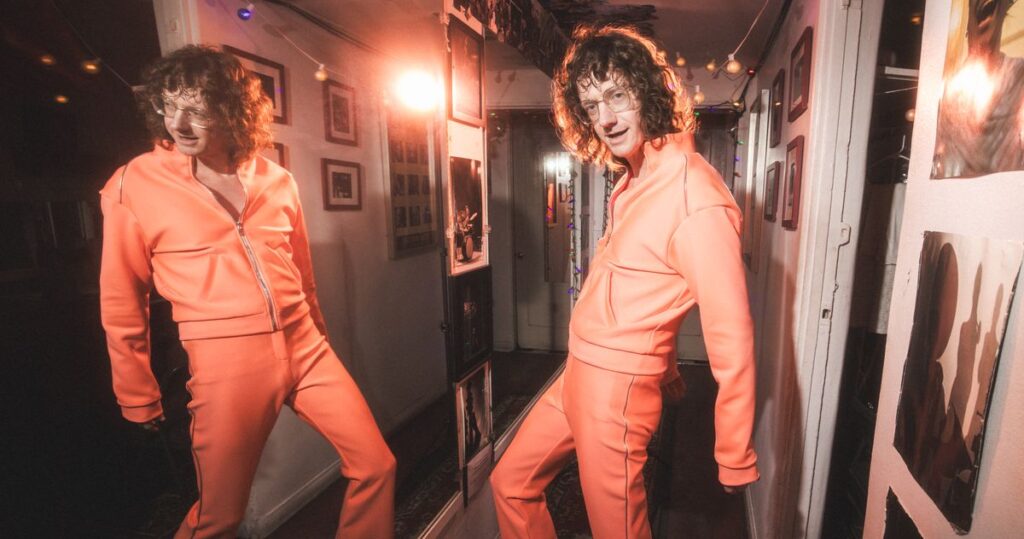
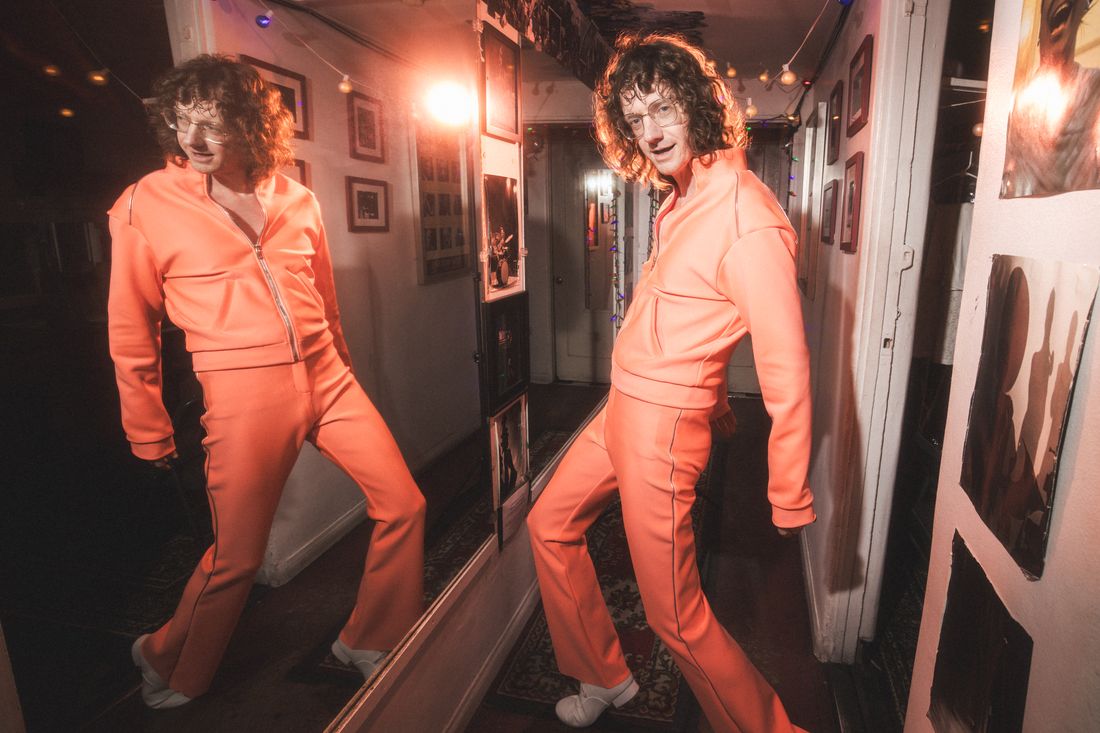
“I access this madwoman part of me that can be really helpful. We were never allowed to show anger or anything as children, and showing off was not acceptable. You can do anything onstage, and it’s not seen as vain. That’s the job.”
Photo: Andrew Max Levy
Comedian Chris Fleming arrives at my hotel in an absurdly tiny seafoam-green car, an object that looks more like a gag gift than a street-legal vehicle. The car is a Nissan Figaro, an obscure 1950s-styled convertible with chrome detailing, tiny round headlights, and a right-side steering wheel. Fleming is six-foot-two, and when he sits in the driver’s seat, his knees fold up nearly to his chest. The top of his voluminous curly hair sticks over the top of the Figaro’s roof frame. He looks like he’s driven straight off the pages of Richard Scarry’s Busytown and onto the streets of Pasadena; he is Lowly Worm bopping around town in an apple.
In podcasts, internet-comment sections, the replies to his viral Instagram videos, and stories from his friends and colleagues, Fleming is described as a Muppet, a fairy, a prophet, a cartoon. I ask Conan O’Brien, who produced Fleming’s new HBO comedy special, Live at the Palace, how he’d describe Fleming to someone who’s never watched him perform before. “I would say somehow a six-foot dandelion stumbled on some cocaine and tore itself out of the earth,” he says. Minutes later, O’Brien is still attempting to describe Fleming, and he eventually lands on the image of “the goop that’s inside a lava lamp.”
Fleming’s work is a hyperspecific, manic, digressive observational comedy buried inside a cloud of performance-art strangeness. A classic Fleming joke begins with him positing the existence of “girlos” — a subgroup of women who exist in opposition to “girlies.” He starts dissecting the girlo as a woman who might have been gay if only she’d been born after 1995, “the Sapphic Meridian.” Now, he says, the girlo is someone who’s sure she’s not gay because she was once attracted to Colin Firth. At this point, the joke veers into tangents. Without any clear sense of direction, Fleming calls Firth a Tofurky and also “a British man poorly pirated by a team of lesbians.” The Firth line is a typical Fleming move; he loves a joke about celebrities, an offhand observation that’s not quite mean but still manages to be completely devastating.
Then his body starts taking over. He sprints around the stage while acting out girlos who “plant their feet” when they flirt with each other “like the mighty sequoia.” By the end, he’s drifted far from the original setup, through so many divergent ideas and bizarre conceptual corners, that the initial impulse is miles in the rearview mirror. Suddenly, the joke’s careful observation of gender turns onto Fleming himself. He has neither the qualities of the “divine feminine” or the “damned masculine.” Both groups, he says, treat him like “a visitor who’s washed up onshore.” He hurls himself prone onto the stage, squirming like an undiscovered marine animal emerging from the deep. On the video clip of that joke posted to Fleming’s Instagram account, a commenter notes, “The person who has to track chris moving around on stage like some kind of daddy-long-legs-in-a-toddler-tumbling-class in order to film these clips deserves an award.”
Live at the Palace is the 39-year-old comedian’s most high-profile platform yet after over a decade of cultish alt-oddball projects, including his web series Gayle from 2012 to 2015, the 2018 YouTube special Showpig, the undeveloped TV pilot I’m the Mayor of Bimmi Gardens, and 2023 Peacock special Hell. With a more mainstream bent, Fleming might have gotten here earlier in his life, and he admits that when he was young, he half-assumed he’d have been more famous by now. But he has not taken the parasocial track of the comedian with a hangout podcast who offers himself up for easy knowability, and he shudders at the thought of reshaping himself to fit corporate dictums. “I hate a company man more than anything in the world,” he says. He now has a devoted following, but it’s taken 15 years to reach a level that allowed him to sell an HBO special, perform shows in theaters, and buy a Nissan Figaro on a whim. (It was about $30,000, and he acknowledges that he shouldn’t have bought it before confirming that a booking for a Red Robin commercial in 2023 would not fall through, which it did.)
“This is just like Seinfeld doing Comedians in Cars Getting Coffee,” I point out to Fleming as we set off for a drive around his favorite spots in Pasadena. “Fuck!” Fleming yells, laughing but also sincerely horrified. “That’s a huge problem if that’s what it’s giving off. Damnit!” That’s the price of a car that’s screaming to be noticed. People notice it then want to understand it. They want to get in it at the gas station. They want to meet the owner and see how he fits inside. I ask Fleming if he cares about cars generally. Is this a hobby? “Oh God, no. No, this is pure aesthetic,” he says. He loves his Figaro for its strangeness, for the surprise of turning a corner and seeing an impractical footnote in the history of car manufacturing driven by a flamingo-like person in enormous, bug-eyed sunglasses. But he’s less comfortable with the invitation of it — the way it prompts the question, What kind of a person would be driving around in that car? He would prefer to remain alien. “It’s easier to be seen as an entity,” he says.
Fleming grew up in Stow, Massachusetts, as an intensely shy kid who nevertheless signed his kindergarten school papers “Chris the Comedian” without knowing where he’d gotten that idea. He loved physical comedy and dance. At his older sister Katie’s dance class, a toddler-age Fleming danced along on the sidelines until his mother Nancy told him to stop and pulled him onto her lap. She started feeling wet drips down her legs — Fleming’s tears, because he wanted to dance so badly. In preschool, he was given a wordless role as Farmer McGregor in a school production of Peter Rabbit and began hamming it up, counting the missing tomatoes and gesticulating at his nemesis rabbit. Around the same age, he played dress-up with his sister and their all-girl troop of cousins. (When they pretended to be the Spice Girls, Fleming was Scary Spice.) Later, he became fixated on pieces of culture like Michael Flatley’s Lord of the Dance and the Yanni album Live at the Acropolis; he spent nine months in high school listening to only the song “Save Tonight,” by Eagle-Eye Cherry, to his sister’s enormous frustration.
“Our mom instilled in us values like kindness and integrity and all those things, but also that comedy is king,” Katie tells me over a video chat. “If something is funny enough, you can’t reasonably get in trouble for it.” Chris and Katie’s parents were both pharmacists who had their children around age 40, and they raised their kids with a combination of humor and self-conscious, Catholic, New England repression. Chris was perpetually flirting with how far he could push that boundary; he made a deal with his high-school band teacher that he’d do a semester of jazz band, but only if he could perform an unlimited drum solo to the jazz standard “St. Thomas.” He had never played drums. On a recording of that performance Fleming later texts me — a blurry video he took of his old iPod — an uneven teenage jazz band is suddenly overtaken by an incongruous flurry of percussion, the crowd whooping and laughing when Fleming wallops a cowbell.
His mother recognized his talent, and when he was 16, she drove him to his first open mic in Merrimack, New Hampshire. “‘You want to be like Robin Williams, right?’” Fleming remembers his mom saying. “‘Well, you gotta do stand-up, motherfucker.’ I was like, I don’t want to do stand-up! Stand-up sucks! I don’t like watching it! I wanted to be in movies, and I found stand-up tedious.” While he revered Williams and had studied his stand-up — Live at the Palace is inspired in part by Williams’s 1986 special An Evening at the Met — Fleming was more inspired by Williams’s work as an actor. But thanks to his mother’s insistence, he did that open mic, where he performed a painstakingly planned series of characters all linked by the single fact of wanting to describe that they’d recently seen a deer.
Fleming graduated from Skidmore College in 2009 with a major in theater and one credit short of a dance minor, but he left without any plan for how to translate the comedy he loved into a self-sustaining career. He’d been working since middle school: His first job was one his dad got him under the table at a country club when he was 12, after which he had stints as a ski instructor, door-to-door paint salesman, barista, and dry-cleaner employee. During college, he spent summers working in New York City. He interned at an advertising-production company, where he was given an unwanted and seemingly unlimited Starbucks gift card originally intended as swag for a commercial shoot starring Heidi Klum, and he spent the whole summer mainlining Starbucks with his friends. (“We called it Klumbucks,” he says.) Another summer, he was ostensibly in the city to get better at stand-up, but his chief love was his job at the flagship Ann Taylor Loft in Times Square. “I was really good at dressing lady cops,” he remembers. “We were taught to put our hands on their shoulders and talk to them in the mirror, and I still have that training in my body.”
He moved back home and worked as a substitute teacher for a year after college, which was the moment he realized he’d grown up in a bubble of love and support — a “bounce-house reality,” Fleming calls it — and wouldn’t have a career if he didn’t buckle down and spend time onstage building an act. This is when Gayle was born. While living at home, he began performing at Boston’s Comedy Studio and developing a character named Gayle Waters-Waters, a middle-age woman much like his own mother, power-walking around the stage while gossiping about her neighbors, worrying about Christmas cards, and insisting that theirs is a shoes-off house. Comedian Gary Gulman, who first met Fleming at a Comedy Studio show, was immediately struck by Fleming’s self-assuredness, in how confident he was onstage even though he looked so unlike the typical, bro-y cohort of Boston stand-ups. “A person who is not comfortable with himself, who doesn’t have the right parents or friends or siblings, is going to try to disappear and blend in. And even then, he was very comfortable in himself,” Gulman remembers. “You immediately see this guy, and you know you’re not going to get jokes about Tinder and how old Joe Biden is.”
The loop we’re driving through Pasadena is Fleming’s usual writing route; it’s a method he’s developed after years of living here that involves consuming huge amounts of sugar and talking through ideas as he drives in circles around town. Fleming first moved to Los Angeles in 2010 and self-produced Gayle as a web series from 2012 to 2015 while working jobs as an SAT tutor and caregiver and companion for a man with Down syndrome to help pay the bills. Gayle was Fleming’s first breakout, especially a video called “Company Is Coming,” where Gayle preps the house for visitors. In the series, Gayle spends endless time fretting about and gossiping with her best friend and rival Bonnie, played by Fleming’s mother Nancy, who had zero reticence about playing a version of herself; she even joined Fleming when he later toured Gayle as a stage show. Gayle was a send-up of what Fleming’s sister refers to as “intensities my mother perhaps exhibited,” but she loved being involved. “The thing about my brother is whenever he eviscerates you, you always end up feeling loved and appreciated.”
Gayle also meant that Fleming’s best-known work was for playing a woman, and in the years since, he’s refused to be defined as any particular gender or sexuality. He wears unexpected, gender-fluid combinations of clothing; in a delicious 2020 joke about attending a Super Bowl party at Dane Cook’s house, which he says happened “at the height of my androgyny,” he describes showing up in a sundress. But now, he wonders if Gayle’s breakout success has also “fucked everything up.” “I literally played a woman and had long hair, but the joke was never that I was dressed in my mom’s clothes. I never wanted breasts to be part of the joke, so I wore a very small bra so that I wasn’t totally flat,” he says. “I think that also made it look more dysmorphic, because the bra wasn’t funny, which made it more confusing or more of an amorphous space.” He wonders how much that early performance has shaped the frequent questions he now gets about his identity, but he doesn’t worry about it enough that he feels the need to clarify. “If a British comedian had played a woman, you’d be like, Obviously that is a man playing a woman.”
He does not think of what he does onstage as gender play, but he acknowledges that he’s cultivated an indefinable fluidity. In the first few minutes of Live at the Palace, he tells the audience, “I released a special two years ago, and it sparked a nationwide manhunt for my pronouns.” There is no next line where Fleming then articulates what those pronouns should be. “To be a good observer of the world, to accept yourself, you have to accept everything,” he tells me. “I have accepted that people can call me whatever.” Fans edit his Wikipedia page, and the pronouns change “like a seasonal menu,” he says, but that has nothing to do with him. It’s a pragmatic perspective as much as a personal one. When you can be interpreted as almost anything — gay, straight, male, female, nonbinary, asexual, alien, sea creature — you get, he says, “carte blanche to talk about literally anything you want.”
Around 2015, Fleming had fallen out of love with stand-up and was struggling creatively. He had retired the Gayle character, and he didn’t want to play clubs like the Comedy Store. (“When you’re like me,” he says, “I do think you have to demean yourself to survive at a tourist-trap club.”) He was frustrated by how hard it was to get stage time in L.A., and he refused to try for a platform like Last Comic Standing because he was certain they’d put circus music underneath his performances. When he first moved to L.A., he’d hoped he might get cast on Saturday Night Live, but he never made it to the camera-test stage after a showcase in front of Lorne Michaels. What eventually made stand-up click again was realizing that he could still access some element of Gayle onstage. He has moved away from recurring characters, but his performance of Chris Fleming As Himself has gotten more physical, raucous, and frenetic. Gayle had given him permission to play with exaggerated, attention-seeking physicality onstage, and in the years afterward, he was able to internalize that those things were not Gayle; they were him. “I access this madwoman part of me that can be really helpful. We were never allowed to show anger or anything as children, and showing off was not acceptable,” Fleming says. “You can do anything onstage, and it’s not seen as vain. That’s the job.”
As we tootle around Pasadena in the Figaro, I ask Fleming what happens when he does perform in more mainstream comedy venues. He has spent his career making conscious choices to avoid the club-comedy spaces he’s sure will reject him, he says. He’s been disconcerted when he tries to open for more mainstream comics like Nikki Glaser, whose crowds wonder what to do with someone who looks like Weird Al and prances around the stage like a My Little Pony. In 2023, he opened for the band Guster for a show that did not go particularly well. “His references are so deep. You have to go in knowing you’re going to a certain kind of dance party,” Guster’s lead singer, Ryan Miller, says. “It’s not a restaurant in Times Square. He’s not an Applebee’s, where there’s something for everyone. It’s a specific thing. But then who wants to be that? Who wants to be a suburban mall in Indiana?”
Fleming pulls over on Arroyo Boulevard for a moment to show me his favorite parking lot in the world, and I have to admit that this overflow Rose Bowl surface parking ringed by the San Gabriel Mountains is, in fact, lovely. I ask him if it would be helpful to give mainstream audiences some labels so they more readily understand who he is. “It probably does work against my career trying to shake that stuff as much as I do, in terms of growth or being easy to digest,” he says. Labels can provide an anchor for unfamiliar things, I suggest. “Oh God, you saying ‘anchor’ right there — my heart just sank. That feels like a cage,” he says. “I’m envisioning a cage. Specifically the ones they put you in to meet sharks.”
Fleming agrees to show me his cabin, a small place on Lake Arrowhead about 90 minutes outside of Los Angeles. Like the Figaro, he bought it on a whim after browsing the area on Zillow. This time, he picks me up in a more practical vehicle, a neon-orange Bronco Sport. He pumps a pop selection in the car and pauses to make sure I fully appreciate the new Hilary Duff single, “Roommates,” which he loves despite his disgust for the lyric “Life is life-ing.” We stop for boba on the drive up. He orders green tea and passionfruit every time; at his favorite boba place in Pasadena, the container of passionfruit mix has a “Chris Fleming Fuel” label on the back. Fleming used to be more of a partier and decided to get sober two years ago. He now drinks a digestively implausible amount of boba.
Fleming hasn’t done much to redecorate the cabin after buying it in 2024. There’s a two-story vaulted window with a view of the hillside, a keyboard, a sofa, crates for when Fleming drives up with his three rescue dogs (Daysy, Erik, and Luchie, two pit mixes and a miniature poodle), and a vintage Mork & Mindy poster on the wall. He also owns a home in Pasadena, but the mountainous area reminds him of where he spent childhood summers in New Hampshire, and it’s where he prefers to go when he needs to focus on new material.
Beyond fully embracing the Gayle-driven aspects of his stand-up, one of the crucial elements of Fleming’s recent success is how prolific he can be. At a time when comedians can flood Instagram with crowdwork clips to achieve constant internet virality without writing new jokes, Fleming has refused to participate. “Oh my God, leave those poor people alone!” he says, imagining a crowd of overinterrogated audience members. Instead, he’s his own video editor, producing clips from his touring events or his regular shows at Largo in L.A. It’s tedious work, but Fleming loves the control it gives him and how much more he can eke out of a joke with the right cut or caption. His videos pull in tight on his face to underline an expression and deploy strange fonts so that an Instagram Reel’s usually soulless captions instead help to bolster and magnify his material. He loves drippy horror fonts and Papyrus, which he pulls out only sparingly, like in a section of his “girlos” joke where he plays Jane Goodall cowering from the terror of an interview with Call Her Daddy’s Alex Cooper.
“I just feel like I’m reporting the news. It’s things I’m seeing and observing and feeling. It doesn’t feel creative, it feels reported,” Fleming says as we sit on the cabin’s porch overlooking a sharp slope of pine trees. Once he’s nailed it, a joke no longer feels alive to him, and he fears losing the immediacy by then mimicking a past performance. When prepping for Live at the Palace, director Bill Benz says, he watched tape of a show Fleming performed at New York’s Bell House about a year before filming. Benz then saw him perform the hour he planned to film for the special a few months later and realized half of it was new and that he had to make an entirely new filming plan. “Then I saw him again a month later and it was, again, half new stuff, and at that point I realized it was just going to be a documentary. And of course on the day we filmed it, he did stuff I did not know he was going to do.” Beyond a few specific multimedia cues, Benz says, the shoot had to be largely unplanned, and the crew were told to treat the special “like a wildlife documentary instead of live comedy.”
Fleming is particularly skilled at choosing celebrity subjects. They’re often well-loved figures — people who live comfortably in a mid-tier Hollywood liberal fondness. His new special includes material on Paul Dano, Zach Braff, Lin-Manuel Miranda, and public-radio personality Terry Gross, a longtime fixture of Fleming’s preoccupation. (Gross tells me she’s “flattered” by the special’s joke, which imagines her cleaning a gun before interviews. “How does he know? I thought there weren’t any cameras.”) Celebrity commentary is one of the most obvious draws to Fleming’s work; for the right audience, it feels like delicious, petty, sharp but not cruel gossip, with an obvious ring of truth to it. “The reason he can get onstage and rip into Establishment figures is because he’s truly beholden to no one,” Fleming’s friend, comedian and actor Hannah Einbinder, says. Sometimes he’s full of disdain, like when he mimes an impression of Subway Takes’s Kareem Rahma. Sometimes it’s more about Fleming negotiating his own adjacency to fame. The special’s Lin-Manuel Miranda joke is about Fleming accidentally DM-ing Miranda an unedited two-minute-long video of himself breathing heavily outside a Starbucks. “That did happen,” Miranda tells me before emailing screenshots of the videos as proof. The two are not close; the exchange happened after Miranda commented on Fleming’s Instagram clip about boomers communicating through Bitmoji, which he then sent to his parents. “He’s really a cultural anthropologist for things we don’t yet have language for,” Miranda says.
Fleming does not subscribe to the Tina Fey–voiced articulation of contemporary fame, the one that insists authenticity is dangerous and expensive. “Almost everything I put out about an archetype is actually about someone specific in my life, and I’m always having to apologize, and so why not do that to a celebrity I’ll never meet?” he says. Yes, it’s more likely that he will actually encounter the people he’s joking about now. “I talk about Zach Braff in the special, and I’m going to have to do Jimmy Kimmel with Braff. I’m going to have to go up and say, ‘Sorry, sorry, sorry,’” he admits. “My life is an apology tour.” It was always going to be awkward. It would be much worse, Fleming says, if he didn’t at least get a joke out of it. “I don’t think Chris cares at all,” Fleming’s friend, comedian Caleb Hearon, says. “I don’t think Chris is concerned about what parties he gets invited to or if he’s going to meet Colin Jost and have to demur about the bit. It’s maybe one of the most charming things about him. I mean, my God, he doesn’t have a podcast, and he’d be making millions.”
Fleming, in fact, loathes the idea of his own podcast and the prospect of sitting and chatting endlessly about his private life for public consumption. He grits his teeth through the appearances he knows he needs to make in order to further his career. Podcasters, he says, are “charlatans,” and while he doesn’t mind guesting on a friend’s show, most of them feel like “being sent to the principal’s office.” Even the ones he likes are a chore. On an episode of Mike Birbiglia’s Working It Out podcast from 2024, Birbiglia listens to Fleming tell a story about his childhood habit of perpetually running away from his mother, sprinting off into a rainstorm rather than pragmatically ducking into her car. Has he talked about this onstage? Why not? Birbiglia keeps asking, and Fleming keeps dodging. He rankles at overly personal questions, he says, which “make me feel like my hackles are up, and I have to protect myself. I feel like I’m at the gyno.” He does not want to winnow himself down to a few telling childhood anecdotes, and he grimaces at the specter of smug self-disclosure. “Ira Glass poisoning,” he says with a side-eye glance.
Fleming shows me around the Lake Arrowhead cabin, where he makes us both tofu tacos for lunch and discusses what he reads (plays, mostly) and his love of horror movies. He talks about the fact that all of his physical stunts mean that he keeps hurting himself onstage. He does not exercise or treat himself as an athlete, and as a result, he’s constantly getting bruised, pulling muscles, tweaking his back. He chipped his front tooth by hitting his face on the stool between the first and second tapings of the new special, and he’s still trying to decide whether he should get it fixed or keep the chip as a souvenir.
He does not say anything about his home in Pasadena, but on our jaunt in the Figaro, he shows me a neighborhood where he’d like to buy a house: quiet, suburban, tree-lined. He is in a relationship, but he does not want to offer information about with whom or for how long. There are tender things, like the realities of his parents aging, that he would prefer to remain private. He wants to be seen; no one could work as hard as Fleming has, post as much on Instagram as he does, and choose to drive in such an attention-grabbing variety of vehicles without wanting to be seen. But he doesn’t ever want his audience to feel like they know him. He believes that intimate, vulnerable one-man-show style comedy is cringey and indulgent; of course, to be rejected after telling a story about your childhood would feel different than being rejected for a joke about snacks in Trader Joe’s. He insists that all interpretations of him are valid, and he wants to ensure those interpretations are based on the specific things he has chosen to reveal. When I wander into the small lofted upstairs area of his cabin, I see a splay of notes on his desk written in bold black marker. “Girlos,” one of the papers reads. “Colin Firth.” “Husband Dan and 6 (3) little psychopaths.” There is a drawing of a child crouched on a ride-on suitcase, notes for a joke Fleming posted online in January. I suspect he has put them out on the desk for me to find.
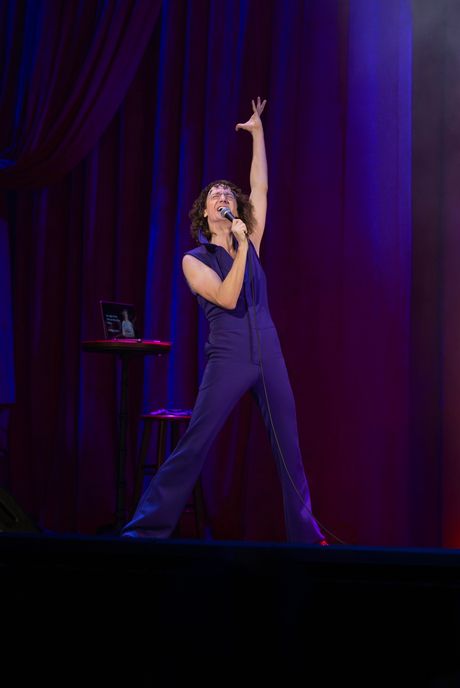
Fleming in Live at the Palace. HBO.
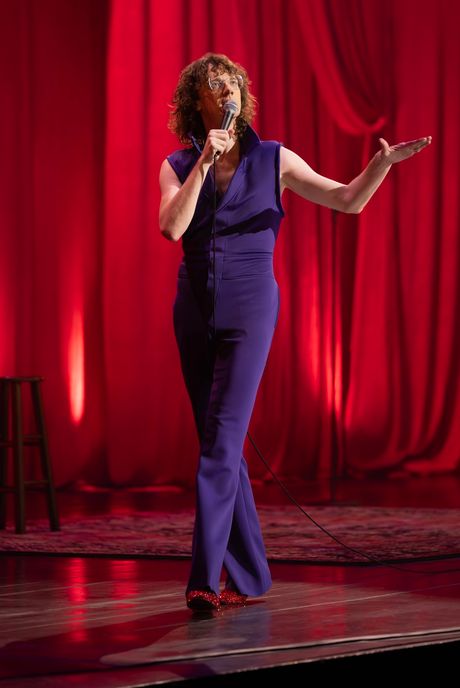
Fleming in Live at the Palace. HBO.
Live at the Palace is a worthy attempt to capture the experience of seeing Fleming live. It has fewer performance-art flourishes than his previous Peacock special, which is to its benefit; he loves the sprawling strangeness of mixing other art forms into his comedy, but his work is often more captivating when it’s stripped of ornamentation that takes away from seeing him onstage sprinting and frolicking and grimacing. It’s a more polished presentation of Fleming. He’s in a lush theater with red velvet seats and gorgeous baroque gold details. He’s begun working with clothing designer Tony Sartino, who has made clothes for Prince and Elton John. “I watched a lot of his YouTube videos, and they looked kind of messy. He was just grabbing pieces — some feminine, some masculine — and I said, Oh, I see the confusion here. He needs someone to help him tie it all together,” Sartino says. For the special, Sartino created a jumpsuit in Prince purple with fabric that stretches to accommodate his movement, a high collar, zip-off sleeves for a bit of surprise, and a small bejeweled butterfly on the lower back.
But the special is not too polished. Benz’s video monitors had been set up directly beneath the Palace’s stage. Fleming was slamming around on the stage above them, Benz says, “and when he hit the ground, the ceiling would rattle. It was like being in a bombing campaign.” Around the midpoint of the special, Fleming winds up for a joke about Oreos, which was material Benz had never heard before. “Is that a pile of soot?” Fleming asks, miming a person examining the topping options at an ice-cream parlor. “Oh no, it’s just America’s cookie, maimed beyond recognition. Looking like a cartel is trying to send a message. Looking like a witch has been grinding them up all winter.” A woman in the audience begins scream-laughing as Fleming imagines the celebrity equivalent of Nabisco’s disregard for brand identity, this utter lack of care for someone’s dignity and integrity. “This would be like if you saw Dame Judi Dench selling vibrators on Instagram,” he says, his hands twitching as he uses the microphone to demonstrate. Fleming becomes a Nabisco supervillain, telling a hopeful Oreo licensee to use and degrade the Oreo however they see fit. He becomes a high-schooler stomping on Oreos in the back room of an ice-cream shop. He never becomes the Oreo; if he did, the joke would fall apart. There’d be too much sympathy in watching this cookie get pulverized by unfeeling overlords. The joke ends, and Fleming walks off the stage. But then he strolls back on to add one more thought. “That exact same dialogue could be copy-paste applied to whoever represents Eugene Levy for commercial work,” Fleming says casually.
Related