
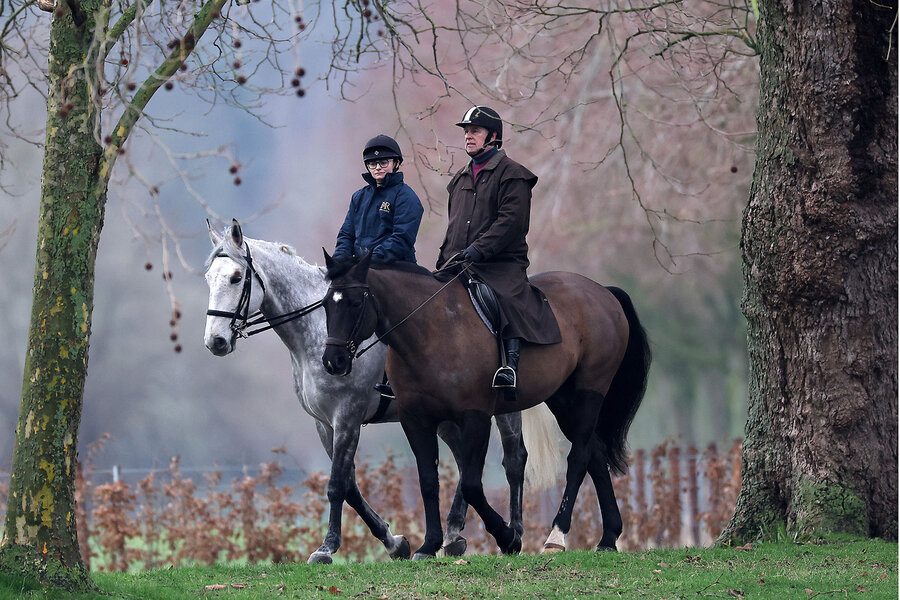
When Trade Minister Chris Bryant stood in the United Kingdom’s House of Commons on Tuesday, he said something that the British people aren’t used to hearing in Parliament.
Mr. Bryant called the man formerly known as Prince Andrew “rude, arrogant, and entitled” – a critique that’s normally forbidden under parliamentary rules, but had been waived for the day’s session.
It was a historic occasion in a country where government criticism of the royal family is still subject to regulation. But as Andrew Mountbatten-Windsor, as the former prince is now known, is being investigated for possible misconduct in public office, it is the kind of criticism that is more broadly broached now, both in government and in public.
Why We Wrote This
The misconduct investigation into the former Prince Andrew is putting the British monarchy under a harsh glare – and giving new energy to chronic questions about whether it should still exist. But the institution’s evolution is already underway.
And for the British royal family, it suggests the sort of erosion that could threaten the monarchy itself. The crumbling of traditional formalities in Parliament, for example, could lead many to question why such provisions were ever put in place at all.
“You’ve got that group of people maybe just taking a bit more interest [in the royal family] and wondering: ‘Should we be really allowing people to think they’re so elite?’” says Pauline Maclaran, a professor of marketing and consumer research who has studied the royal family extensively at Royal Holloway, University of London.
Yet the royal family could still use this episode as an opportunity to remold the monarchy for the 21st century. King Charles III and other royal family members have attempted to distance themselves from Mr. Mountbatten-Windsor and his connections with the late financier and convicted sex offender Jeffrey Epstein. (Mr. Mountbatten-Windsor is not under investigation for sexual offenses.) They might opt to go further and take lessons from other European crown families – slimming the institution down in order to protect against its complete dissolution.
Power and preconceptions
Views on the royal family are still largely positive. Polling data from YouGov in January 2026 found that 64% of respondents believe the U.K. should continue to have a monarchy, with 58% saying the centuries-old tradition is good for Britain.
Still, the allegations against Mr. Mountbatten-Windsor have stirred anger in the British public, and the royal family is not beyond reproach. King Charles knows this better than most, having viewed firsthand the outraged public response to the monarchy’s muted reaction after Princess Diana died in 1997.

British King Charles III and Queen Camilla walk outside the St. Mary Magdalene Church, on the Sandringham Estate, one of the royal residences, in Norfolk, England, Feb. 1, 2026.
He has tackled the alleged misbehavior of Mr. Mountbatten-Windsor, his younger brother, head on with a public statement that sought to distance the royal family from the allegations. His approach is very different from the one that may have been taken by his mother, Queen Elizabeth II, whose reported mantra was, “don’t complain, don’t explain.”
“There’s a bit of a difference with the change of monarch,” says Saad Salman, a jewelry historian and editor-in-chief of monarchy-focused news outlet and Instagram account The Royal Watcher. “The late queen really protected Andrew. I think if it had been up to King Charles, Prince Andrew would have been sidelined a long time ago.”
Perhaps because of the position he is in, the king does earn some public sympathy, says Professor Maclaran.
“For royalists, there is a general understanding that [Mr. Mountbatten-Windsor] is the king’s brother. We don’t choose our family and people can relate to that,” she says. “In many ways, it endears them more to the royal family.”
An evolving institution
Mr. Mountbatten-Windsor’s arrest has thrown slow-moving changes within the monarchy into sharper focus.
The king largely finished the process of stripping Mr. Mountbatten-Windsor of his titles and duties. But it was part of a broader process to downsize the royal family that began in the 1990s, when it was decided that the former prince’s own children, Princess Beatrice and Princess Eugenie, would receive royal titles, but not royal duties or taxpayer funding.
This puts British royals more closely in line with other European crown families, such as those in Spain, Belgium, and Scandinavia, where monarchs take a far more low-profile and symbolic role.
Members of the British royal family are also taking a stand more often, focusing their support on impact-based projects or charitable foundations, more than traditional royal duties of opening schools and hospitals.
“They’re showing that the monarchy can use its influence to bring overall societal change, rather than just the representational duties that they’ve been doing in the past,” Mr. Salman says.
The question is whether such changes have gone far enough. A second YouGov survey in February 2026 found that 51% of respondents believed that Buckingham Palace should have done more to condemn Mr. Mountbatten-Windsor’s ties to Epstein.

Police officers stand guard as members of the media gather outside the Sandringham Estate, one of the royal residences of King Charles III, in Norfolk, England, Feb. 20, 2026.
Taking a stand
Just as Mr. Mountbatten-Windsor’s fall from grace has been years in the making, any change is also likely to be slow. King Charles III is 77 years old and is living with a cancer diagnosis. It is his son, Prince William, who is more likely to lead such reforms – particularly as the prince has said in the past that change for the monarchy is “on his agenda.”
For now, it is unclear when William may get to implement such change. But if senior royals intend to imitate European monarchies, then it might be sooner than expected. While almost all British monarchs reign for life, other royal families have seen older members step aside for the new generation, such as when Queen Beatrix of the Netherlands abdicated in 2013 at the age of 75.
“Passing on [the crown] to William before [Charles’] death would be a new thing for the monarchy,” says Professor Maclaran. “It would also mark a monarchy that was more forward-thinking.”