
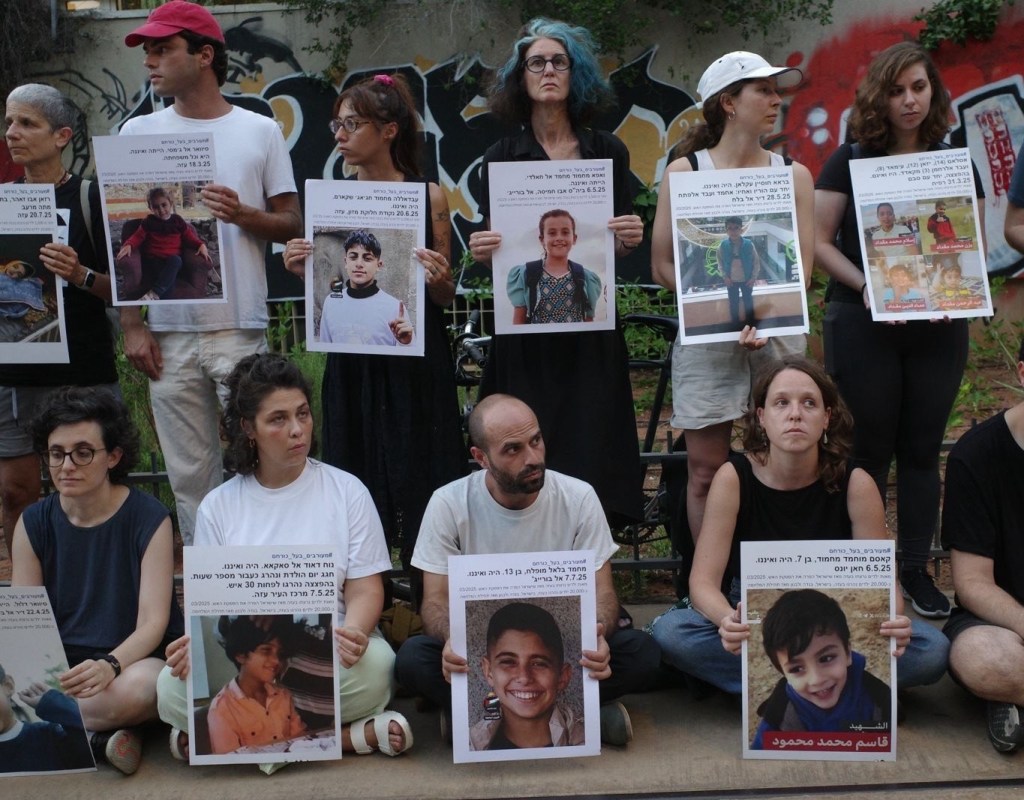
The men and women hold signs, but do not speak. Words in Hebrew on their placards — each bearing the face of a child — do all the talking:
“Ahmed Abu Sief, 9 yrs old. Was and is no more, May 7, 2025.”
“Ghazal Ismail Mahmud Abu Layla, 7 yrs old. Was and is no more, June 20, Gaza.”
“Muhammad Bilal Muflah, 13 yrs old. Was and is no more, July 7, al-Bureij.”
“Ahlam Muhammad Syam, 3 yrs old. Was and is no more, April 17, Khan Younis.”
These are images from peaceful demonstrations held weekly in Tel Aviv at the height of Israel’s retaliatory destruction of Gaza, demonstrations meant to highlight the killing of innocent Palestinian children in the thousands. Many Israeli Jews participated in the vigils built around the ethos that sometimes silence speaks loudest of all.

‘Children No More: Were and Are Gone‘
Medalia Productions/Salty Features/Full Story Films
The gatherings are documented in the Oscar-nominated short film Children No More: ‘Were and Are Gone,’ directed by Hilla Medalia, and produced by Medalia, Yael Melamede, and Sheila Nevins – the documentary legend, winner of over 30 Primetime Emmy Awards.
“It’s a little film with a big heart,” Nevins tells Deadline. “To me, it’s a little gem, a little polished gem… I think when you watch it, you feel fury and love simultaneously, which if you can get that out in a docu, you’ve gone really far.”
Producer Sheila Nevins
Courtesy of Valerie Chiang
The documentary has brought Nevins her second Oscar nomination in as many years, following The ABCs of Book Banning, which she directed with Trish Adlesic and Nazenet Habtezghi. The filmmaker and producer, who grew up in a secular Jewish family, says Children No More “basically says to people, not all Jews think the same thing and they’re not all warriors and they’re not all out there to kill. And some of them do want to hope that there could be a two-state [solution in Israel]. Not everybody wants to take over Gaza and build a Trump hotel. So, I think it was interesting politically in its very simple way, in terms of what it said about Jews and where they are… For me, it was an education to learn that there were so many Israelis in Israel who were opposed to this war.”
Medalia Productions/Salty Features/Full Story Films
In the film, organizers of the silent demonstrations describe their motivations and approach. “The vigil is not intended to provoke. It’s so people take it in and take it home with them,” one organizer explains. “How can you argue in the face of a boy or a girl who was murdered? How can you argue with that? That’s why we avoid confrontations and lead people away.”
The organizer continues, “The only way to make change is for people to look inward and understand that something very, very dark is going on. And it goes against all the principles of humanity, and Judaism. Our goal is to awaken something inside.”
As the organizers make clear, the vigils in no way negate the tragedy of October 7, when more than 1,200 Israelis were killed in the terror attack by Hamas, and more than 250 civilians were kidnapped and spirited off to captivity in Gaza. Two things can be true, that October 7 was an outrage and that the killing of innocent Palestinian civilians is a tragedy, and yet some Israelis who witness the demonstrations appear unwilling to accept that notion. In the documentary, demonstrators receive abuse from some passersby who demand to know why they aren’t protesting for the release of hostages — or who openly cheer the razing of Gaza.
People, holding portraits of Palestinian children killed during Israeli attacks on Gaza, gather for silent protest in Tel Aviv, Israel on December 6, 2025.
Mostafa Alkharouf/Anadolu via Getty Images
One organizer observes, “This [silent demonstration] does not come at the expense of the hostages’ families or the children who were murdered here. One murder does not justify another, and our injustice is not a weapon that can be used to wipe out entire families.”
Despite Nevins’ stature as one of the most important figures in the history of American documentary filmmaking, no U.S. distributor would take Children No More: ‘Were and Are Gone.’ That includes HBO, which Nevins built into a nonfiction film powerhouse over the course of a generation.
“It was very obvious what this film was. And I sent it out a lot without even asking — just, ‘Interested? (question mark)’ — because these are all people I know and I bought with and bought from. But there was no response,” Nevins says. “It was a very, very, very difficult film to be involved with. You didn’t see any network pick it up, did you? You didn’t see any big screenings, did you? Except among filmmakers. We couldn’t get it into a lot of places to be seen.”
Nevins comments, “It was like they didn’t want to anger anybody. This film angers people. I once had a well-known man who hung up on me and said, ‘How dare I? What kind of a Jew was I?’ And so, it’s a troublesome film. It’s sweet and kind and dear and extremely well-made, but it’s trouble.”
She adds, “There are a lot of right-wing Jews in this country who are very for taking over Gaza, and a lot of them are in power, and it’s very difficult to get a showing for a film like this. There’s a lot of opposition to it.”
Demonstrators in Habima Square hold photos of Palestinian children who lost their lives in Gaza, September 30, 2025, in Tel Aviv, Israel.
Mostafa Alkharouf/Anadolu via Getty Images
Nevins draws a comparison between the demonstrations shown in Children No More and the mass protests in Minneapolis over ICE tactics that succeeded in convincing the Trump administration to reduce its occupation of the city.
“Somehow with all the injustices, if you fight hard enough, you’re still in a democracy and you can get a few victories. You couldn’t do this in Russia. You couldn’t do this in China,” she says. “Israel is a democracy, and America, for better or worse, is a democracy… [In Tel Aviv], they were protected by the police — those young people going out with the children and the posters. The police didn’t particularly like them, but they gave them protection.”
She adds, “I think occasionally you see the power of one or the power of a group to change things. And I guess that’s the only hope that’s left.”