
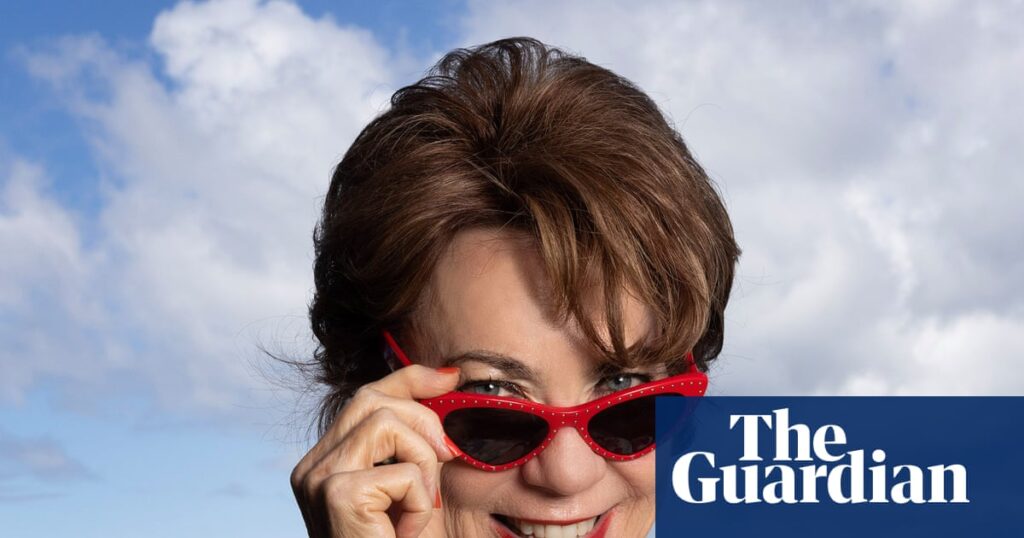
Kathy Lette is describing a recent encounter with grey nurse sharks – “People say, ‘oh, they’re the puppy dogs of the sea’, and I’m like, really? I didn’t see them fetching any sticks” – when a woman with deeply tanned skin and long, sunbleached hair stops her on the walkway. “I know you don’t know me. I know you,” she says. Lette immediately compliments her choice of eyewear. When she tells Lette she’s here with her daughter and granddaughters, the author expresses disbelief.
“You can’t be a grandma – look at you! I would call you a glam-ma.”
“Girls,” Lette calls out to the mother and daughters who’ve just passed us on the path. “You’ve got the coolest grandma!”
With all the warmth of the early afternoon sun, the woman tells Lette: “I’m so glad I saw you.”
It is one of many pauses we take along the “quite short, really” new boardwalk that tops the cliffs of Cronulla’s southern tip. We’ve barely finished introducing ourselves before we’re stopping by her car so I can borrow a hat (I am very pale and she is, justifiably, worried about me).
We also stop to admire the “clear sparkling water, through the pine trees”, a cute baby, a wind gnarled tree, and a street library erected along the path. “I think that’s a good choice,” Lette says to a young woman in activewear who’s just picked out a copy of The Girls by Emma Cline. “I’m glad to see the Shire girls have good taste in literature,” she says softly, just after the reader has walked out of earshot.
Lette’s glasses are a sharp and ostentatious pair of studded red catseyes; a fitting metaphor for how the comic novelist, television presenter and professional bon vivant sees the world.
Kathy Lette: ‘Go forth, be fabulous.’ Photograph: Jessica Hromas/The Guardian
At Hungry Point, the end of the track, we look out across Port Hacking to a little village called Bundeena, inside the Royal national park. Aside from the odd beachside mansion, Lette says the view has not changed much since the 1970s, when she co-wrote Puberty Blues with Gabrielle Carey. That loosely fictionalised account of surfing, sexism and substance abuse in Sutherland Shire made Lette a household name in Australia and beyond. Today the indicolite water and distant broccoli heads of bushland are, as they ever were, stunning.
After Puberty Blues came out, it took Lette a long time to be able to come back to Cronulla, “because I was so traumatised by my youth here”.
“Apart from the horrible sexism and the surfy tribal rituals of sexual initiation – before that, it was a beautiful place to grow up.”
Going from a 19-year-old “non-entity to overnight notoriety” did not help, Lette says. While many may remember Puberty Blues for cementing the Chiko Roll in Australian culinary history, and for the phrase “you’re dropped”, the book and film which swiftly followed, raised hackles at the time for their depictions of underage sex, binge drinking, rape and drug use.
Lette’s mother, now 94, only recently told her about the anonymous phone calls, which ranged from heavy breathing to streams of misogynistic abuse, made to their home after Puberty Blues came out. “The anonymous phone call was the Twitter troll of its time,” she says. And because everyone had their names in the phonebook, it was almost as easy to do.
“She didn’t tell me at the time,” Lette says. “I would’ve been just heartbroken.”
‘Girls, when I talk to them, they’re not just surfing – they’re surfing their brainwaves.’ Photograph: Jessica Hromas/The Guardian
Mercifully, when Lette comes to Cronulla now, the view is the only thing that hasn’t changed. Now she’s wryly enthusiastic about her frequent trips to the beach – and not just because she fit in “cheek to cheek” the last time she stripped down to her G-string for an impromptu swim.
“I see the girls are all surfing, the surfy boys have finally flopped on the shore and evolved. And the girls, when I talk to them, they’re not just surfing – they’re also surfing their brainwaves, they’re all at university and they’ve got ambition.
“It’s just so heartening for me to see that huge generational shift.”
While Lette divides her time between London and Sydney, her mother and sisters still live in the Shire. Her sisters “didn’t have the whole post-traumatic stress syndrome that I had”, so the water and walking tracks have always been “their playground”.
At first when she came south to visit them, “I would be so tense”. She could feel herself tightening up as she approached Cronulla. “But when you’ve got love and laughter and sisterly camaraderie in your life … that’s the best cure for everything.”
Familial bonds are at the centre of Lette’s latest novel, The Sisterhood Rules. As one might expect from Lette, it’s twisty, risque and packed to the margins with puns.
Told from the perspective of frumpy 49-year-old music teacher Izzy, the story follows her unwilling reunion with elegant, icy twin sister Verity, who ran off with Izzy’s husband five years before the novel commences. But it is the twins’ mother Nicole who steals the show. The 69-year-old is on a mission to live spectacularly, through lavish travel, desertion of duties and a fling with an often-nude alpine horn player 30 years her junior. Of course, Lette, at 67 – “or as I like to say six-seven” – relates most to Nicole. “My whole literary raison d’être now is saying to women, have a sensational second act. Go forth, be fabulous. Don’t feel guilty about it.”
Lette on menopause and getting older: ‘You get a fuck-it-I’m-50 gene … and it’s just totally freeing.” Photograph: Jessica Hromas/The Guardian
Everything gets better after menopause, she says. “Post 50, you get a fuck-it-I’m-50 gene, and you’re no longer in the male gaze the way you were … and it’s just totally freeing and liberating.”
Stepping out of the male gaze has nothing to do with giving up on sex, Lette says. “Because what is good sex about? Feeling. Feeling relaxed in your skin, at ease with your body. And by this age, you know yourself so well. You know what you want and you’re not afraid to ask for it.” These are exactly the characteristics that men, particularly younger ones, are drawn to. “Young guys are thinking, ‘she’s funny, she’s fabulous, she’s independent. She knows her way around a wine list. Great lingerie, knows what you want in bed. Doesn’t want kids. What’s not to love?’”
Lette is speaking firmly from experience. “Every book I write is like a how-to manual,” she says. “This is how I survived this stage of my life. This is how I found the funny, this is how you’ll get through it. So I’ve cannibalised my entire life from puberty to … menopause blues.”
That practice-as-process extends to a detailed sex scene in the Sisterhood Rules’ final act, which Lette says she rehearsed with her partner. “Oh, it’s a hard day. Hard day’s work at the orifice! What could I say?”
Jokes, even the daggy ones, serve a higher purpose for Lette. It’s the same purpose as cocktails, chocolate, swinging from the chandeliers and exciting eyewear: “Joy builds resilience.”
“We’re living in a world where we are challenged every day – politically, environmentally, socially. We are being bombarded. And you have to make space for friends, for frivolity, fun, family. You just have to do that, or you will lose your equilibrium,” she says. Lette wants fun to build not just resilience, but resistance. She would like to see women become more militant. “We are on the road to Gilead. We need to get organised and angrier. We’re far too nice. And look what’s happening in America. A woman born in America today has less rights than her grandmother.”
“Have fun and be joyous, but also be tough,” she says. “We’re at a very crucial time right now. We can’t be complacent.”
When our photographer arrives, she’s sporting two surfboards and a special request – she’d like Lette to sign them for her teenage daughters. Apparently, this is a first for Lette. “Just make sure you catch some good ones,” she says, addressing them through a video as she autographs a board. “And drop in on any dickheads.”