
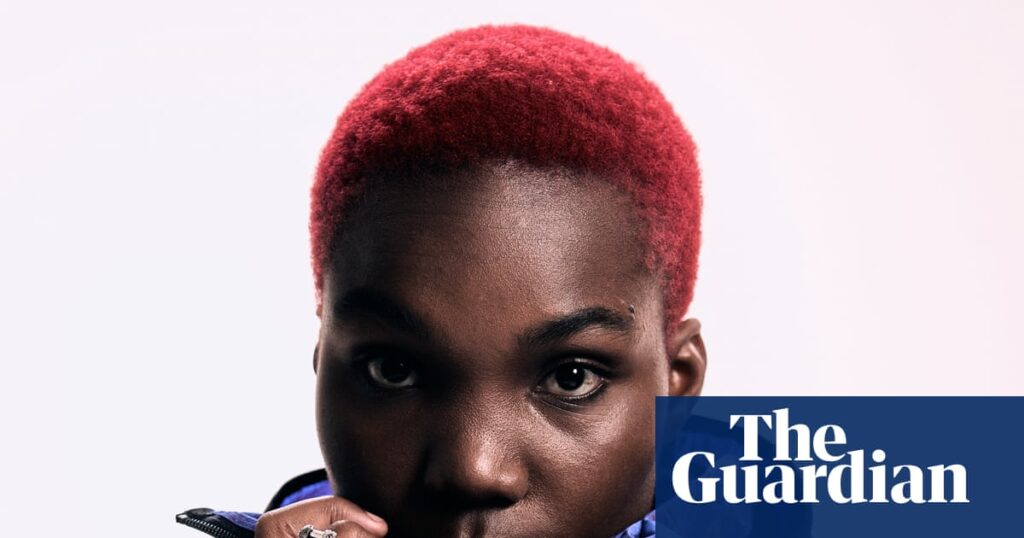
Until only a few years ago, Arlo Parks had never been clubbing. The lack of a party phase makes sense when you consider that while most of her friends were decamping to university at 18, Parks was busy bagging a record deal, releasing her debut album, Collapsed in Sunbeams, a few months after her 20th birthday. “It’s something that I almost didn’t have time to think about,” she says, speaking from LA, where she has lived since 2022, and where she feels very much at home. (This morning has already consisted of gymming and a walk in 28-degree sunshine that’s as bright as her neon-red hair.) “But I definitely did come to the conclusion that I had missed out – I hadn’t really had the time to be silly and have crazy, deep conversations in the smoking area. To be in an anonymous space and feel like you’re part of this whole.”
Now 25, she has very much made up for lost time with her third album, Ambiguous Desire – a paean to the night-time, which fuses elements of house, techno, UK garage and more with Parks’s celestial, feather-light vocals. While she hasn’t ditched the guitars altogether, it’s a long way from where we were when we first met Parks, born Anaïs Marinho, back in 2018. Fresh out of sixth form, where she had honed her craft via GarageBand, hers was a confessional, clear-eyed strain of alt-pop, with influences that ranged from Nick Cave to Erykah Badu. Before long, she had signed with an agent and nabbed that aforementioned record deal with Transgressive, fuelled by youthful chutzpah rather than any nepo connections. While her songs were often laced with perfectly curated cultural callbacks (“You do your eyes like Robert Smith,” she cooed on Black Dog), she didn’t shy away from singing about mental health, romantic rejection or drug abuse. One of the top comments on the YouTube video for her early single Eugene reads: “It’s so undignified for a 51-year-old bloke to be crying on a train about a song but here I am.”
Parks was swiftly dubbed the voice of a generation and fans poured their hearts out to her online; in previous interviews, she’s recalled how heavily this could weigh on her, and the need to not feel personally responsible for every fan who DMed. With time, she says, “it became easier to take the good from that – it’s such a high compliment that what I’m making touches people on that level but still preserve a sense of independence”. Gaining acclaim during the pandemic (she scooped the Mercury prize not long after lockdown ended for a final time in 2021) sounds nothing short of surreal: of the Mercury, she says: “I remember it just feeling like a dream – I was like, oh my God, I’m living this?!” Then 2022 saw her back at it, full pelt, supporting the likes of Harry Styles and Billie Eilish, leading to a debilitating and much-documented period of burnout in 2022.
double quotation markYou’re on tour and you’re on stage at a certain time and then bus call … There isn’t much space in between to just be
By 2023 she returned with another album, the rockier My Soft Machine, which arrived to less acclaim but still bothered the Top 10. Parks certainly doesn’t condemn that album to the dustbin of UK indie history, but clarifies that it was made in “snatched moments, in between touring and other things”. This time round, she says: “I really did have to go away and create this insular bubble with my friend [and producer] Baird.” The pair spent two years going to clubs, crate-digging (at least one UK pirate radio sample made it on to the album) and making hundreds of new songs, a teeny sliver of which have ended up on Ambiguous Desire (though clearly there might be enough material for a deluxe edition or two).
Club class … Arlo Parks. Photograph: Sully
It wasn’t, she says, a conscious decision to lean into dance music, but rather a byproduct of the life she was living in the States, spending much of the past two years bouncing between the west and east coasts. “I was falling in love with somebody,” she says, sounding rapturous (her previous relationship with the singer Ashnikko ended in 2024), “and hanging out with her friends and some of my friends as well in New York.” She reels off a list of the clubs she frequented, among them the techno-focused Basement and Nowadays, both in Queens, the latter known for its marathon 24-hour raves. And in case it wasn’t clear from those early days when Parks was namechecking everyone from MF Doom to Sylvia Plath in interviews, she’s a student of the greats. That meant studying the history of New York’s nightlife, “of Paradise Garage and the Loft and Studio 54. All of that was so inspiring”, she adds.
She also read the book Raving by the writer and academic McKenzie Wark, who wrote about “the journey to the club – packing your bag, getting an Uber with your friends. There’s something about that bubbling excitement of being on the way somewhere with your people and feeling safe enough to really let yourself go.” Really, though, she’s keen to emphasise that this was less about channelling certain influences than it was about just living her life. “My intention going into those few years was like: I just need to live, I just need to be better at being spontaneous,” she says, the animation in her voice peaking. Parks is chatty and engaging, but clearly a focused professional, and it’s easy to forget that she is only in her mid-20s. “My life has been in tiny little slices, to be honest, for all of my adult life – you’re on tour and you’re on stage at a certain time and then bus call is a certain time. There isn’t much space in between to just be. I wanted to say yes to more things and have more fun and be freer.”
The Parks stage … Arlo at the 2024 Glastonbury festival. Photograph: Luke Brennan/Redferns
It’s a feeling that comes through strongly on the album – not least on Jetta, which has an ecstatic quality that recalls partying all night and gladly welcoming the sunshine rather than blinking it away sheepishly. “I’d learned about this genre of music called morning music, which was what DJs would play as a bridge for the people who had been dancing all night, to kind of soften and then emerge back into the day,” she says. Elsewhere, Heaven – complete with a big, bassy drop – perfectly captures the feeling of being high (maybe even just on life) as day breaks. It was inspired by hearing her friend Kelly Lee Owens play a frenetic Gigamesh remix of Radiohead’s Everything in Its Right Place. “I remember just transcending in that moment – I was like, this is the best day of my life!”
Intriguingly, she declares that she had “no desire to soften Heaven into an Arlo Parks-y song”. What does that mean, exactly? “It wasn’t a super-intentional thing of rejecting what I had done in the past,” she clarifies. “It was more just being like, OK, what am I like now? Ignoring the past and what people’s perceptions might be of me – who am I now?”
Freed with Desire … Arlo Parks. Photograph: Sully
While much of the album grew from Parks and Baird working in close quarters, there was also room for other collaborators, among them Sampha, who features on Senses – the pair fuse in blissed-out angelic harmony even as they sing a song with the refrain “I can’t find no love for myself”. “I’m so happy with it,” says Parks, grinning. “He and Dev Hynes have this sense of Black British music that falls in this almost genreless space – they’ve always been some of my biggest inspirations. And his voice is ancient, timeless – it’s a woodwind instrument or something, it’s so special.”
If it seems like something of an artistic repositioning, there is still much here that does feel like Arlo Parks, not least her unapologetic queerness, very much at home in an exploration of electronic music. “Historically, clubs have provided this refuge for people who feel like outsiders or aliens for any reason, to come together and find a sense of peace and connection,” she says. “And I think it’s always been a big part of the language of queer community to get in touch with the body in that way, and to share music and share space.”
Of course, engaging with the history of queer nightlife in a city such as New York also means confronting the fact that so much of it has been lost – physically bulldozed, but also not always contained in oral histories. “It’s really heartbreaking, to be honest,” says Parks, sounding flat. “A lot of those stories have been lost … there isn’t that much imagery around or you only get fragments of stories. [But] there are always DIY parties that are cropping up in non-normative spaces. And I like to think people in this more grassroots way are continuing on the spirit of those spaces.”
Away from the pain, the album embraces the pleasure of queer desire and the thrill of hoping that your feelings are requited. Nowhere is this more evident than on the synth-swathed, drum machine-heavy lead single 2SIDED, which begins with the words “I’ve been waiting for this moment all night/Yeah, I only made it out for you”. It’s steamy, but it’s also got that classic Arlo Parks candour, that same 18-year-old who was as inspired by Elliott Smith as she was by Zadie Smith. “It’s very much kind of about yearning, and the feeling when there’s something bubbling with somebody, and no one wants to be the one to put themselves out and put their heart on the line first and be like: do you feel the same as me?” she says. “The way the song builds, I wanted it to almost feel like the words are rising up in your throat – like the courage is building, and then the chorus is unapologetic, almost a release of the feeling.”
After spending close to an hour talking about club culture, via Madonna (she is inspired by Madge’s crossover era, and how she would rock up to clubs with her latest records) and Roland Barthes (whose ideas about the democratisation of space can be seen clearly in nightclubs around the world, where the booth is often at the same level as the punters), Parks takes a thoughtful pause. “I think it’s really important for people to understand that this isn’t this kind of costume I’m putting on – I don’t feel I’m like a tourist in that world; I’ve been in it and really embodying it.”
She’s also keen to emphasise that even if she no longer feels the same intensity of parasocial obligation, her fans are still a crucial part of what she does. “I think it’s more important than ever to do good where you can, and it’s not lost on me that so much of my work and my job is giving people hope or a sliver of release or a space to just be. It’s important to lean into that, and to realise how lucky I am to do what I do.” All of this, and she’s made something for them to dance all night to as well. What more could their hearts desire?
Ambiguous Desire is released via Transgressive on 3 April.